
Flashcards
Cells ,Cell Membrane and Function, Transport Across the Membrane
Cards in this deck (47)
- 1What is the phospholipid bilayer?double layer of phospholipids arranged so that their polar ends face outside towards water and their non-polar ends facing the inside.
- 2What are ribosomes and what are they made up of ?Ribosomes are small particles of RNA (proteins). They make more proteins by using instructions that come from the nucleus during protein synthesis.
- 3What does the term selectively permeable mean?Selectively permeable means that the membranes are able to select substances to move through them.
- 4What are microtubules?Microtubules are hollow structures that are made up of proteins known as tubulins. They maintain the cell shape and are also important for cell division
- 5What are plastids?Plastids are the storage of important chemical compounds containing pigments or food
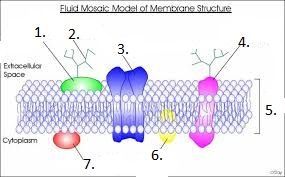
- 6Label the following numbers.1. Integral Glycoprotein
2. Carbohydrate of Glycoprotein
3. Membrane Channel
4. Integral Protein
5. Lipid Bilayer
6. Integral Protein
7. Peripheral Protein - 7What is the Law of DiffusionThe Law of Diffusion is the concentration of substances will become the same throughout (unless impaired by other factors)
- 8What structures are only involved in mitosis of animal cells?Centrioles
- 9What is the difference between Chlorophyll and Chloroplasts?Chlorophyll is the molecule in chloroplasts that uses photosynthesis to generate energy/food for the cell
- 10What are nuclear pores?Nuclear pores are minute holes in the nuclear membrane that allows mRNA and proteins to pass through
- 11What are vacuoles and what do they contain?Vacuoles are storage sites that contain water, salts, proteins, and carbohydrates that will by digested by lysosomes using hydrolytic enzymes
- 12What is the function of the nucleus and what does it contain?The nucleus is the centre of the cell, which controls most cell processes. It contains hereditary information in the form of a double helix called DNA
- 13What three statements make up the cell theory?1. All living things are made up of cells
2. Cells are the basic structure/function in all living things
3. New cells are produced from existing cells - 14What is the digestion centre in the cell and what do they break down?Lysosomes are the digestion centres in cells that break down lipids, carbs, proteins and food vacuoles using hydrolytic enzymes so that they can be used for the cell.
- 15What occurs in the endoplasmic reticulum?In the endoplasmic reticulum, lipid components of the cell membrane are assembled along with proteins and other materials that are exported from the cell through exocytosis.
- 16What are chromosomes and what do they do?Chromosomes contain genetic information (DNA that is supercoiled) which guides all cell activities.
- 17What are two functions of the cytoskeleton?The cytoskeleton maintains the cells shape and is also involved in the cells movement by using flagells.
- 18What is the mitochondria's function?Mitochondria are known as the powerhouses of the cell. They are organelles that act like a digestive system which takes in nutrients, breaks them down, and creates energy-rich molecules for the cell (process called cellular respiration)
- 19What is the function of the nucleolus?The nucleolus created the assembly of ribosomes
- 20What types of proteins can be found in a cell's membrane? What are their functions?1. Receptor : reacts with environment to bring change into cell
2. Transport Proteins: moves substances through the membrane by active/passive transport.
3. Cytoskeletal Anchor: inner surface protein to which cytoskeleton is attached - 21What are SEM's?SEM's are scanning electron microscopes that scan's samples using a focused beam of electrons. The samples do not need to be cut as they are easily visualized.
- 22What are TEM's?TEM's are transmission electron microscopes that use electromagnetic lenses to focus the electrons into a very thin beam. The sample must be cut into ultra-thin slices in order to be viewed
- 23What is the formula for photosynthesis in the chloroplast?Energy + 6CO2 +6H2O = C6H12O6 + 6CO2
- 24Describe the steps of the secretory pathway.1. Proteins start at the ribosomes
2. Rough ER
3. Transition Vesicle
4. Golgi Apparatus
5. Secretory Vesicle or Lysosome
6. Exocytosis - 25What does the term Pinocytosis mean?Pinocytosis is the endocytosis of small particles through the membrane, which turns into a vesicle that moves to a lysosome for intracellular digestion.
- 26How does temperature affect diffusion?Increasing the temperature of a solution allows the particles to diffuse faster.
- 27What does the term Hypertonic mean?Hypertonic is when the concentration of a substance is greater inside the cell than outside the cell (will shrink to equal conc)
- 28How does concentration of a substance affect the rate of diffusion?the greater the concentration of a substance between two regions, the faster the rate of diffusion
- 29What are the differences between plant and animal cells?Animal Cells:
-Contain Lysosomes
- Contain Centrioles
- Small Vaculoles
- Phagocytic
Plant Cells:
-Cell Wall
-Chloroplast & Chlorophyll
-Large Vacuole - 30What is active transport?Active Transport is a type of transport of substances across the cell membrane against the concentration gradient, which requires energy.
- 31What does the term Isotonic mean?Isotonic means that the concentration of a substance is equal between two regions
- 32What does the term Phagocytosis meanPhagocytosis is the endocytosis of large particles, that result in the formation of food vacuoles that will undergo intracellular digestion in a lysosome.
- 33What is passive transport?Passive Transport is a type of transport that does not require energy for substances to cross the cell membrane and therefore flows with the concentration gradient.
- 34What is exocytosis?materials are exported out of the cell via secretory vesicles. In this process, the Golgi complex packages macromolecules into transport vesicles that travel to and fuse with the plasma membrane. This fusion causes the vesicle to spill its contents out of the cell.
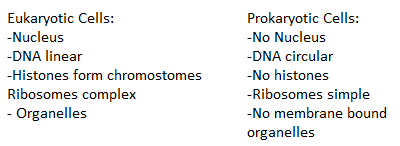
- 35What is the difference between Prokaryotic Cells and Eukaryotic Cells?
- 36What is endocytosis?Endocytosis is the process of taking in a substance through the cell membrane to form a food vacuole for the cell, which will later by digested through intracellular digestion.
- 37What is concentration gradient?Concentration Gradient is the difference of concentrations between two regions of substances
- 38What is osmotic gradient?Osmotic gradient is the difference in concentrations of two solutions between a semi-permeable membrane
- 39How does viscosity (thickness) of a solution effect the rate of diffusion?The lower the viscosity (thickness of fluid density), the faster the rate of diffusion.
- 40How does size and shape affect the rate of diffusion?the smaller and more streamlined a substance is the faster the rate of diffusion.
- 41What are channel proteins?Channel proteins are proteins that allow specific substances across a cell membrane.
ex. water - 42What are two types of oligosaccharides? What is their function?Glycoproteins and Glycolipids; both contribute to the cells ability to recognize cells.
- 43What is the formula for cellular respiration in the mitochondria?C6H12O6 +6O2 = 6CO2 + 6H2O + Energy
- 44What does the term Hypotonic mean?Hypotonic is when the concentration of a substance is less inside the cell than outside the cell (will swell to equal conc.).
- 45What does the term Hydrophilic mean?Hydrophilic means that the substance will mix with water
- 46What does the term Hydrophobic mean?Hydrophobic means that the substance will not mix with water
- 47What does the term Plasmolysis mean?Plasmolysis is the loss of cytoplasmic water due to being in a hypertonic environment (lower concentration of water)
Information
- Description
- Descriptive Flashcards of prokaryotic and eukaryotic cells, how they are replicated, protein synthesis, organelles within the cell etc.
- Created by
- Kaitlyn Schrauwen
- Views
- 113
- Rating