
Flashcards
Hand and Wrist Procedure

Cards in this deck (115)
- 1—A. Shoulder Girdle
B. Humerus
C. Radius & Ulna
D. Hand & Wrist - 2—A. Distal
B. Middle
C. Proximal
D. Head
E. Body
F. Base
G. Head
H. Body
I. Base
- 3—A. Interphalangeal Joint (IP)
B. 1st Metacarpophalangeal Joint (MCP)
C. Trapezoid
D. Trapezium
E. Capitate
F. Hamate
G. 5th Carpometacarpal Joint (CMC)
H. 5th Metacarpophalangeal Joint (MCP)
I. Proximal Interphalangeal Joint (PIP)
J. Distal Interphalangeal Joint (DIP)
- 4Joint types and bone typesA. first metacarpal
B. MP joint 1st digit
C. proximal phalanx 1st digit
D. IP joint 1st digit
E. proximal phalanx 2nd digit
F. PIP 2nd digit
G. middle phalanx 2nd digit
H. DIP 2nd digit
I. distal phalanx 3rd digit
J. middle phalanx 4th digit
K. DIP 5th digit
L. proximal phalanx 4th digit
M. 5th MP joint
N. 4th metacarpal
O. 5th CM joint
- 5—A. Trapezium
B. Trapezoid
C. Capitate
D. Hamate
E. Scaphoid
F. Lunate
G. Triquetrum
H. Pisiform
- 6—A. Triquetrum
B. Pisiform
C. Hamate
D. Capitate
E. Scaphoid
F. Trapezium
G. thumb
H. Trapezoid
- 7—A. Scaphoid
D. Pisiform
E. Trapezium
F. Trapezoid
G. Capitate
H. Hamate
h. Hamulus (process of Hamate)
- 8—A. scaphoid
B. lunate
C. triquetrum
D. pisiform
E. trapezium
F. trapezoid
G. capitate
H. hamate
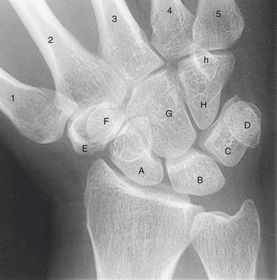
- 9Radial DeviationA. scaphoid
B. lunate
C. triquetrum
D. pisiform
E. trapezium
F. trapezoid
G. capitate
H. hamate
- 10Ulnar DeviationA. scaphoid
B. lunate
C. triquetrum
D. pisiform
E. trapezium
F. trapezoid
G. capitate
H. hamate
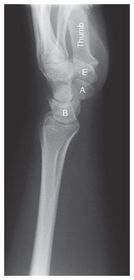
- 11Lateral WristA. scaphoid
B. lunate
C. trapezium
- 12Types of JointsA. MCP - Metacarpophalangeal
B. CMC - Carpometacarpal
C. IC - Intercarpals
D. CMC Carpometacarpal
E. IP - Interphalangeal (proximal = PIP, distal = DIP)
- 13—A. thumb
B. scaphoid
C. radius
D. ulna
E. Ulnar Deviation
F. thumb
G. hamate
H. pisiform
I. triquetrum
J. lunate
K. radius
L. ulna
M. Radial Deviation
- 14What would displacement of this indicate?Wrist Fat Pad
displacement could indicate a fracture or more serious injury
- 15What is the most commonly fractured carpal bone?Scaphoid
- 16Inflammation of the bursae, or fluid filled sacs, that enclose the joints is called _______Bursitis
- 17The transfer of disease or cancerous lesions from one organ or part that may not be directly connected is called ____ ______ . Malignant tumors have the ability to metastasize, or transfer from one body part to another.Bone Metastases
- 18the painful disorder of the wrist and hand that results from compression of the median nerve is called ____ ____ syndrome.Carpal Tunnel
- 19Fracture and dislocation of the posterior lip of the distal radius is called ______ ______ .Barton's Fracture
- 20A fracture of the base of the first metacarpal bone is called ____ ____ .Bennett's Fracture
- 21A transverse fracture that extends through the metacarpal neck - most commonly seen in the 5th metacarpal is called ________ .Boxer's Fracture
- 22A transverse fracture of the distal radius where the distal fragment is displaced posteriorly is called _____ _____ .Colle's Fracture
- 23the reverse of Colle's Fracture, the transverse fracture of the distal radius with the distal fragment displaced anteriorly is called __________ .Smith's Fracture
- 24A ____ _____ describes the accumulated fluid (synovial or hemorrhagic) in the joint cavity.Joint Effusion
- 25_____ AKA degenerative joint disease, is a noninflammatory joint disease where the bone gradually deterioratesOsteoarthritis
- 26A local or generalized infection of bone or bone marrow is called _______ .Osteomyelitis
- 27A hereditary disease marked by abnormally dense bone is called _____Osteopetrosis
- 28The reduction in the quantity of bone, or atrophy of skeletal tissue is called _______ .Osteoporosis
- 29A common chronic skeletal disease where the bone is destructed and repaired by the overproduction of very dense yet soft bones that fracture easily is termed ______ .Paget's Disease
- 30A chronic systemic disease with inflammatory changes throughout the connective tissues is called ______ arthritis. It's more common in women than in men.Rheumatoid Arthritis
- 31____ ____ refers to a sprain or tear of the ulnar collateral ligament of the thumb near the MCP jointSkier's Thumb
- 32Bone tumors or neoplasms are also called ____ ____ .Bone Neoplasia
- 33Neoplasms are also called ____Tumors
- 34The most primary malignant cancerous bone tumor that affects people 40 - 70 years old is called ______ ______ .Multiple Myeloma
- 35The 2nd most common type of malignant primary cancerous bone tumor that generally affects people 10-20 years old is called ____ ____ .Osteogenic Sarcoma
- 36A common malignant bone tumor in children and adults that arises from bone marrow is called ____ ____ .Ewing's Sarcoma
- 37—A. Bennet's Fx
B. Smith's Fx
C. Colle's Fx
D. Boxer's Fx
- 38What are the routine exams for a finger AND thumb?PA
PA Oblique
Lateral - 39What are the routine exams for the hand?PA
PA Oblique
Lateral Fan or Lateral - 40What are the routine exams for the wrist?PA
PA Oblique
Lateral - 41PA Fingers Technique & Evaluation CriteriaSID 40 in
Analog 50-55 kV
Digital 55-60 kV
IR 8x10
non grid
CR @ PIP joint
must see distal, middle, and proximal phalanges; distal metacarpal, and joints
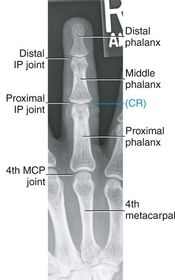
- 42PA Oblique Finger Medial or Lateral RotationSID 40 in
Analog 50-55 kV
Digital 55-60 kV
IR 8x10 in
non grid
CR @ PIP joint
must see distal, middle, and proximal phalanges, distal metacarpal, and joints
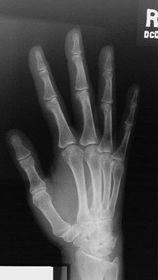
- 43Lateral Finger lateromedial or mediolateralSID 40 in
Analog 50 - 55 kV
Digital 55 - 60 kV
IR 8x10 in
non grid
CR @ PIP joint
must see lateral view of distal, middle, and proximal phalanges; distal metacarpal, and joints.
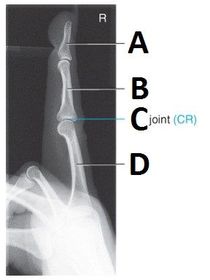
- 44AP ThumbSID 40 in
Analog 50 - 55 kV
Digital 55 - 60 kV
IR 8x10 in
non grid
CR @ 1st MCP joint
must see distal and proximal phalanges, first metacarpal, trapezium, and associated joints
IP and MC joints should appear open
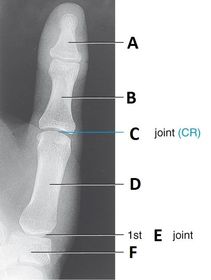
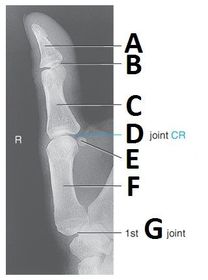
- 45PA Oblique Thumb Medial RotationSID 40 in
Analog 50 - 55 kV
Digital 55 - 60 kV
IR 8x10 in
non grid
CR @ 1st MCP joint
must see distal and proximal phalanges, first metacarpal, trapezium, and associated joints
- 46Lateral ThumbSID 40 in
Analog 50 - 55 kV
Digital 55 - 60 kV
IR 8x10 in
non grid
CR @ 1st MCP joint
must see distal and proximal phalanges, first metacarpal, trapezium (superimposed), and joints
- 47AP Axial Thumb Modified Robert's MethodSID 40 in
Analog 50 - 55 kV
Digital 55 - 60 kV
IR 8x10 in
non grid
CR angled 15 degrees proximally (toward wrist) @ 1st CMC joint
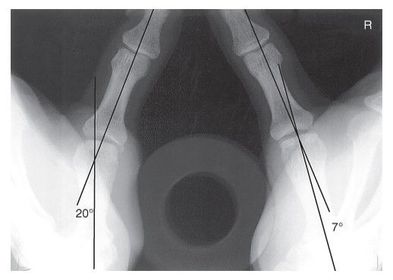
- 48PA StressSID 40 in
Analog 50 - 55 kV
Digital 55 - 60 kV
IR 8x10 in
non grid
CR midway between MCP joints
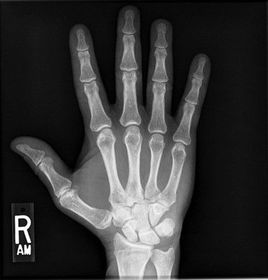
- 49PA HandSID 40 in
Analog 50 - 55 kV
Digital 55 - 60 kV
IR 8x10 in
nongrid
CR @ 3rd MCP joint
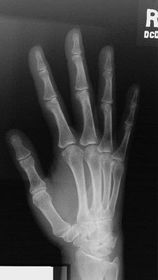
- 50PA Oblique HandSID 40 in
Analog 50 - 55 kV
Digital 55 - 60 kV
IR 8x10 in
nongrid
CR @ 3rd MCP joint
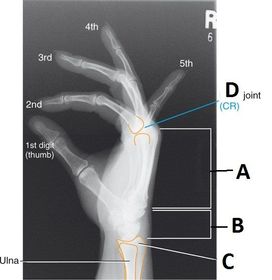
- 51Lateral Fan Hand LateromedialSID 40 in
Analog 60-65 kV
Digital 65-70 kV
IR 8x10 in
nongrid
CR @ 2nd MCP joint
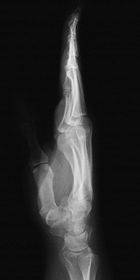
- 52Lateral Hand Extension & FlexionSID 40 in
Analog 60-65 kV
Digital 65-70 kV
IR 8x10 in
non grid
CR @ 2nd to 5th MCP joints
* alternative to fan lateral *
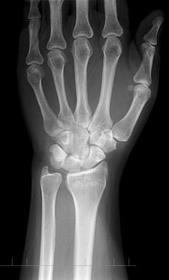
- 53PA and AP WristSID 40 in
Analog 50 - 55 kV
Digital 55 - 60 kV
IR 8x10 in
nongrid
CR @ midcarpal area
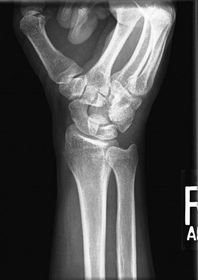
- 54PA Oblique WristSID 40 in
Analog 60-65 kV
Digital 65-70 kV
IR 8x10 in
nongrid
CR @ midcarpal area
- 55Lateral Wrist LateromedialSID 40 in
Analog 60-65 kV
Digital 65-70 kV
IR 8x10 in
nongrid
CR @ midcarpal area
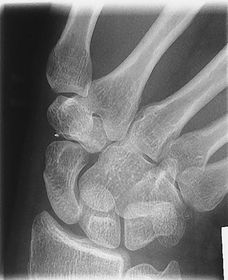
- 56PA Axial Ulnar Deviation Scaphoid WristSID 40 in
Analog 60-65 kV
Digital 65-70 kV
IR 8x10 in
nongrid
CR angled 10 - 15 degrees proximally centered at the scaphoid
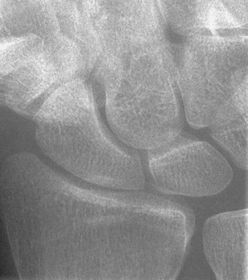
- 57PA Scaphoid-Hand Elevated Ulnar Deviation wristSID 40 in
Analog 60 - 65 kV
Digital 65 - 70 kV
IR 8x10 in
nongrid
position and wrist palm down on IR with hand elevated on 20 degree sponge
CR @ scaphoid
- 58PA Radial Deviation WristSID 40 in
Analog 60 - 65 kV
Digital 65 -70 kV
IR 8x10 in
nongrid
CR @ midcarpal area
- 59How many bones make up the hand and wrist?27
- 60Which carpal bone is the smallest?Pisiform
- 61the _______ position/projection is preferred for localizing foreign bodiesTrue Lateral
- 62If the fingers are rotated how will the finger x-ray appear?no spaces between the joints
- 63for a PA Oblique finger, the fingers MUST be ______ to the IRparallel
- 64if you're doing an oblique x-ray of the 1st-3rd digit you're going to rotate the wrist _____ to reduce OIDmedially
- 65If you're doing an oblique x-ray of the the 4th-5th digit, you rotate the wrist _____ to reduce OIDlaterally
- 66For all of the fingers BESIDES the thumb, you are centering at the _____ joint.PIP
- 67For thumb projections you're going to center at the ______ joint.MCP
- 68the PA stress thumb x-ray demonstratestears in the ligaments
- 69If the joints do not appear open on the x-ray, that means ______the hand was rotated, or fingers bent
- 70For PA oblique of the hand, if the 4th and 5th digits are superimposed that meansthe hand was not in a true 45 degree oblique
- 71How can you tell if oblique position is good based on the radiograph of the 45 degree oblique finger?the joints will be open and slightly concaved
- 72It's better to see the _____ on the fan lateral position.phalanges
- 73Lateral hand, both fanned and true lateral, demonstrate the ______ fractureBoxer's Fracture
- 74true lateral hand position best shows ______ _____ in the handForeign Bodies
- 75AP Oblique Bilateral (ball catcher's) you should center at the ____ MCP joint, this radiograph demonstrates ______5th
rheumatoid arthritis, 5th metacarpal Fx's (commonly from punching) - 76For Boxer's Fx's AND 5th metacarpal Fx's, you need to ask the patient......what the cause of injury was
- 77Why do you flex the fingers for the PA wrist?to flatten the wrist for the projection
- 78TTCH SLTPSome Lovers Try Positions That They Can't Handle
Scaphoid Lunate Triquetrium Pisiform
Trapezium Trapezoid Capitate Hamate - 79For a lateral wrist you want to rotate the hand externally (laterally) __ degrees to get it in TRUE lateral5 degrees
- 80For radial deviation projections you want to angle the CR ___ to ___ degrees10-15 degrees
- 81For modified Stecher (modified ulnar deviation), you're elevating the hand ___ degrees on a sponge with no deviation. This is done only if patient cannot deviate the wrist.20 degrees
- 82Which position should you use if the patient cannot angle their wrist for an Ulnar Deviation projection?Modified Stecher
- 83For most hand projections you should center the CR at the ___ ___ joint. Most lateral hand projections should be centered at the ___ ___ joint.3rd MCP joint
2nd MCP joint - 84TRUE OR FALSE? You want the forearm and elbow in the same plane as the finger, hand, or wrist that's being x-rayed.TRUE
- 85you should place your marker on the ____ side of the appendage in most cases.LATERAL
- 86TRUE OR FALSE? If you have to do several different appendage series all together, you should group them together. For example, all the AP's should be done first, then the PA's, then the obliques, etc...TRUE
- 87Why do you want to group all your similar projections together for multiple appendage projections?Patient comfort
Time efficiency - 88Bone Age StudiesViewing growth plates in bones to observe the maturity and growth patterns
- 89Which carpal bone is most anterior?Pisiform
- 90with the AP thumb projection, the hand is positioned in _____ ____ rotation.Extreme Internal
- 91Why is PA preferred vs AP in most hand, finger, and wrist projections?PA reduces OID
- 92Where do you place the CR for all finger exams?PIP joint
- 93Where do you place the CR for all thumb exams?1st MCP joint
- 94Where do you place the CR for all hand exams?3rd MCP joint
- 95Where do you put the CR for all wrist projections?Midcarpals
- 96What's the kVp range for finger projections?50-60 kVp
- 97What's the kVp range for thumb projections?50-60 kVp
- 98The kVp range for most hand projections is ___ - ___ kVp. The two projections that are still 50-60 kVp are ____ and ____60-70 kVp
PA Oblique and PA - 99What's the kVp range for wrist projections?60 - 70 kVp
- 100For large plaster casts you ____ technique by __-___ kV.increase
8-10 - 101For fiberglass casts you _____ technique by __-__ kV.Increase
3-4 - 102_____ is a procedure that uses contrast injected into a joint capsule to visualize soft tissue pathology.Arthrogram
- 103You want to use a ____ focal spot for finger, hand and wrist projectionsSMALL
- 104You want ____ exposure time for finger, hand and wrist projectionsSHORT
- 105For the ulnar deviation projection, the CR should be angled ___ - ___ degrees ______ .10-15
proximally - 106Which projection/position demonstrates Rheumatoid Arthritis?Norgaard
"ball-catchers"
AP Oblique Bilateral - 107Which projection/position demonstrates Carpal Tunnel Syndrome?Carpal Canal
Gaynor-Hart - 108Which projection/position demonstrates injuries to the Ulnar Collateral Ligament?PA Stress
Folio-method - 109Why is the AP projection preferred for the thumb instead of the PA?Less OID
- 110Modified Robert'sAP Axial Thumb
- 111Stecher Method or Navicular ViewUlnar Deviation
- 112Modified StecherElevated Ulnar Deviation
- 113Norgaard or Ball-Catcher's MethodAP Oblique Bilateral
- 114Gaynor-Hart MethodCarpal Canal
- 115Folio-MethodPA Stress Thumbs
Information
- Description
- ARRT Radiologic Procedures I Flashcards on Hand and Wrist Procedure, created by RadTech Fairy on 04/10/2016.
- Created by
- RadTech Fairy
- Views
- 994
- Rating