
Flashcards
homeostais and cell transport unit A.4
Cards in this deck (44)
- 1what is homeostasisprocess by which an organism maintains a stable internal environment
- 2What is thermoregulationmaintaining a body temperature
- 3what is water regulationmaintaining enough water in the body
- 4What are 2 functions of a plasma membrane1. encloses and protects the cell
2. allows certain particles in and out of it - 5what is selective permiabilitythe plasma membrane can pick and choose what particles can pass through it
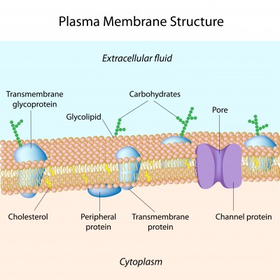
- 63 parts of a plasma membranephospholipids, proteins, and sometimes cholesterol
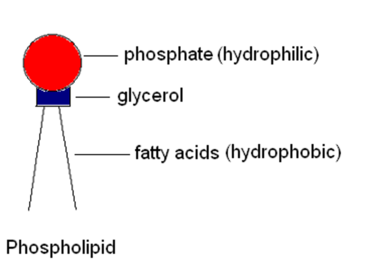
- 7what is a phospholipid made froma glycerol attached to 2 fatty acids and a phosphate group
- 8the fatty acids in a phospholipid are _____________ meaning they hate waterhydrophobic
- 9the phosphate group in phospholipids are ____________ (like water)hydrophilic
- 10draw or be able to picture the structure of a single phospholipid
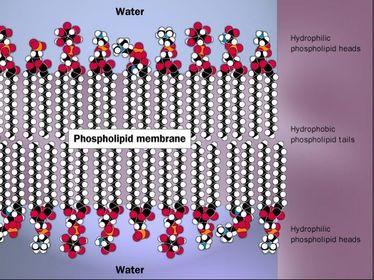
- 11what does the bilayer structure look like in a plasma membrane
- 12what plasma membranes have cholesterol in between phospholipids and why?Animal plasma membranes, and to make plasma membrane more firm, and less permeable for some molecules
- 13Where can proteins be in membranesthey can be on the inner or outer surfaces, and some go through the bilayer
- 143 jobs of the proteins in membranes1. regulate which particles can pass through membrane (transport)
2. act as ENZYMES in chemical reactions
3. act as MARKERS on outside of cell to identify itself - 15Study this (what a plasma membrane may look like)
- 16what is active transporta way that requires energy to move molecules through the plasma membrane
- 17what is passive transporta way that does not require energy to move molecules through plasma membrane, occurs spontaneously
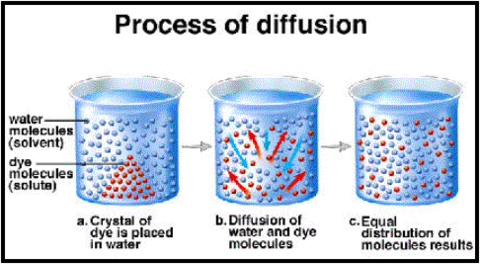
- 18Define diffusionthe principle means of passive transport. Movement of molecules from a high concentration to a low concentration
- 19study this (process of diffusion)
- 20What is equilibriumWhen two opposing actions occur at the same rate
- 21Finish the sentence: diffusion occurs when system is not at _________equilibrium
- 22What 2 factors affect diffusionTEMPERATURE (higher temperature means molecules will diffuse faster), and SIZE (smaller molecules will move more rapidly than larger ones)
- 23steps of diffusion in the human body: (idk I feel like this could be an open ended question)CO2 and O2 diffuse across plasma membranes
O2 moves from high concentration to low from lungs to blood to cells
as chemical reactions in cell use up O2 they produce CO2
concentration of Co2 increases, so more CO2 in side of the cell
therefore CO2 diffuses into blood and then into lungs where it is exhaled - 24What is Osmosismovement of water from high concentration to low. "DIFFUSION OF WATER" that can cause cells to burst or shrink
- 25what is osmoregulation (remember homeostasis)Saltwater fish get rid of salt and conserve water (scanty urine)
Freshwater get salt and get rid of excess water (large amounts of dilute urine) - 26What determines the tonicity of cellsIf the concentration of solution is not equal on both sides, there will be movement of water molecules in or out of cell. What direction water molecules are going determines where it is isotonic, hypotonic, or hypertonic
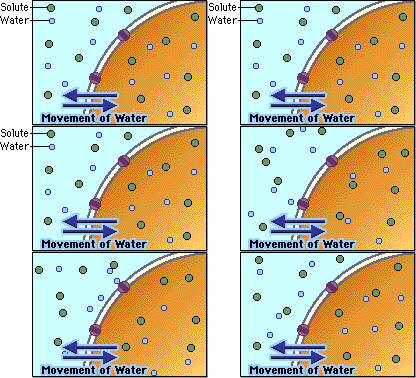
- 27when does isotonic occurmovement of water out of the cell is balanced with movement of water into the cell. Example: saline solution is isotonic to human cells.
- 28isotonic solution looks like:
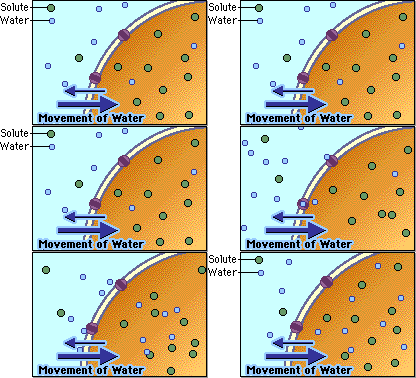
- 29Hypotonic solution occurs whendissolved solutions are less outside of the cell than inside the cell. (A LOT OF WATER GOING IN, NOT A LOT COMIN OUT) cells w/o walls can swell or burst!
- 30hypotonic looks like:
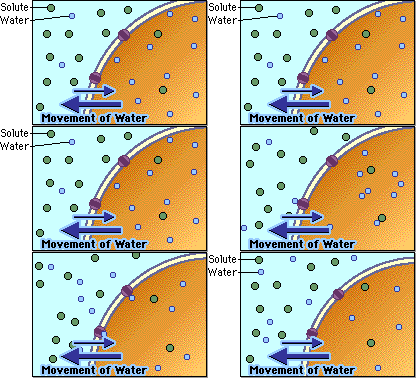
- 31hypertonic occurs when:concentrations of dissolved are GREATER outside the cell, so concentration of water inside the cell is LOWER. Cells get rid of water more than they take in water, start to shrink
- 32a hypertonic solution looks like
- 33Tonicity in plant cells look like:
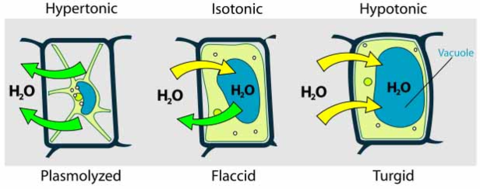
- 34In plant cells, plasmolyzed cells are _________, flaccid cells are ____________, and turgid cells are _____________.Hypertonic, isotonic, hypotonic
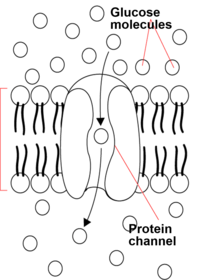
- 35what is facilitated diffusion? when does it occur?When proteins help certain chemicals pass through a membrane. Requires NO ENERGY (passive transport) and it usually occurs for larger molecules like glucose
- 36facilitated diffusion looks like:
- 37Active transport is when a cell _____________ energy to move from low to high concentration. Proteins pump _____________ through membranes. Molecules move _________ diffusion (from a low to high concentration)NEEDS, MOLECULES, AGAINST
- 383 OTHER WAYS CELLS GET MATERIALS1. vesicles
2. endocytosis
3. exocytosis - 39what is endocytosiswhen the plasma membrane engulfs and takes in materials and puts them into a vesicle
- 40what are the two types of endocytosisPhagocytosis and Pinocytosis
- 41Phagocytosis is when...When living cells phagocytes engulf other cells or particles (remember this type of cell gets "PHAt" when it engulfs another cell)
- 42Pinocytosis is when...liquid droplets are ingested by living cells
- 43exocytosis is whena vacuole fuses to the cell membrane and releases its contents to the exterior
- 44ways to remember difference between endocytosis and exocytosisEndocytosis- cell is bringing food "en" (in)
Exocytosis- contents are "EXiting" the cell
Information
- Description
- study guide for unit A.4 homeostasis and cell transport
- Created by
- mallary g
- Views
- 20
- Tags
- Rating