
Flashcards
3.1 Gas Exchange in Fish, Animals, Humans and Plants
Cards in this deck (76)
- 1What does Fick's Law tell us about?Rate at which a substance can diffuse
- 2What is Fick's law?(Surface area x difference in concentration) / length of diffusion pathway
- 34 properties of specialised exchange surfaces which allow efficient exchange?•Large surface area to volume ratio
•Thin to ensure short diffusion pathway
•Partially permeable membrane to allow selected materials to cross without obstruction
•Movement of the internal medium - 42 reasons why specialised exchange surfaces are often located inside organisms?•Protection and avoid damage
•Stay moist so diffusion can occur & stops them drying out - 52 examples of single celled organisms?Amoeba and flatworms
- 6How do single celled organisms get oxygen?Diffuses through their body surface which is only covered by a cell surface membrane, which is possible because they are flat/thin so the cells are near the surface
- 7What will happen to a small animal in terms of heat loss?RATE of heat loss will be greater than it would with a large animal as small animals have a large surface area to volume ratio
- 8Example of a behavioural adaptation?Hippos spending the majority of their time in water to lose heat
- 9What is the ventilation mechanism in fish?llows water to pass across the gills in one direction continuously, which requires less energy. Continuously replacing low oxygenated water with highly oxygenated water. Same with blood.
- 10Relationship between size of an organism and its surface area to volume ratio?As the size increases, the surface area to volume ratio decreases
- 11How does ventilation occur in fish?•Mouth opens, water enters and flows over gills. Operculum is closed
•Mouth closes and water flows over gill cavities, operculum opens and water passes out - 123 ways fish maximise diffusion?•Structure of the gills
•Countercurrent flow
•Ventilation - 13What is the structure of the gills like? (3)•Gills located behind head of fish
•Consist of gill filaments
•Each filament has many lamellae on the surface - 14What provides a large surface area in fish?Lots of gill filaments and lots of gill lamellae
- 15What provides a short diffusion pathway in fish?Thin surface layer of epithelial cell on each gill lamellae
- 16What provides a steep diffusion gradient in fish?Each gill lamellae has a large number of capillaries
- 17What is a countercurrent flow?Water flows over the gill lamellae in an opposite direction to the flow of blood inside the lamellae
- 18Why is a countercurrent system better than a concurrent system?Countercurrent flow ensures a steep concentration gradient is maintained along the whole length of the gill lamellae, so equilibrium is never reached
- 19What do active fish need?A larger gill surface area, so more gill filaments and gill lamellae which allows more oxygen and more respiration to occur
- 20Why are insects at risk of dehydrating?Because they are terrestrial and have a large surface area to volume ratio (as they are small)
- 21What covers the insect and what does it do?Waterproof cuticle, which allows the insect to conserve water as it is impermeable to water so water cannot evaporate
- 22Disadvantage to impermeable cuticle?Stops insect from receiving oxygen and carbon dioxide, so it needs another way
- 23What are the name of the pores found on the surface of an insect body called which gases diffuse through?Spiracles
- 24Function of the spiracle?Surrounded by hairs to help retain water, and they can be opened and closed by valves for water to evaporate
- 25What is the structure of the gas exchange system of the insect which allows respiration to occur? (2)•Tracheae are supported by rings of chitin
•Tracheae divide to form many branched tracheoles which provide a large surface area for diffusion - 262 ways how gases move in and out of a tracheal system?•Ventilation
•Along a diffusion gradient - 27How does ventilation occur in insects? (3)•Contract their abdominal muscles, flatten their body and compress air tubes
•When these muscles relax, the tracheal tubes expand and fresh air is drawn into the spiracles
•Ventilation movements are synchronised with the opening and closing of spiracle valves - 28How does a steep diffusion gradient exist inside insects?•High conc of oxygen is supplied at the tracheae
•Conc of oxygen reduces along tracheoles as the cells at the end of tracheoles use it for respiration - 29How does a short diffusion pathway exist inside insects?Distance from spiracles to body cells is very short, and insects are small which also ensures this
- 30Why is more oxygen needed for insects?Need oxygen for respiration for energy for things like flight
- 31What happens in insects when they respire anaerobically? (4)•Lactate is produced, and acts as a solute to reduce water potential in muscle cells
•Ends of tracheoles are filled with water, water moves from there into cells down a water potential gradient by osmosis
•Volume of water in tracheoles decreases and so draws air into them
•Therefore final diffusion pathway occurs in gas rather than liquid, which is faster - 32One way how the transport of oxygen to a muscle in an insect is different from that in a fish?Transport of oxygen in fish involves blood. No blood in insects
- 33Structure of the lungs? (5)•Trachea (windpipe) splits into 2 bronchi
•Bronchi branches into bronchioles
•Bronchioles have alveoli on the ends
•Enclosed in ribs, with intercostal muscles between each bone
•Diaphragm at the bottom - 34Where is cartilage found, what is it made of and what does it do? (3)•Trachea and bronchi
•Chitin
•Prevents them from collapsing when the pressure drops from breathing in - 35Where is smooth muscle found and what does it do? (2)•Walls of the trachea, bronchi and bronchioles
•Contract and relax to change the diameter of the airway and control the flow of air in and out of the alveoli - 36Where is elastic tissue found and what does it do? (2)•Walls of the alveoli
•Force air out during exhalation due to elastic recoil - 37Where are ciliated epithelial cells and goblet cells found and what do they do? (3)•Trachea and bronchi
•Goblet cells produce mucus to trap bacteria and dirt particles
•Cilia move the mucus up to the mouth to be swallowed - 38What surrounds the alveoli?Blood capillaries (deoxygenated)
- 39Structure of an alveolus? (3)•Alveolar space in centre
•Surrounded by alveolar epithelium
•Capillary surrounded by capillary endothelium - 40How does gas exchange occur in the alveoli? (2)•O2 diffuses out of alveoli across alveolar epithelium and the capillary endothelium into the blood
•CO2 diffuses from blood over capillary endothelium and alveolar epithelium into alveolar space and is breathed out - 41How are alveoli adapted for an increased rate of gas exchange by diffusion? (3)•Large number of alveoli provides large surface area to volume ratio
•Short diffusion pathway as alveolar epithelium is 1 cell thick
•Steep diffusion gradient provided by ventilation and circulation of blood - 42What happens during inspiration? (5)•Internal intercostal muscles relax, external intercostal muscles contract, diaphragm muscles contract
•Ribcage moves up/outwards
•Diaphragm flattens
•Lung volume increases, lung pressure decreases
•Air flows into lungs from a higher to lower pressure - 43What happens during expiration? (5)•Internal intercostal muscles contract, external intercostal muscles relax diaphragm muscles relax
•Ribcage moves down/inwards
•Diaphragm becomes curved
•Lung volume decreases, lung pressure increases
•Air flows out of lungs from a higher to lower pressure - 44Is inspiration passive or active?Active
- 45Is expiration passive or active?Passive
- 46How does ventilation increase the rate of gas exchange?Maintains a steep concentration gradient by bringing in highly oxygenated air and removing low oxygenated air
- 47In what cells does gas exchange occur inside in plants?Mesophyll - large SA as lots present in tissues
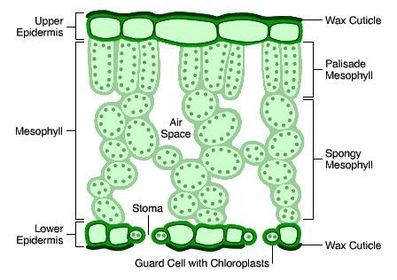
- 48How do gases reach the mesophyll cells?Move through pores in epidermis called stomata which are controlled by guard cells to open to allow the exchange of gases and close to prevent water loss
- 49Label the diagram of the cross-section of a leaf
- 50What is the function of the palisade cell and which organelle of the photosynthesisFunction is to carry out photosynthesis
Chloroplasts - 513 ways a palisade cell is adapted to its function?•Long thin cells that form a continuous layer to absorb sunlight
•Numerous chloroplasts that arrange themselves in the best positions to absorb maximum sunlight
•A large vacuole that pushes chloroplasts to the edge of the cell - 52What is a chloroplast envelope?Double plasma membrane that surrounds the organelles. Highly selective and is permeable to O2, CO2, glucose.
- 53What is a thylakoid?A disc-like structure containing chlorophyll to absorb light energy
- 54What is a granum?Stack of up to 100 thylakoids to increase SA and carries out light independent reactions. Where the first stage of photosynthesis takes place
- 55What is a stroma and what is its function?Fluid filled matrix where the 2nd stage of photosynthesis takes place. Contains enzymes for light independent reactions to occur
- 56Explain how chloroplasts are able to manufacture proteins?Contain both DNA and ribosomes to quickly manufacture some of the proteins needed for photosynthesis
- 57What are cell walls made from? (3)•Microfibrils of cellulose
•Hemicellulose (2-3 glucose molecules) add additional strength to microfibrils
•Microfibrils cemented into cell wall using hemicellulose which acts as glue - 583 functions of the cell wall?•Provide mechanical strength to prevent cell bursting bc of pressure created by osmosis
•Give mechanical strength to plant as a whole
•Allow water to pass along it and so contribute to the movement of water through the plant - 592 sources of carbon dioxide?•External air
•Within plant as product of respiration - 60Explain how the structure of a leaf is adapted for efficient gas exchange? (3)•Many stoma, mostly in lower epidermis
•Numerous interconnecting air-spaces that occur throughout the mesophyll
•No cell far from the air so short diffusion pathway - 61What does a plant vacuole contain?Solution of mineral salts, sugars, amino acids, wastes and some pigments
- 62What is a tonoplast?The single membrane around a vacuole
- 633 functions of vacuoles?•Support herbaceous plants/herbaceous parts of woody plants by making cells turgid
•Sugars and amino acids act as a temporary food store
•Pigments may colour petals to attract pollinating insects - 642 ways structure of chloroplast is adapted for its function?•Contains DNA and ribosomes to produce proteins for enzymes for photosynthesis
•Thylakoids stacked to maximise absorption - 65Process by which cells become adapted for a different function?Differentiation
- 66What is transpiration?The evapouration of water vapour from the leaves of plants
- 67Why does the majority of transpiration occur from the underside of a leaf?Because the underside of a leaf has many stomata in the epidermis which allow water loss
- 68Why do leaves need a large surface area to volume ratio?Capture the maximum amount of light for photosynthesis
- 69What are xerophytes?Plants adapted to living in dry habitats where water loss is a problem
- 708 xerophyte adaptations?•Small SA to vol ratio
•Thick waxy cuticle
•Sunken stoma
•Rolled up leaves
•Hairy leaves
•Fewer stoma
•Extensive roots
•Photosynthesis only occurs during the day - 71Explain how a small surface area to volume ratio allows a reduced rate of transpiration? (2)•Needle-like leaves are small narrow and circular in cross section
•Reduced water potential gradient therefore less water loss by evapouration - 72Explain how a thick waxy cuticle allows a reduced rate of transpiration?•Forms a waterproof/impermeable barrier and reduces the water potential gradient
•This reduces water loss by evapouration - 73Explain how sunken stomata allows a reduced rate of transpiration?•Sunken stoma trap moist air next to leaf, which creates local humidity and decreases exposure to air currents
•Reduces water potential gradient and reduces water loss by evapouration - 74Explain how rolled up leaves allow a reduced rate of transpiration?•Region becomes saturated with water vapour, which reduces the water potential gradient
•Less water loss by evapouration - 75Explain how hairy leaves allow a reduced rate of transpiration?•Trap air to make it saturated with water vapour to reduce the water potential gradient
•Less water loss by evapouration - 76Explain how only opening stoma at night allows a reduced rate of transpiration?•Photosynthesis occurs in the light
•Open stoma at night to absorb CO2, combined with organic compound to form malic acid
•Acid broken down during day to release CO2 needed for photosynthesis
Information
- Description
- AS level AS Biology (Unit 3 - Exchange and Transport Systems) Flashcards on 3.1 Gas Exchange in Fish, Animals, Humans and Plants, created by Tania Parvaiz on 11/03/2017.
- Created by
- Tania Parvaiz
- Views
- 34
- Rating