
Mind map
Human Origins
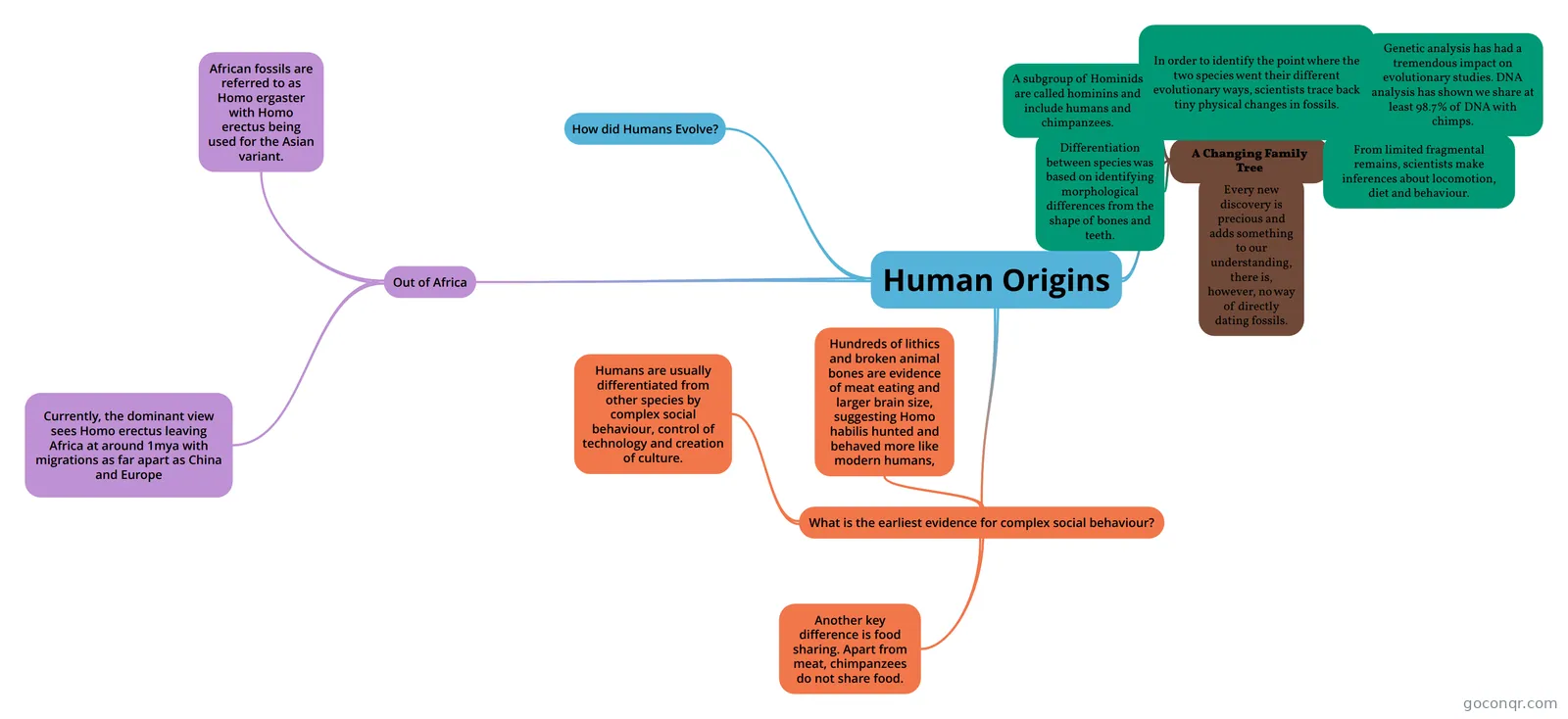
Mind map: Human origins
Map content
Human Origins
A Changing Family Tree
- Differentiation between species was based on identifying morphological differences from the shape of bones and teeth.
- In order to identify the point where the two species went their different evolutionary ways, scientists trace back tiny physical changes in fossils.
- From limited fragmental remains, scientists make inferences about locomotion, diet and behaviour.
- Every new discovery is precious and adds something to our understanding, there is, however, no way of directly dating fossils.
- Genetic analysis has had a tremendous impact on evolutionary studies. DNA analysis has shown we share at least 98.7% of DNA with chimps.
- A subgroup of Hominids are called hominins and include humans and chimpanzees.
How did Humans Evolve?
What is the earliest evidence for complex social behaviour?
- Humans are usually differentiated from other species by complex social behaviour, control of technology and creation of culture.
- Another key difference is food sharing. Apart from meat, chimpanzees do not share food.
- Hundreds of lithics and broken animal bones are evidence of meat eating and larger brain size, suggesting Homo habilis hunted and behaved more like modern humans,
Out of Africa
- African fossils are referred to as Homo ergaster with Homo erectus being used for the Asian variant.
- Currently, the dominant view sees Homo erectus leaving Africa at around 1mya with migrations as far apart as China and Europe
Information
- Description
- A2 Archaeology Mind Map on Human Origins, created by Elena Corfield on 04/10/2017.
- Created by
- Elena Corfield
- Views
- 1
- Rating