
Mind map
Evolution
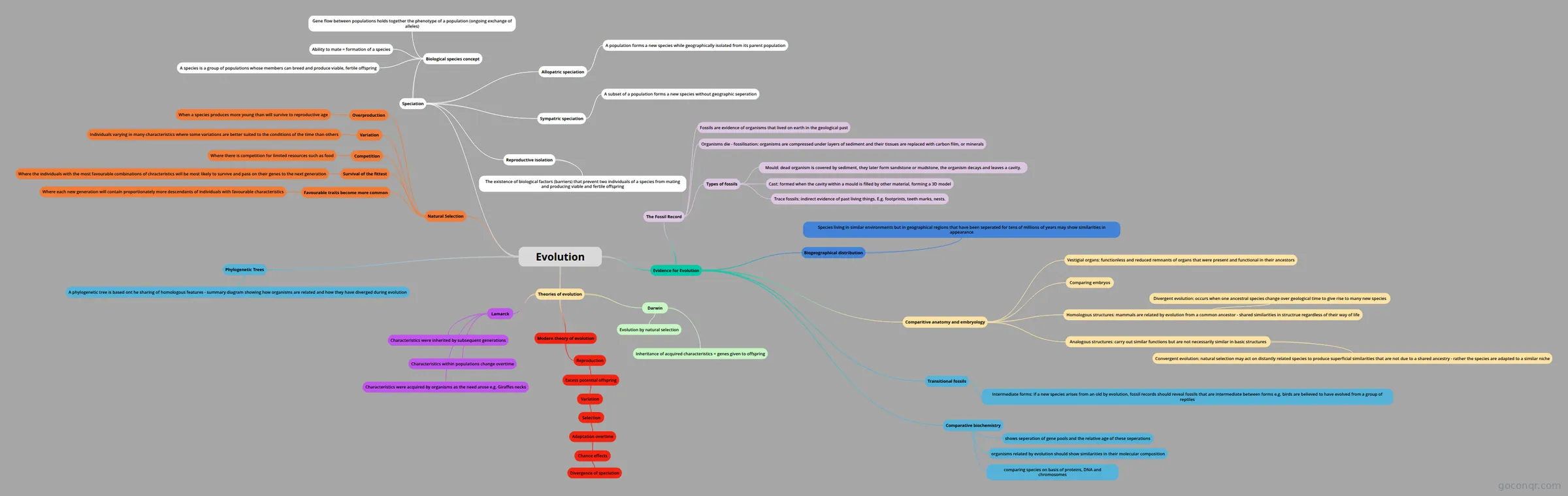
Mind map: Evolution
Map content
Evolution
Theories of evolution
- Lamarck
- Characteristics were inherited by subsequent generations
- Characteristics within populations change overtime
- Characteristics were acquired by organisms as the need arose e.g. Giraffes necks
- Darwin
- Evolution by natural selection
- Inheritance of acquired characteristics = genes given to offspring
- Modern theory of evolution
- Reproduction
- Excess potential offspring
- Variation
- Selection
- Adaptation overtime
- Chance effects
- Divergence of speciation
- Chance effects
- Adaptation overtime
- Selection
- Variation
- Excess potential offspring
- Reproduction
- Lamarck
Speciation
- Biological species concept
- A species is a group of populations whose members can breed and produce viable, fertile offspring
- Ability to mate = formation of a species
- Gene flow between populations holds together the phenotype of a population (ongoing exchange of alleles)
- Reproductive isolation
- The existence of biological factors (barriers) that prevent two individuals of a species from mating and producing viable and fertile offspring
- Allopatric speciation
- A population forms a new species while geographically isolated from its parent population
- Sympatric speciation
- A subset of a population forms a new species without geographic seperation
- Biological species concept
Evidence for Evolution
- The Fossil Record
- Fossils are evidence of organisms that lived on earth in the geological past
- Organisms die - fossilisation: organisms are compressed under layers of sediment and their tissues are replaced with carbon film, or minerals
- Types of fossils
- Mould: dead organism is covered by sediment, they later form sandstone or mudstone, the organism decays and leaves a cavity.
- Cast: formed when the cavity within a mould is filled by other material, forming a 3D model
- Trace fossils: indirect evidence of past living things. E.g. footprints, teeth marks, nests.
- Transitional fossils
- Intermediate forms: if a new species arises from an old by evolution, fossil records should reveal fossils that are intermediate between forms e.g. birds are believed to have evolved from a group of reptiles
- Comparitive anatomy and embryology
- Homologous structures: mammals are related by evolution from a common ancestor - shared similarities in structrue regardless of their way of life
- Divergent evolution: occurs when one ancestral species change over geological time to give rise to many new species
- Analogous structures: carry out similar functions but are not necessarily similar in basic structures
- Convergent evolution: natural selection may act on distantly related species to produce superficial similarities that are not due to a shared ancestry - rather the species are adapted to a similar niche
- Vestigial organs: functionless and reduced remnants of organs that were present and functional in their ancestors
- Comparing embryos
- Homologous structures: mammals are related by evolution from a common ancestor - shared similarities in structrue regardless of their way of life
- Biogeographical distribution
- Species living in similar environments but in geographical regions that have been seperated for tens of millions of years may show similarities in appearance
- Comparative biochemistry
- comparing species on basis of proteins, DNA and chromosomes
- shows seperation of gene pools and the relative age of these seperations
- organisms related by evolution should show similarities in their molecular composition
- The Fossil Record
Phylogenetic Trees
- A phylogenetic tree is based ont he sharing of homologous features - summary diagram showing how organisms are related and how they have diverged during evolution
Natural Selection
- Overproduction
- When a species produces more young than will survive to reproductive age
- Variation
- Individuals varying in many characteristics where some variations are better suited to the conditions of the time than others
- Competition
- Where there is competition for limited resources such as food
- Survival of the fittest
- Where the individuals with the most favourable combinations of chracteristics will be most likely to survive and pass on their genes to the next generation
- Favourable traits become more common
- Where each new generation will contain proportionately more descendants of individuals with favourable characteristics
- Overproduction
Information
- Description
- Year 12 Biology Mind Map on Evolution, created by Bella Kirby on 10/11/2017.
- Created by
- Bella Kirby
- Views
- 3
- Rating