
Mind map
Cell Transport
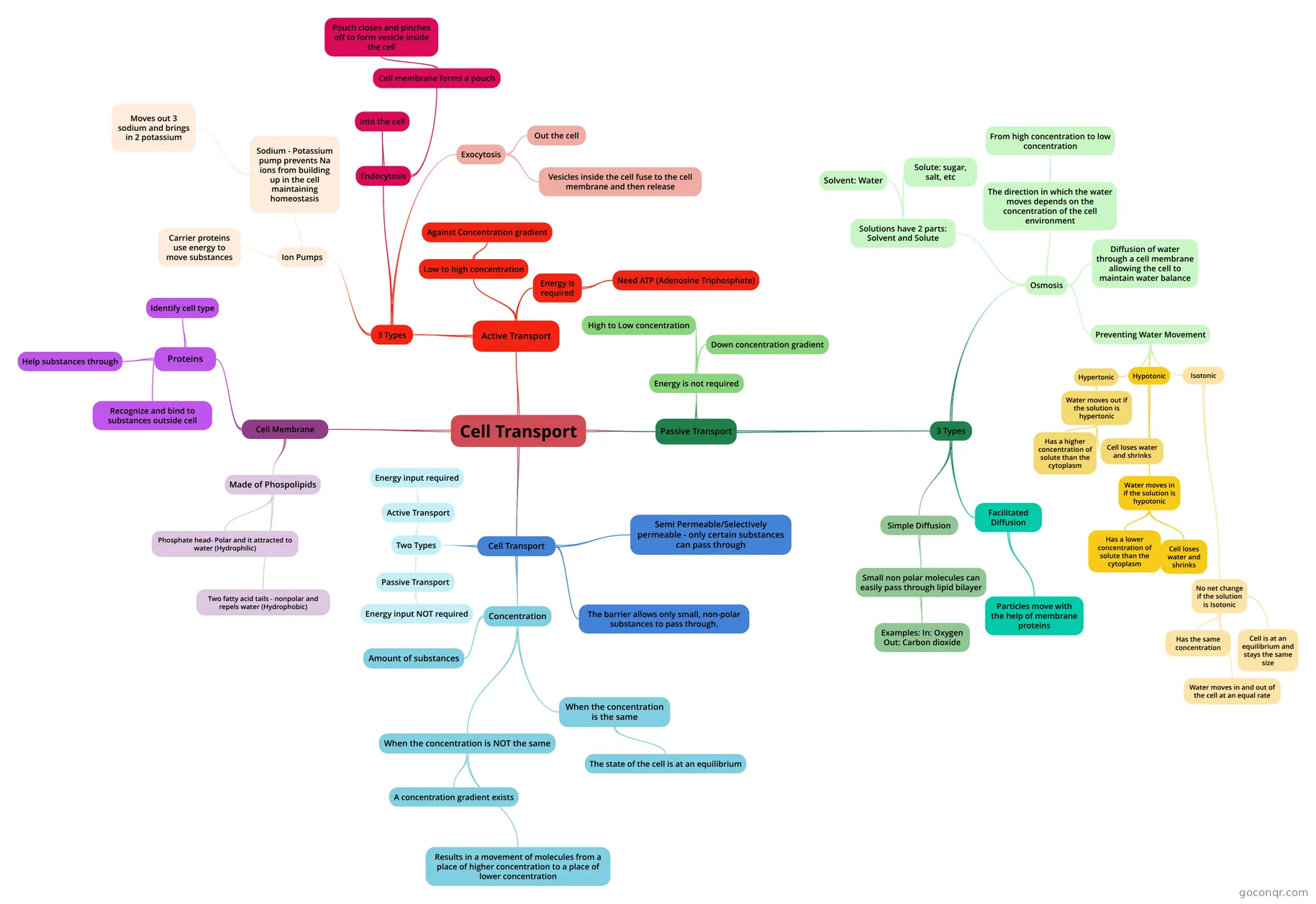
Mind map: cell transport
Map content
Cell Transport
Cell Membrane
- Made of Phospolipids
- Phosphate head- Polar and it attracted to water (Hydrophilic)
- Two fatty acid tails - nonpolar and repels water (Hydrophobic)
- Proteins
- Identify cell type
- Help substances through
- Recognize and bind to substances outside cell
- Made of Phospolipids
Cell Transport
- Semi Permeable/Selectively permeable - only certain substances can pass through
- The barrier allows only small, non-polar substances to pass through.
- Concentration
- Amount of substances
- When the concentration is the same
- The state of the cell is at an equilibrium
- When the concentration is NOT the same
- A concentration gradient exists
- Results in a movement of molecules from a place of higher concentration to a place of lower concentration
- Two Types
- Passive Transport
- Energy input NOT required
- Active Transport
- Energy input required
- Passive Transport
Passive Transport
- Energy is not required
- High to Low concentration
- Down concentration gradient
- 3 Types
- Simple Diffusion
- Small non polar molecules can easily pass through lipid bilayer
- Examples: In: Oxygen Out: Carbon dioxide
- Small non polar molecules can easily pass through lipid bilayer
- Facilitated Diffusion
- Particles move with the help of membrane proteins
- Osmosis
- Diffusion of water through a cell membrane allowing the cell to maintain water balance
- The direction in which the water moves depends on the concentration of the cell environment
- From high concentration to low concentration
- Solutions have 2 parts: Solvent and Solute
- Solvent: Water
- Solute: sugar, salt, etc
- Preventing Water Movement
- Hypertonic
- Water moves out if the solution is hypertonic
- Has a higher concentration of solute than the cytoplasm
- Cell loses water and shrinks
- Water moves out if the solution is hypertonic
- Hypotonic
- Water moves in if the solution is hypotonic
- Has a lower concentration of solute than the cytoplasm
- Cell loses water and shrinks
- Water moves in if the solution is hypotonic
- Isotonic
- No net change if the solution is Isotonic
- Has the same concentration
- Water moves in and out of the cell at an equal rate
- Cell is at an equilibrium and stays the same size
- No net change if the solution is Isotonic
- Hypertonic
- Simple Diffusion
- Energy is not required
Active Transport
- Energy is required
- Need ATP (Adenosine Triphosphate)
- Low to high concentration
- Against Concentration gradient
- 3 Types
- Ion Pumps
- Carrier proteins use energy to move substances
- Sodium - Potassium pump prevents Na ions from building up in the cell maintaining homeostasis
- Moves out 3 sodium and brings in 2 potassium
- Endocytosis
- Into the cell
- Cell membrane forms a pouch
- Pouch closes and pinches off to form vesicle inside the cell
- Exocytosis
- Out the cell
- Vesicles inside the cell fuse to the cell membrane and then release
- Ion Pumps
- Energy is required
Information
- Description
- A flow chart describing the different methods of cell transport
- Created by
- Savannah Reynolds
- Views
- 56
- Tags
- Rating