
Mind map
FOUNDATIONS
Map content
FOUNDATIONS
One method of describing a building’s construction is based on the location of the lowest building floor:
- a.) slab-on-grade construction
- The lowest floor of the building rests directly on the ground
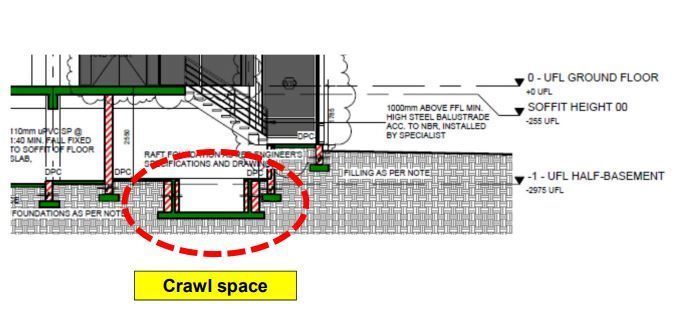
- b.) crawl space construction
- The lowest floor of the building is suspended a short distance (less than a full floor height) above the ground.
- Provides convenient access to utility lines & simplifies the installations of below the floor utilities.
- The lowest floor of the building is suspended a short distance (less than a full floor height) above the ground.
- c.) basement construction
- Provides one or more full stories below ground level.
- Provides storage space or additional living space at relatively low cost.
- Provides one or more full stories below ground level.
- a.) slab-on-grade construction
STABILITY OF EXCAVATIONS
- Slope stability = Soil strength
- Soil Identification:
- Soil considered to consist of 5 fundamental material types:
- 1. Gravel - 6mm to 75mm dia.
- 2. Sand - particles 0.7mm dia
- 3. Silt - particles 0.002mm dia
- 4. Clay - particles smaller than 0.002mm dia
- 5. Organic material - particles 3-6mm dia.
- 4. Clay - particles smaller than 0.002mm dia
- 3. Silt - particles 0.002mm dia
- 2. Sand - particles 0.7mm dia
- 1. Gravel - 6mm to 75mm dia.
- Soil Classification Systems:
- AASHTO – American Association of State Highway and Transportation Officials – applies to South African industry
- Liquid limit: water content at which the soil will start to flow when subjected to shaking test
- Plastic limit: moisture content in % at which the soil will begin to crumble
- Geo-Technical Engineer to issue Geo-Tech Report of soil classification
- Plastic limit: moisture content in % at which the soil will begin to crumble
- Liquid limit: water content at which the soil will start to flow when subjected to shaking test
- AASHTO – American Association of State Highway and Transportation Officials – applies to South African industry
- Soil considered to consist of 5 fundamental material types:
- Soil Identification:
- Soil divided into cohesionless and cohesive
- cohesionless
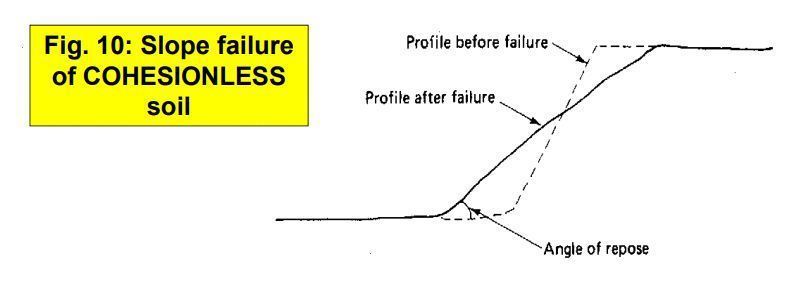
- cohesionless soil is one whose grains do not show any tendency to stick together.
- The shear strength is thus solely to the friction developed between the grains.
- When an embankment composed of a cohesionless soil fails
- Material from the upper part of the slope breaks away and falls to the toe of the slope until the face of the embankment reaches the natural angle of repose for the soil.
- When an embankment composed of a cohesionless soil fails
- The shear strength is thus solely to the friction developed between the grains.
- cohesionless soil is one whose grains do not show any tendency to stick together.
- cohesive
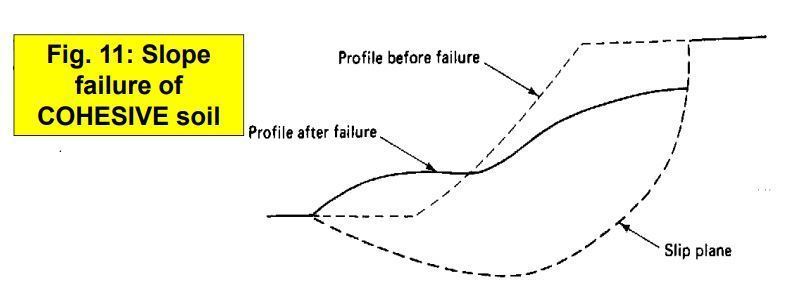
- cohesive soil, on the other hand, shear strength is provided primarily by the attraction between soil grains (called cohesion)
- Failure of a highly cohesive soil typically occurs as shown in figure 11 where a large mass of soil has moved along a surface, called a slip plane
- The natural shape of this failure surface resembles the arc of an ellipse but is usually considered to be circular in soil stability analyses.
- Failure of a highly cohesive soil typically occurs as shown in figure 11 where a large mass of soil has moved along a surface, called a slip plane
- cohesive soil, on the other hand, shear strength is provided primarily by the attraction between soil grains (called cohesion)
- cohesionless
- Slope stability = Soil strength
EMBANKMENT FAILURE DURING CONSTRUCTION
- the stability of embankments are affected by external factors
- weather conditions
- ground water level,
- presence of loads for example materials and equipment near the top of the embankment/excavation
- the presence of vibration equipment or other sources
- the stability of embankments are affected by external factors
Images and files in the map
Information
- Description
- Building Science Mind Map on FOUNDATIONS, created by Ansonique Smit on 18/03/2020.
- Created by
- Ansonique Smit · Mar 2020
- Updated
- Mar 19, 2020
- Views
- 0
- Rating