
Mind map
C2 Revision
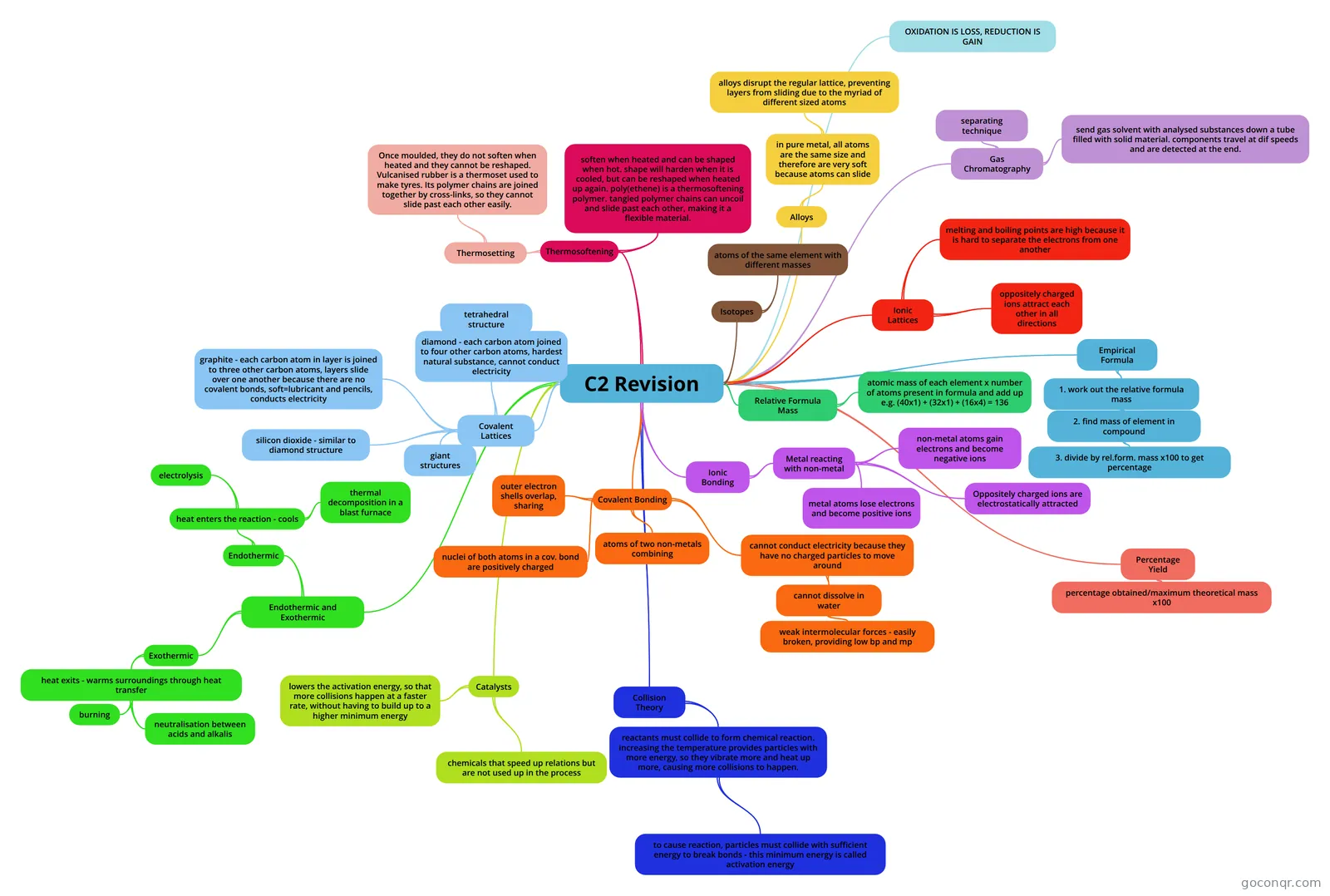
Mind map: C2 revision chemistry
Map content
C2 Revision
Isotopes
- atoms of the same element with different masses
Relative Formula Mass
- atomic mass of each element x number of atoms present in formula and add up e.g. (40x1) + (32x1) + (16x4) = 136
Ionic Bonding
- Metal reacting with non-metal
- metal atoms lose electrons and become positive ions
- non-metal atoms gain electrons and become negative ions
- Oppositely charged ions are electrostatically attracted
- Metal reacting with non-metal
Ionic Lattices
- oppositely charged ions attract each other in all directions
- melting and boiling points are high because it is hard to separate the electrons from one another
Covalent Bonding
- atoms of two non-metals combining
- outer electron shells overlap, sharing
- nuclei of both atoms in a cov. bond are positively charged
- cannot conduct electricity because they have no charged particles to move around
- cannot dissolve in water
- weak intermolecular forces - easily broken, providing low bp and mp
- cannot dissolve in water
Covalent Lattices
- giant structures
- diamond - each carbon atom joined to four other carbon atoms, hardest natural substance, cannot conduct electricity
- tetrahedral structure
- graphite - each carbon atom in layer is joined to three other carbon atoms, layers slide over one another because there are no covalent bonds, soft=lubricant and pencils, conducts electricity
- silicon dioxide - similar to diamond structure
Thermosoftening
- soften when heated and can be shaped when hot. shape will harden when it is cooled, but can be reshaped when heated up again. poly(ethene) is a thermosoftening polymer. tangled polymer chains can uncoil and slide past each other, making it a flexible material.
- Thermosetting
- Once moulded, they do not soften when heated and they cannot be reshaped. Vulcanised rubber is a thermoset used to make tyres. Its polymer chains are joined together by cross-links, so they cannot slide past each other easily.
Alloys
- in pure metal, all atoms are the same size and therefore are very soft because atoms can slide
- alloys disrupt the regular lattice, preventing layers from sliding due to the myriad of different sized atoms
- in pure metal, all atoms are the same size and therefore are very soft because atoms can slide
Gas Chromatography
- separating technique
- send gas solvent with analysed substances down a tube filled with solid material. components travel at dif speeds and are detected at the end.
OXIDATION IS LOSS, REDUCTION IS GAIN
Empirical Formula
- 1. work out the relative formula mass
- 2. find mass of element in compound
- 3. divide by rel.form. mass x100 to get percentage
- 2. find mass of element in compound
- 1. work out the relative formula mass
Percentage Yield
- percentage obtained/maximum theoretical mass x100
Collision Theory
- reactants must collide to form chemical reaction. increasing the temperature provides particles with more energy, so they vibrate more and heat up more, causing more collisions to happen.
- to cause reaction, particles must collide with sufficient energy to break bonds - this minimum energy is called activation energy
- reactants must collide to form chemical reaction. increasing the temperature provides particles with more energy, so they vibrate more and heat up more, causing more collisions to happen.
Catalysts
- chemicals that speed up relations but are not used up in the process
- lowers the activation energy, so that more collisions happen at a faster rate, without having to build up to a higher minimum energy
Endothermic and Exothermic
- Endothermic
- heat enters the reaction - cools
- electrolysis
- thermal decomposition in a blast furnace
- heat enters the reaction - cools
- Exothermic
- heat exits - warms surroundings through heat transfer
- burning
- neutralisation between acids and alkalis
- heat exits - warms surroundings through heat transfer
- Endothermic
Information
- Description
- Mind Map on C2 Revision, created by georgialennon on 15/03/2015.
- Created by
- georgialennon
- Views
- 19
- Rating