
Mind map
WCC VCE PE: Energy Systems
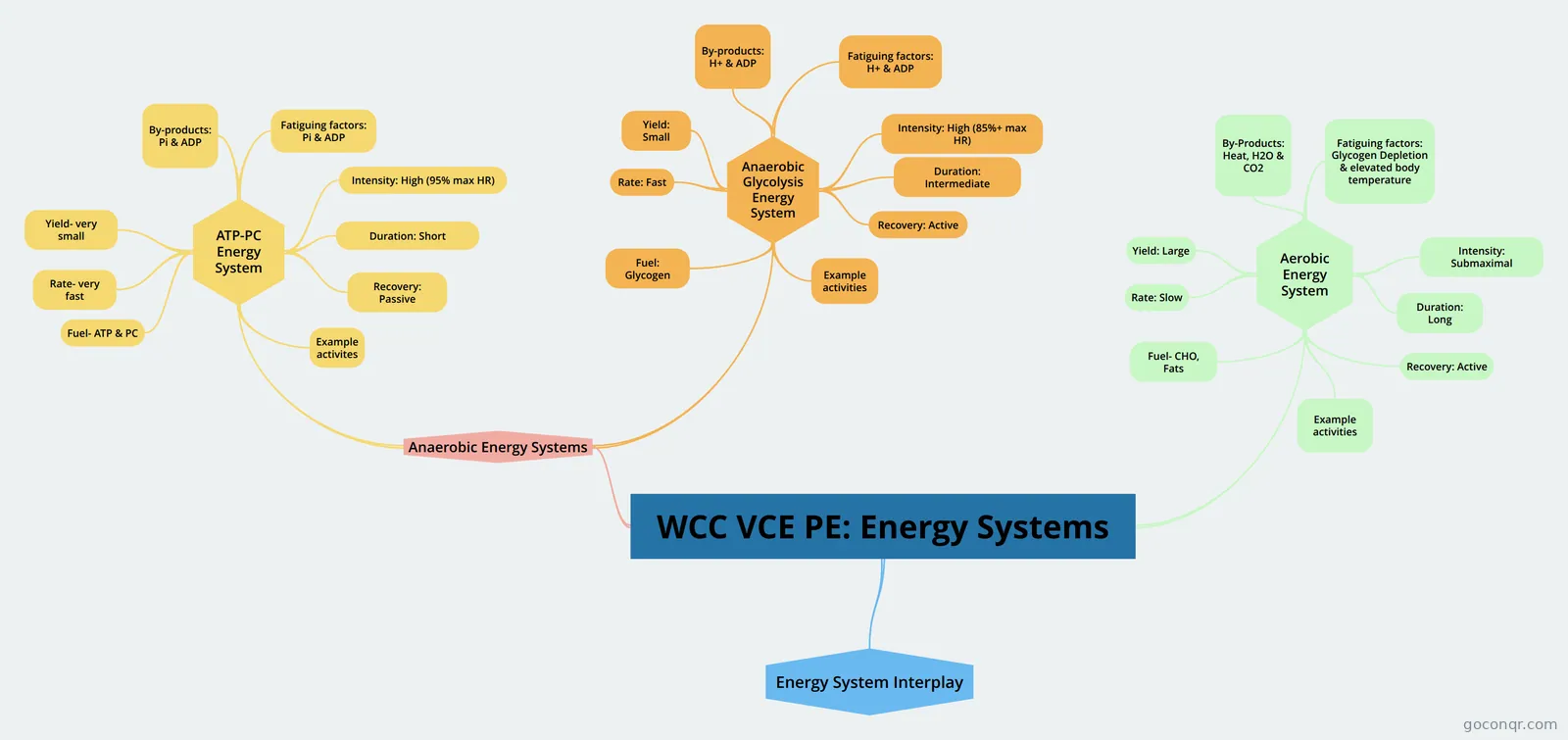
Mind map: VCE PE energy systems
Map content
WCC VCE PE: Energy Systems
Anaerobic Energy Systems
- Energy Systems that operate without Oxygen
- ATP-PC Energy System
- Fuel- ATP & PC
- both stored in the muscle 2 secs of ATP 10 secs of PC
- Rate- very fast
- both fuels are stored in the muscles simple chemicle reaction torelease energy
- Yield- very small
- PC releases enpugh energy to resynthesise 0.7 ATP
- By-products: Pi & ADP
- Pi: o slows the release of calcium ions and reduces the contraction force of muscles o Removed best during passive recovery where high levels of O2 are available
- ADP: o accumulates during explosive activities and reduces the power muscles can exert o Removed best during passive recovery where high levels of O2 are available
- Intensity: High (95% max HR)
- Duration: Short
- Dominant: 0-5 secs Peak: 2-4 secs
- Example activites
- Short Sprints (50-100m) Initial Contests in team sports Field events (HJ, LJ, Pole vault)
- Recovery: Passive
- PC can only be restored when high levels of O2 are present during passive recovery The more aerobically fit an athlete, the faster the recovery.
- Fatiguing factors: Pi & ADP
- Pi: o slows the release of calcium ions and reduces the contraction force of muscles o Removed best during passive recovery where high levels of O2 are available
- ADP: o accumulates during explosive activities and reduces the power muscles can exert o Removed best during passive recovery where high levels of O2 are available
- Fuel- ATP & PC
- Anaerobic Glycolysis Energy System
- Fuel: Glycogen
- Only partially broken down in Anaerobic conditions
- Rate: Fast
- Only Partially breaks down Glycogen in anaerobic environment
- Yield: Small
- Glycogen releases enough energy to resynthesise 2 ATP in Anaerobic conditions
- By-products: H+ & ADP
- H+ o Increased amounts of H+ cause muscle acidity which slows the actions of glycolytic enzymes and the rate of glycogen breakdown o Occurs when the Anaerobic Glycolysis ES has a higher contribution towards energy production o LIP is an identifying factor of H+ accumulation o Lactate Inflection Point § The L.I.P. has been exceeded when lactate appearance in the blood is greater than lactate removal from the blood. (Lactate rises from a steady state) § When the L.I.P. is reached most energy is still supplied aerobically, however, an increased reliance on the Anaerobic Glycolysis energy system due to an increased intensity results in the lactate increase § Remember: It is not the lactate itself that causes fatigue. The rise in blood lactate is a good indicator of the amount of H+ that is in the muscle o Removed best when oxygen levels are above resting and an increased blood flow is present. § Active Recovery § Massage § Contrast bathing
- ADP: o accumulates during explosive activities and reduces the power muscles can exert o Removed best during passive recovery where high levels of O2 are available
- Intensity: High (85%+ max HR)
- Used for increases in intensity during long duration events when PC has not restored. However, it will not be dominant in these cirumstances, just an increased contibution
- Duration: Intermediate
- Dominant: 5-30 secs Peak: 5-15 secs
- Recovery: Active
- Example activities
- 400m run repeated sprints 50m Swim
- Fatiguing factors: H+ & ADP
- H+ o Increased amounts of H+ cause muscle acidity which slows the actions of glycolytic enzymes and the rate of glycogen breakdown o Occurs when the Anaerobic Glycolysis ES has a higher contribution towards energy production o LIP is an identifying factor of H+ accumulation o Lactate Inflection Point § The L.I.P. has been exceeded when lactate appearance in the blood is greater than lactate removal from the blood. (Lactate rises from a steady state) § When the L.I.P. is reached most energy is still supplied aerobically, however, an increased reliance on the Anaerobic Glycolysis energy system due to an increased intensity results in the lactate increase § Remember: It is not the lactate itself that causes fatigue. The rise in blood lactate is a good indicator of the amount of H+ that is in the muscle o Removed best when oxygen levels are above resting and an increased blood flow is present. § Active Recovery § Massage § Contrast bathing
- ADP: o accumulates during explosive activities and reduces the power muscles can exert o Removed best during passive recovery where high levels of O2 are available
- Fuel: Glycogen
Aerobic Energy System
- Energy Systems that operate with the presence Oxygen
- Fuel- CHO, Fats
- At rest: 1/2 CHO, 2/3 Fats CHO are preferable to break down when exercising. Fats require more oxygen so need to perform at a lower intensity
- Rate: Slow
- Slower due to the full break down of glycogen through both the Krebs Cycle and the Electron Transport Chain (more complex chemical reactions)
- Yield: Large
- Glycogen releases enough energy to resynthesise 38 ATP in aerobic conditions
- Triglycerides release enough energy to resynthesise 441 ATP
- By-Products: Heat, H2O & CO2
- CO2 & H2O have no fatiguing effects on the body
- Heat can potentially cause fatigue if preventative measures aren't put in place, such as rehydration and wearing appropriate clothing
- Fatiguing factors: Glycogen Depletion & elevated body temperature
- Glycogen Depletion o Considered a fatiguing factor after 60mins of continuous exercise o Restored through replenishment during and postexercise bout (best results with high GI in first 30mins after) o Will ‘Hit the wall’ 2-3hrs into an endurance event
- Elevated body Temperature Causes fatigue via o Less oxygen being delivered to the working muscles § Due to an increase in blood being sent to the skin for thermoregulation § Results in an increase in Q & HR § Results in a greater reliance on AnaerobicbGlycolysis ES, meaning a build up of Metabolic by-products
- Intensity: Submaximal
- Aerobic training zone is considered 70-85% max HR Also dominant during maximal efforts after prolonged bouts of exercise
- Duration: Long
- Dominant: 30/45+ secs Peak: 1-1.5 mins
- Recovery: Active
- Example activities
- Any event lasting longer than 90secs 1500m running race AFL football player 400m swim
Energy System Interplay
Information
- Description
- A mindmap outlining Energy systems. The 3 pathways the body has to resynthesis ATP for movement
- Created by
- Tim Hodge
- Views
- 2,544
- Tags
- Rating