
Mind map
Hydrophytes
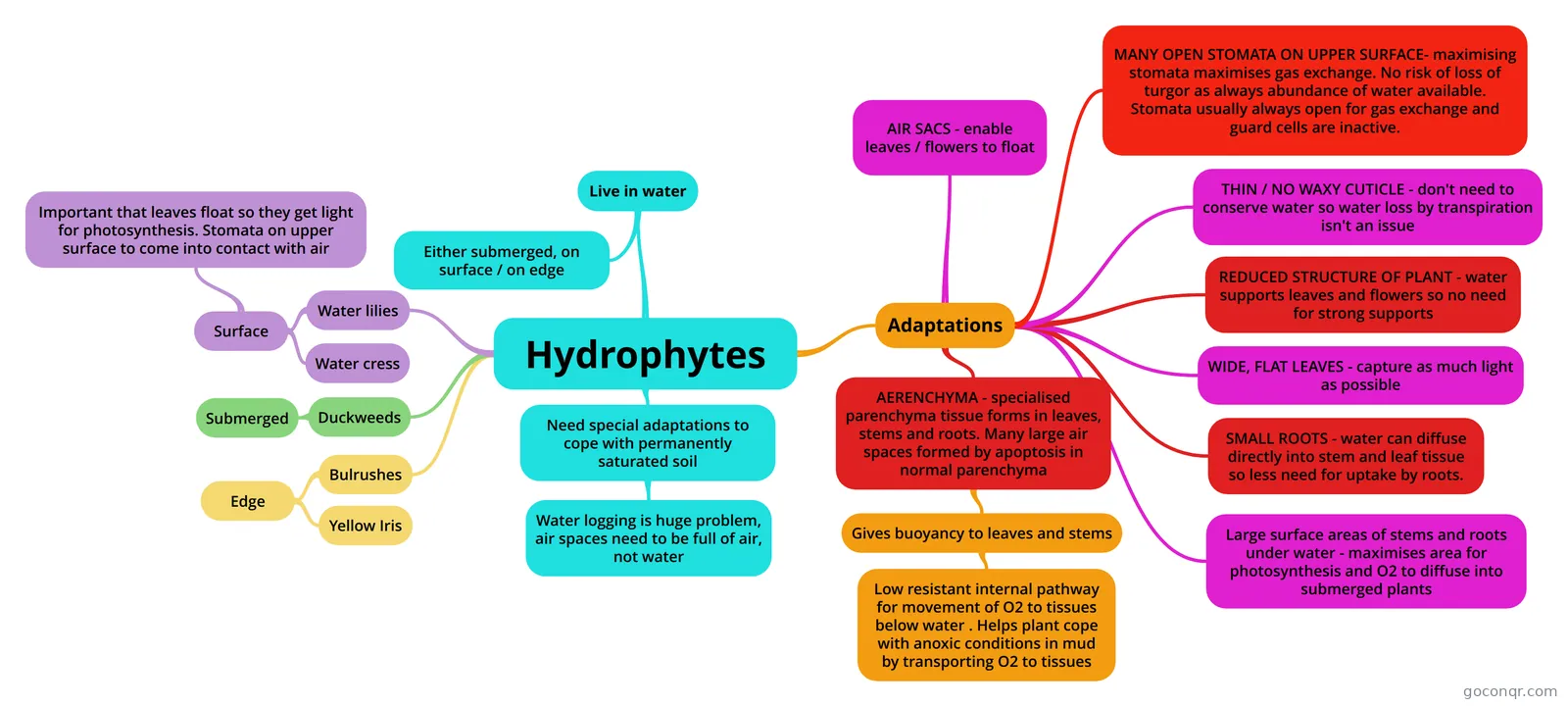
Mind map: Hydrophytes
Map content
Hydrophytes
Live in water
- Either submerged, on surface / on edge
Need special adaptations to cope with permanently saturated soil
- Water logging is huge problem, air spaces need to be full of air, not water
Water lilies
- Surface
- Water cress
- Important that leaves float so they get light for photosynthesis. Stomata on upper surface to come into contact with air
- Surface
Duckweeds
- Submerged
Bulrushes
- Edge
- Yellow Iris
- Edge
Adaptations
- MANY OPEN STOMATA ON UPPER SURFACE- maximising stomata maximises gas exchange. No risk of loss of turgor as always abundance of water available. Stomata usually always open for gas exchange and guard cells are inactive.
- THIN / NO WAXY CUTICLE - don't need to conserve water so water loss by transpiration isn't an issue
- REDUCED STRUCTURE OF PLANT - water supports leaves and flowers so no need for strong supports
- WIDE, FLAT LEAVES - capture as much light as possible
- SMALL ROOTS - water can diffuse directly into stem and leaf tissue so less need for uptake by roots.
- Large surface areas of stems and roots under water - maximises area for photosynthesis and O2 to diffuse into submerged plants
- AIR SACS - enable leaves / flowers to float
- AERENCHYMA - specialised parenchyma tissue forms in leaves, stems and roots. Many large air spaces formed by apoptosis in normal parenchyma
- Gives buoyancy to leaves and stems
- Low resistant internal pathway for movement of O2 to tissues below water . Helps plant cope with anoxic conditions in mud by transporting O2 to tissues
- Gives buoyancy to leaves and stems
Information
- Description
- AS - Level Biology (Chapter 9 - plants) Mind Map on Hydrophytes, created by Jess Hughes on 02/03/2016.
- Created by
- Jess Hughes
- Views
- 1
- Rating