
Mind map
The biosocial approach to gender development
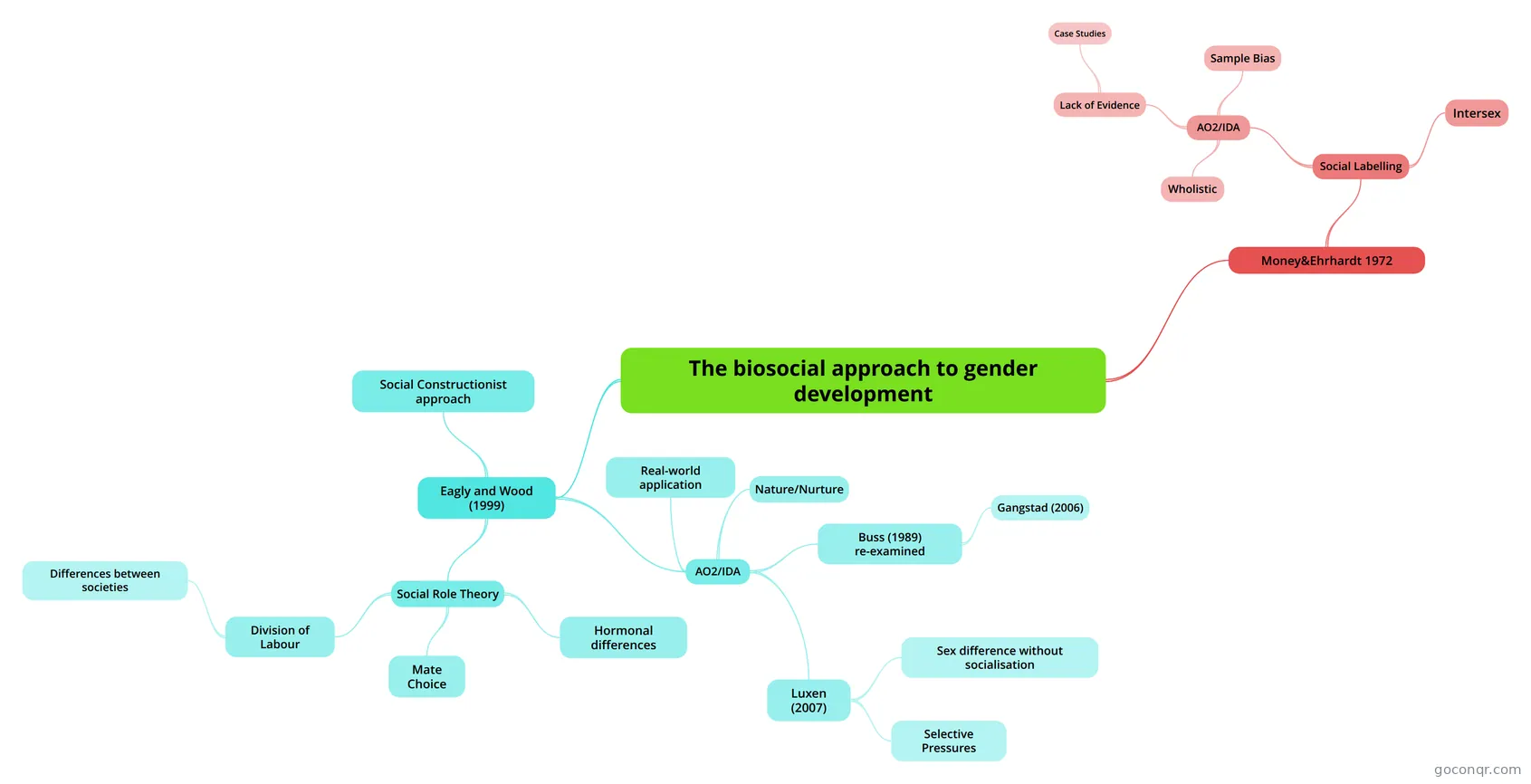
Mind map: The biosocial approach to gender development
Map content
The biosocial approach to gender development
Money&Ehrhardt 1972
- Social Labelling
- From birth, it is differential treatment of boys and girls interacting with biological factors which steer development. Sex rearing is the pivotal point in gender development. Biology determines rearing of sex.
- Intersex
- mistyped at birth - is a genetic male is mislabelled and raised as a girl before 3, he would acquire the gender identity of a girl - so the key to gender development is the label that a person receives.
- AO2/IDA
- Wholistic
- integration of nature and nurture (label + biology (such as exposure to testosterone))
- Lack of Evidence
- David Reimer CS went very wrong
- Case Studies
- Not able to be generalised Ethics - psychological harm David Reimer - consent, privacy and confidentiality
- Sample Bias
- Derived from the study of abnormal individuals (e.g. females exposed to male hormones in utero due to drugs taken by their mothers) Not relevant to understanding normal gender development
- Wholistic
- Social Labelling
Eagly and Wood (1999)
- Social Role Theory
- Selective pressures do not cause both physical and psychological differences they only cause physical differences, and these lead to sex role allocations which in turn creates psychological sex differences.
- Division of Labour
- Biological differences allow the performance of certain tasks. e.g. childbearing and nursing infants means women are well placed to care for the young and are less able to be away from the home. mens greater speed and upper body strength = efficient performance in energy consuming tasks.
- Differences between societies
- where strength is not required for occupational roles or there is alternative care for children, social roles will be more similar and psychological differences will be reduced.
- Mate Choice
- The physical differences create social roles - women are domestic and men are providers. Women maximise outcome by selecting a good wage earner and men maximise their outcome by selecting a successful domestic mate.
- Hormonal differences
- May be the outcome of social roles and psychological sex differences rather than the cause. e.g. higher testosterone in men is an effect of the activities in which men engage(athletic and competitive)
- Social Constructionist approach
- much of human behaviour is an outcome of a particular society or culture. No objective reality, such as a real difference between sexes - or where there is one, it is irrelevant. Behaviours are best understood in terms of the social context in which they occur.
- AO2/IDA
- Real-world application
- last 100yrs - feminist movement = great change. Evolutionary seen as a force against gender equality (sex differences are innate and cannot be changed) Supports feminist view - changes in society = changes in psychological differences High ethical appeal as sex differences are perceived as flexible (not overly socially senstive)
- Nature/Nurture
- no doubt social factors guide gender development - such influences have reduced the division of roles.
- Luxen (2007)
- Selective Pressures
- behaviour is at least as important as physical characteristicsm and therefore selective pressure would act directly on behaviour to create a psychological as well as a physical difference.
- Sex difference without socialisation
- research has shown that very young children and animals display sex differences in toy preference. This indicates biology rather than psychology as socialisation is unlikely to have yet occured.
- Selective Pressures
- Buss (1989) re-examined
- Women have less earning capacity and so sought a good wage earner. Men want younger women for obedience to their authority. Used Gender Empowerment Measure to identify where societies had less or more gender equality. Where women had higher status, and division on labour was less pronounced, sex differences in mate choice were too.
- Gangstad (2006)
- conducted the same analysis with more controls (affluence and social structure) and found gender equality tended not to be related to sex differences, and thus concluded that the evolutionary theory provides a better explanation for joint effects of biology and culture.
- Real-world application
- Social Role Theory
Information
- Description
- A Levels Psychology (Gender) Mind Map on The biosocial approach to gender development, created by ktuffin_95 on 27/01/2014.
- Created by
- ktuffin_95
- Views
- 279
- Tags
- Rating