
Mind map
Rosenhan 1973
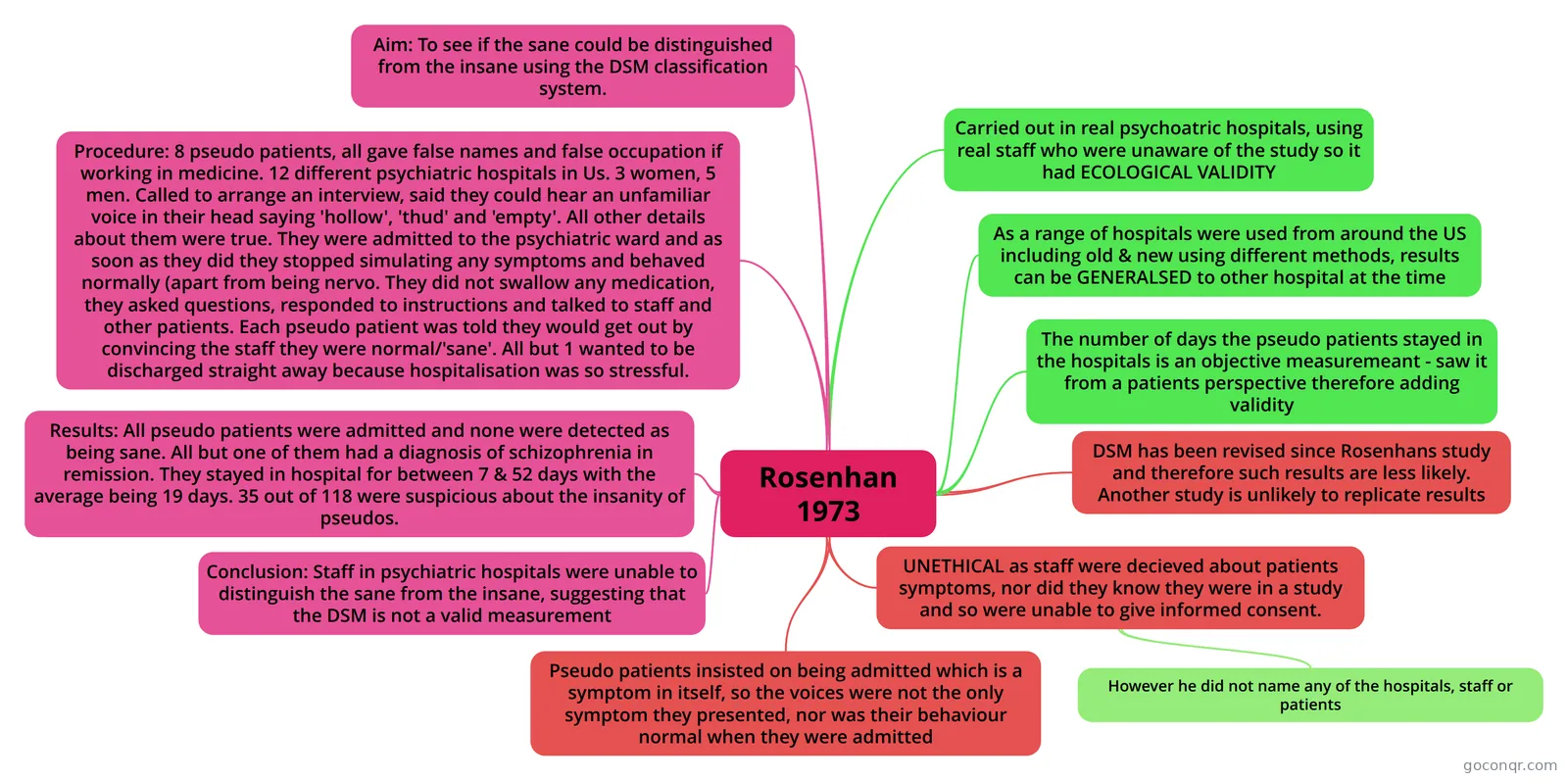
Mind map: Rosenhan 1973 study
Map content
Rosenhan 1973
Aim: To see if the sane could be distinguished from the insane using the DSM classification system.
Procedure: 8 pseudo patients, all gave false names and false occupation if working in medicine. 12 different psychiatric hospitals in Us. 3 women, 5 men. Called to arrange an interview, said they could hear an unfamiliar voice in their head saying 'hollow', 'thud' and 'empty'. All other details about them were true. They were admitted to the psychiatric ward and as soon as they did they stopped simulating any symptoms and behaved normally (apart from being nervo. They did not swallow any medication, they asked questions, responded to instructions and talked to staff and other patients. Each pseudo patient was told they would get out by convincing the staff they were normal/'sane'. All but 1 wanted to be discharged straight away because hospitalisation was so stressful.
Results: All pseudo patients were admitted and none were detected as being sane. All but one of them had a diagnosis of schizophrenia in remission. They stayed in hospital for between 7 & 52 days with the average being 19 days. 35 out of 118 were suspicious about the insanity of pseudos.
Conclusion: Staff in psychiatric hospitals were unable to distinguish the sane from the insane, suggesting that the DSM is not a valid measurement
Carried out in real psychoatric hospitals, using real staff who were unaware of the study so it had ECOLOGICAL VALIDITY
The number of days the pseudo patients stayed in the hospitals is an objective measuremeant - saw it from a patients perspective therefore adding validity
As a range of hospitals were used from around the US including old & new using different methods, results can be GENERALSED to other hospital at the time
UNETHICAL as staff were decieved about patients symptoms, nor did they know they were in a study and so were unable to give informed consent.
- However he did not name any of the hospitals, staff or patients
DSM has been revised since Rosenhans study and therefore such results are less likely. Another study is unlikely to replicate results
Pseudo patients insisted on being admitted which is a symptom in itself, so the voices were not the only symptom they presented, nor was their behaviour normal when they were admitted