
Mind map
speaking acquisition
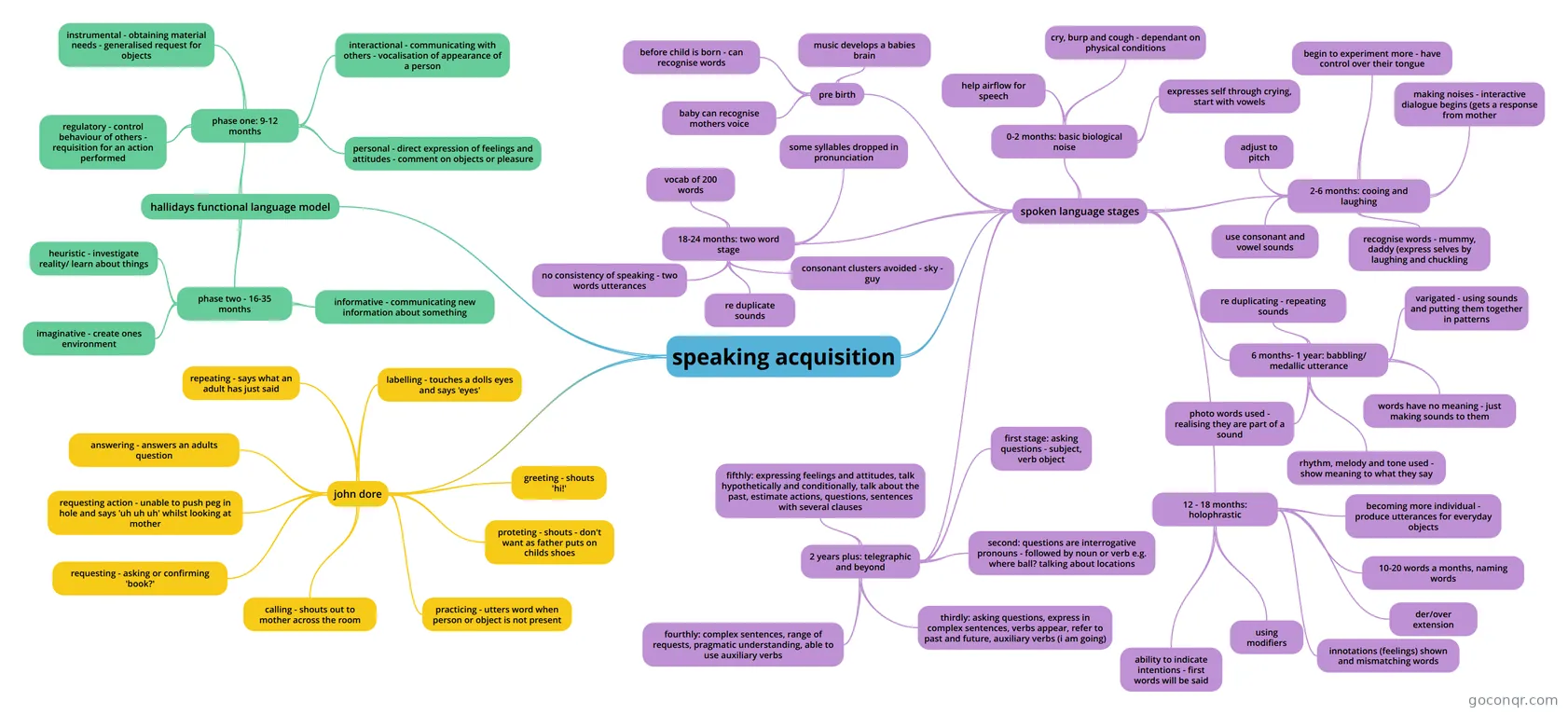
Mind map: speaking acquisition
Map content
speaking acquisition
spoken language stages
- pre birth
- baby can recognise mothers voice
- before child is born - can recognise words
- music develops a babies brain
- 0-2 months: basic biological noise
- cry, burp and cough - dependant on physical conditions
- help airflow for speech
- expresses self through crying, start with vowels
- 2-6 months: cooing and laughing
- begin to experiment more - have control over their tongue
- making noises - interactive dialogue begins (gets a response from mother
- recognise words - mummy, daddy (express selves by laughing and chuckling
- adjust to pitch
- use consonant and vowel sounds
- 6 months- 1 year: babbling/ medallic utterance
- re duplicating - repeating sounds
- varigated - using sounds and putting them together in patterns
- words have no meaning - just making sounds to them
- rhythm, melody and tone used - show meaning to what they say
- photo words used - realising they are part of a sound
- 12 - 18 months: holophrastic
- ability to indicate intentions - first words will be said
- becoming more individual - produce utterances for everyday objects
- 10-20 words a months, naming words
- der/over extension
- innotations (feelings) shown and mismatching words
- using modifiers
- 18-24 months: two word stage
- vocab of 200 words
- some syllables dropped in pronunciation
- consonant clusters avoided - sky - guy
- re duplicate sounds
- no consistency of speaking - two words utterances
- 2 years plus: telegraphic and beyond
- first stage: asking questions - subject, verb object
- second: questions are interrogative pronouns - followed by noun or verb e.g. where ball? talking about locations
- thirdly: asking questions, express in complex sentences, verbs appear, refer to past and future, auxiliary verbs (i am going)
- fourthly: complex sentences, range of requests, pragmatic understanding, able to use auxiliary verbs
- fifthly: expressing feelings and attitudes, talk hypothetically and conditionally, talk about the past, estimate actions, questions, sentences with several clauses
- pre birth
hallidays functional language model
- phase one: 9-12 months
- instrumental - obtaining material needs - generalised request for objects
- regulatory - control behaviour of others - requisition for an action performed
- interactional - communicating with others - vocalisation of appearance of a person
- personal - direct expression of feelings and attitudes - comment on objects or pleasure
- phase two - 16-35 months
- heuristic - investigate reality/ learn about things
- imaginative - create ones environment
- informative - communicating new information about something
- phase one: 9-12 months
john dore
- labelling - touches a dolls eyes and says 'eyes'
- repeating - says what an adult has just said
- answering - answers an adults question
- requesting action - unable to push peg in hole and says 'uh uh uh' whilst looking at mother
- requesting - asking or confirming 'book?'
- calling - shouts out to mother across the room
- greeting - shouts 'hi!'
- proteting - shouts - don't want as father puts on childs shoes
- practicing - utters word when person or object is not present
Information
- Description
- A level English Mind Map on speaking acquisition, created by madeline harris on 19/12/2016.
- Created by
- madeline harris
- Views
- 1
- Rating