
Mind map
OFFICIAL STATISTICS
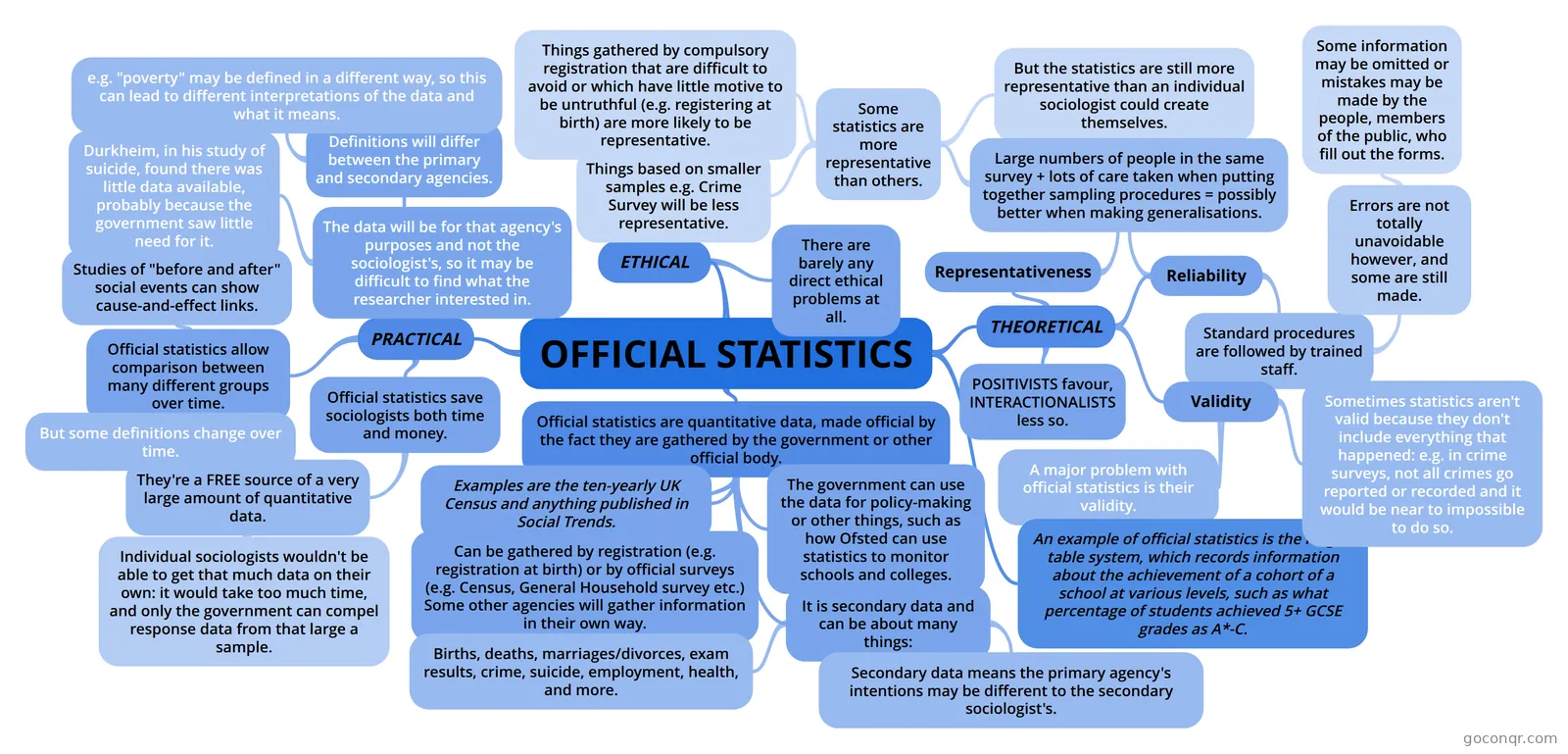
Mind map: official statistics
Map content
OFFICIAL STATISTICS
Official statistics are quantitative data, made official by the fact they are gathered by the government or other official body.
- Examples are the ten-yearly UK Census and anything published in Social Trends.
- The government can use the data for policy-making or other things, such as how Ofsted can use statistics to monitor schools and colleges.
- Can be gathered by registration (e.g. registration at birth) or by official surveys (e.g. Census, General Household survey etc.) Some other agencies will gather information in their own way.
- It is secondary data and can be about many things:
- Births, deaths, marriages/divorces, exam results, crime, suicide, employment, health, and more.
- Secondary data means the primary agency's intentions may be different to the secondary sociologist's.
PRACTICAL
- Official statistics save sociologists both time and money.
- They're a FREE source of a very large amount of quantitative data.
- Individual sociologists wouldn't be able to get that much data on their own: it would take too much time, and only the government can compel response data from that large a sample.
- They're a FREE source of a very large amount of quantitative data.
- Official statistics allow comparison between many different groups over time.
- Studies of "before and after" social events can show cause-and-effect links.
- But some definitions change over time.
- The data will be for that agency's purposes and not the sociologist's, so it may be difficult to find what the researcher interested in.
- Durkheim, in his study of suicide, found there was little data available, probably because the government saw little need for it.
- Definitions will differ between the primary and secondary agencies.
- e.g. "poverty" may be defined in a different way, so this can lead to different interpretations of the data and what it means.
- Official statistics save sociologists both time and money.
ETHICAL
- There are barely any direct ethical problems at all.
THEORETICAL
- Representativeness
- Some statistics are more representative than others.
- Things gathered by compulsory registration that are difficult to avoid or which have little motive to be untruthful (e.g. registering at birth) are more likely to be representative.
- Things based on smaller samples e.g. Crime Survey will be less representative.
- But the statistics are still more representative than an individual sociologist could create themselves.
- Some statistics are more representative than others.
- POSITIVISTS favour, INTERACTIONALISTS less so.
- Reliability
- Large numbers of people in the same survey + lots of care taken when putting together sampling procedures = possibly better when making generalisations.
- Standard procedures are followed by trained staff.
- Errors are not totally unavoidable however, and some are still made.
- Some information may be omitted or mistakes may be made by the people, members of the public, who fill out the forms.
- Errors are not totally unavoidable however, and some are still made.
- Validity
- A major problem with official statistics is their validity.
- Sometimes statistics aren't valid because they don't include everything that happened: e.g. in crime surveys, not all crimes go reported or recorded and it would be near to impossible to do so.
- Representativeness
An example of official statistics is the league table system, which records information about the achievement of a cohort of a school at various levels, such as what percentage of students achieved 5+ GCSE grades as A*-C.
Information
- Description
- A Levels Sociology Mind Map on OFFICIAL STATISTICS, created by Els Pg on 18/04/2014.
- Created by
- Els Pg
- Views
- 29
- Rating