
Mind map
Lexis and Semantics
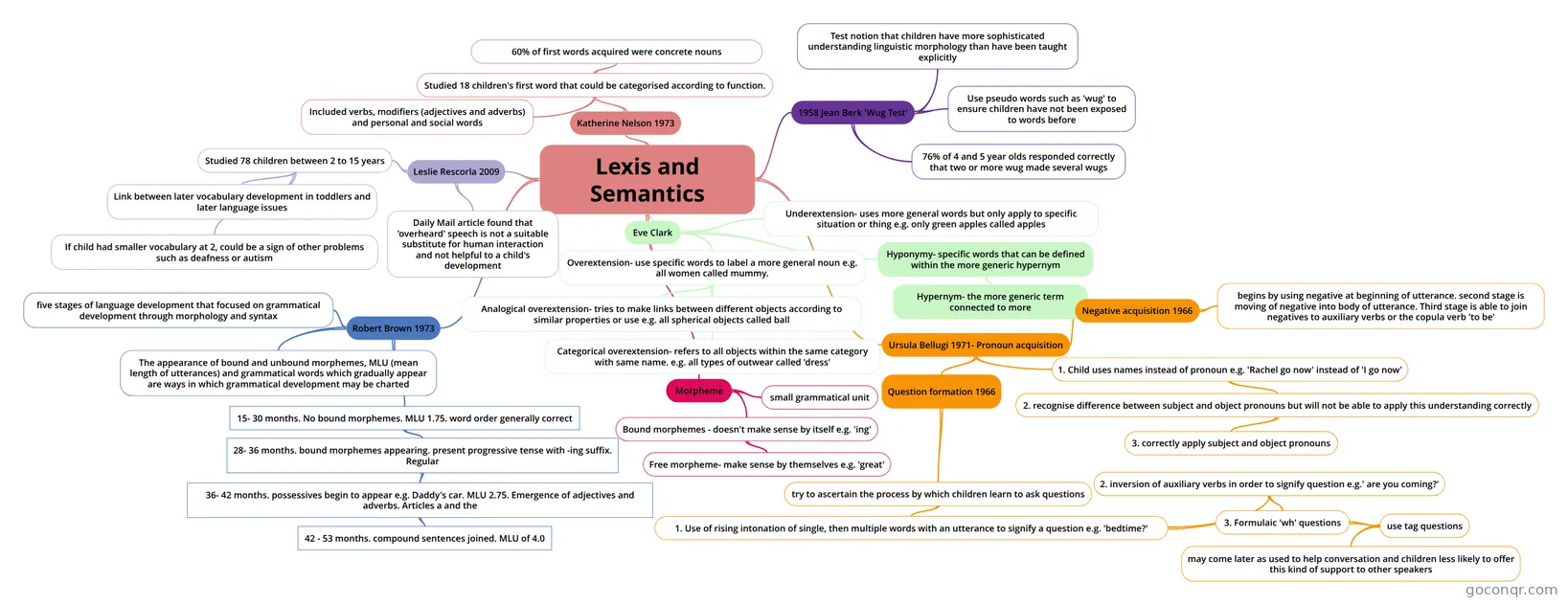
Mind map: Lexis and semantics
Map content
Lexis and Semantics
Katherine Nelson 1973
- Studied 18 children's first word that could be categorised according to function.
- 60% of first words acquired were concrete nouns
- Included verbs, modifiers (adjectives and adverbs) and personal and social words
- Studied 18 children's first word that could be categorised according to function.
Leslie Rescorla 2009
- Studied 78 children between 2 to 15 years
- Link between later vocabulary development in toddlers and later language issues
- If child had smaller vocabulary at 2, could be a sign of other problems such as deafness or autism
- Daily Mail article found that 'overheard' speech is not a suitable substitute for human interaction and not helpful to a child's development
- Studied 78 children between 2 to 15 years
Eve Clark
- Overextension- use specific words to label a more general noun e.g. all women called mummy.
- Analogical overextension- tries to make links between different objects according to similar properties or use e.g. all spherical objects called ball
- Categorical overextension- refers to all objects within the same category with same name. e.g. all types of outwear called 'dress'
- Underextension- uses more general words but only apply to specific situation or thing e.g. only green apples called apples
- Hyponymy- specific words that can be defined within the more generic hypernym
- Hypernym- the more generic term connected to more
- Overextension- use specific words to label a more general noun e.g. all women called mummy.
1958 Jean Berk 'Wug Test'
- Test notion that children have more sophisticated understanding linguistic morphology than have been taught explicitly
- Use pseudo words such as 'wug' to ensure children have not been exposed to words before
- 76% of 4 and 5 year olds responded correctly that two or more wug made several wugs
Robert Brown 1973
- five stages of language development that focused on grammatical development through morphology and syntax
- The appearance of bound and unbound morphemes, MLU (mean length of utterances) and grammatical words which gradually appear are ways in which grammatical development may be charted
- 15- 30 months. No bound morphemes. MLU 1.75. word order generally correct
- 28- 36 months. bound morphemes appearing. present progressive tense with -ing suffix. Regular
- 36- 42 months. possessives begin to appear e.g. Daddy's car. MLU 2.75. Emergence of adjectives and adverbs. Articles a and the
- 42 - 53 months. compound sentences joined. MLU of 4.0
- 36- 42 months. possessives begin to appear e.g. Daddy's car. MLU 2.75. Emergence of adjectives and adverbs. Articles a and the
- 28- 36 months. bound morphemes appearing. present progressive tense with -ing suffix. Regular
Morpheme
- small grammatical unit
- Bound morphemes - doesn't make sense by itself e.g. 'ing'
- Free morpheme- make sense by themselves e.g. 'great'
Ursula Bellugi 1971- Pronoun acquisition
- 1. Child uses names instead of pronoun e.g. 'Rachel go now' instead of 'I go now'
- 2. recognise difference between subject and object pronouns but will not be able to apply this understanding correctly
- 3. correctly apply subject and object pronouns
- 2. recognise difference between subject and object pronouns but will not be able to apply this understanding correctly
- Negative acquisition 1966
- begins by using negative at beginning of utterance. second stage is moving of negative into body of utterance. Third stage is able to join negatives to auxiliary verbs or the copula verb 'to be'
- Question formation 1966
- try to ascertain the process by which children learn to ask questions
- 1. Use of rising intonation of single, then multiple words with an utterance to signify a question e.g. 'bedtime?'
- 2. inversion of auxiliary verbs in order to signify question e.g.' are you coming?'
- 3. Formulaic 'wh' questions
- use tag questions
- may come later as used to help conversation and children less likely to offer this kind of support to other speakers
- use tag questions
- 3. Formulaic 'wh' questions
- 2. inversion of auxiliary verbs in order to signify question e.g.' are you coming?'
- 1. Use of rising intonation of single, then multiple words with an utterance to signify a question e.g. 'bedtime?'
- try to ascertain the process by which children learn to ask questions
- 1. Child uses names instead of pronoun e.g. 'Rachel go now' instead of 'I go now'
Information
- Description
- A2 English (child language) Mind Map on Lexis and Semantics, created by Taylor Pickering on 07/04/2017.
- Created by
- Taylor Pickering
- Views
- 1
- Rating