
Mind map
AP Bio Unit 3: Cells
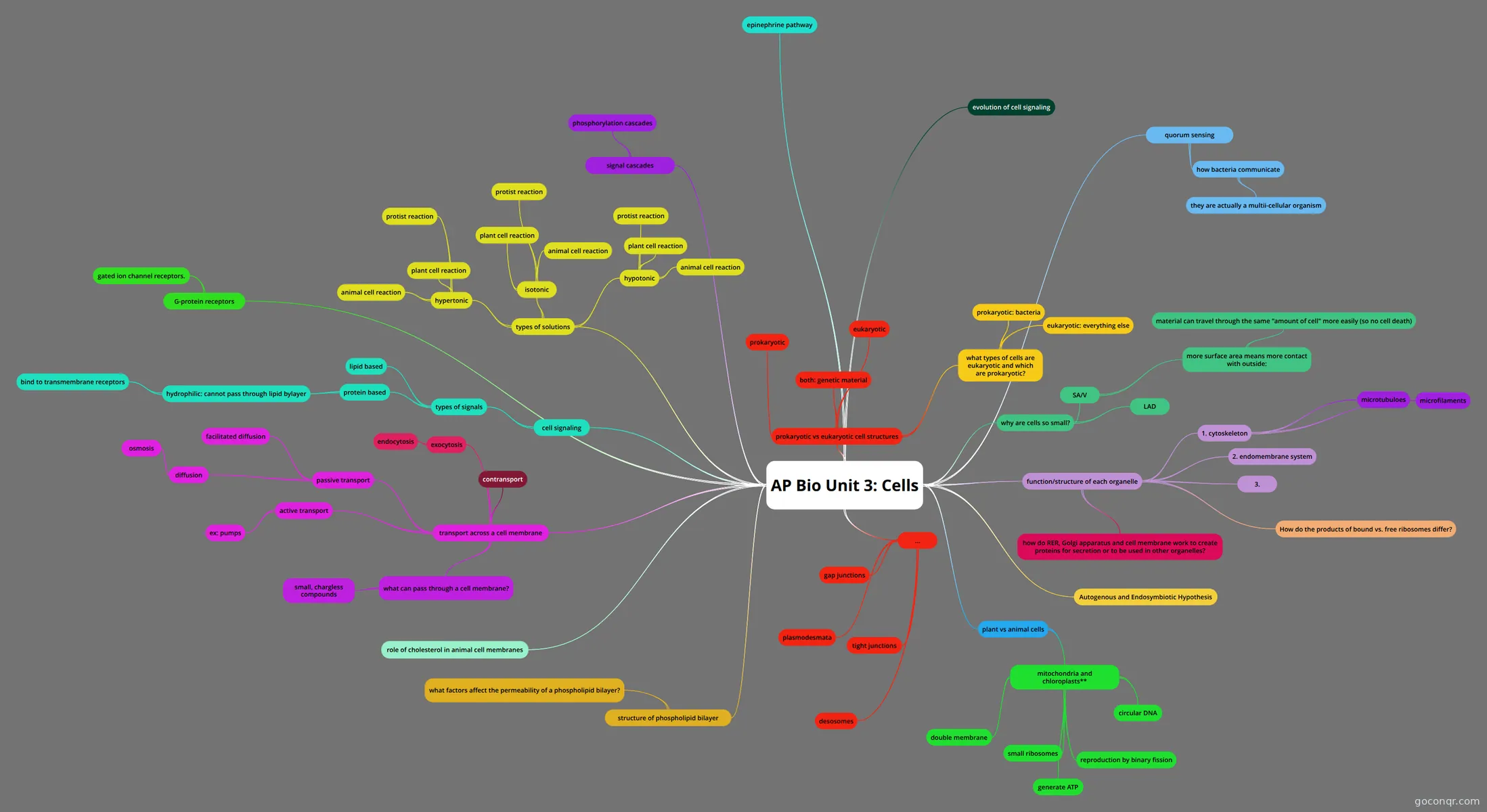
Mind map: AP Bio Unit 3 cells
Map content
AP Bio Unit 3: Cells
prokaryotic vs eukaryotic cell structures
- what types of cells are eukaryotic and which are prokaryotic?
- prokaryotic: bacteria
- eukaryotic: everything else
- both: genetic material
- prokaryotic
- eukaryotic
- what types of cells are eukaryotic and which are prokaryotic?
why are cells so small?
- SA/V
- more surface area means more contact with outside:
- material can travel through the same "amount of cell" more easily (so no cell death)
- more surface area means more contact with outside:
- LAD
- SA/V
function/structure of each organelle
- how do RER, Golgi apparatus and cell membrane work to create proteins for secretion or to be used in other organelles?
- How do the products of bound vs. free ribosomes differ?
- 1. cytoskeleton
- like a bridge, holds up the cell and its organelles...
- microtubuloes
- the large ones??
- microfilaments
- 2. endomembrane system
- 3.
Autogenous and Endosymbiotic Hypothesis
- something abt cell origin story....
plant vs animal cells
- mitochondria and chloroplasts**
- circular DNA
- reproduction by binary fission
- generate ATP
- small ribosomes
- double membrane
- mitochondria and chloroplasts**
...
- gap junctions
- plasmodesmata
- tight junctions
- desosomes
structure of phospholipid bilayer
- what factors affect the permeability of a phospholipid bilayer?
role of cholesterol in animal cell membranes
transport across a cell membrane
- what can pass through a cell membrane?
- small, chargless compounds
- contransport
- exocytosis
- endocytosis
- passive transport
- diffusion
- osmosis
- diffusion of water
- osmosis
- facilitated diffusion
- diffusion
- active transport
- ex: pumps
- what can pass through a cell membrane?
types of solutions
- isotonic
- plant cell reaction
- animal cell reaction
- protist reaction
- hypertonic
- plant cell reaction
- animal cell reaction
- protist reaction
- hypotonic
- plant cell reaction
- animal cell reaction
- protist reaction
- isotonic
G-protein receptors
- gated ion channel receptors.
signal cascades
- occur for protein based receptors
- phosphorylation cascades
epinephrine pathway
evolution of cell signaling
quorum sensing
- how bacteria communicate
- they are actually a multii-cellular organism
- how bacteria communicate
cell signaling
- types of signals
- protein based
- hydrophilic: cannot pass through lipid bylayer
- so bind through
- bind to transmembrane receptors
- hydrophilic: cannot pass through lipid bylayer
- lipid based
- protein based
- types of signals
Information
- Description
- currently unfinished (using to see what I already know)-- made based on the first part of mrs c's study guide
- Created by
- Meredith W
- Views
- 326
- Tags
- Rating