
Mind map
TORT DUTY
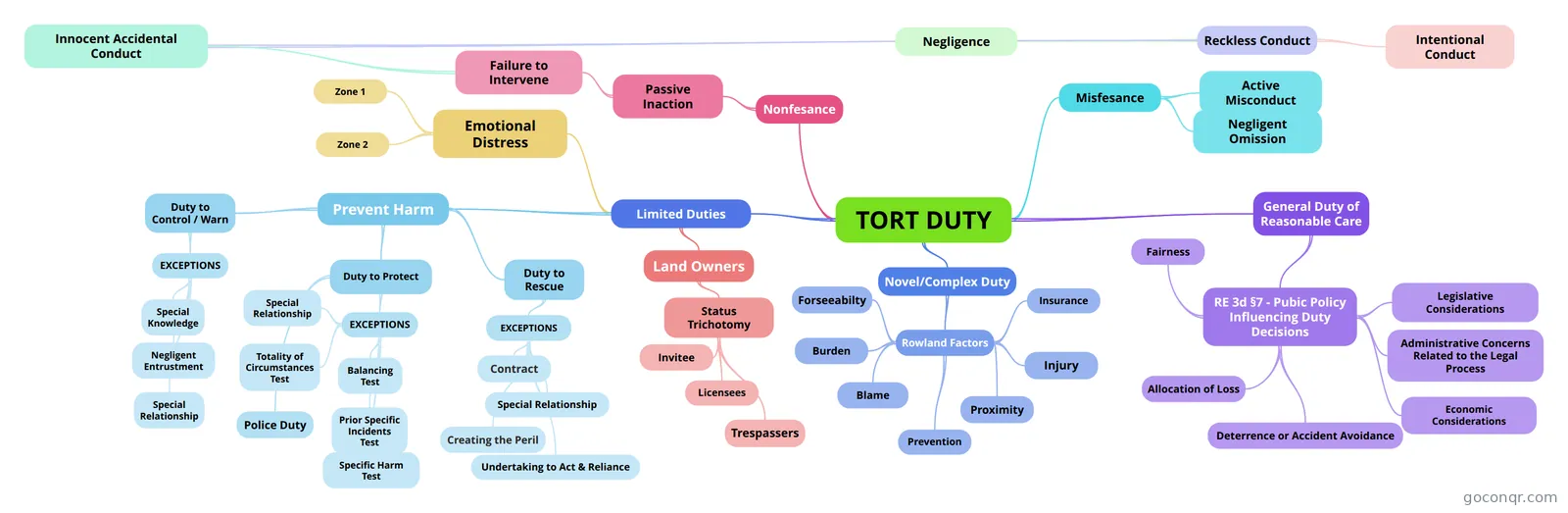
Mind map: Tort duty
Map content
TORT DUTY
- Duty is a legal obligation to act in a reasonable manner. The π should treat the ∆ with a duty to care.
General Duty of Reasonable Care
- “[A]n actor owes a duty of reasonable care under the circumstances to those persons who are foreseeably (at risk) exposed to physical risks arising from the actor’s conduct.”
- RE 3d §7 - Pubic Policy Influencing Duty Decisions
- Allocation of Loss
- Fairness
- Deterrence or Accident Avoidance
- Economic Considerations
- Administrative Concerns Related to the Legal Process
- Legislative Considerations
Limited Duties
- No affirmative duty to rescue; Limited duty: for land occupiers; to control the conduct of others; to avoid emotional harms; and to avoid economic damages.
- Prevent Harm
- Duty to Rescue
- Restatement 2d 314 “The fact that the actor realizes or should realize that action on his part is necessary for another’s aide or protection does not of itself impose upon him a duty to take such action.”
- EXCEPTIONS
- Special Relationship
- ◦ parent-child ◦ employer-employee) ◦ land possessor-user ◦ someone who takes someone else into custody ◦ chattel possessor-user ◦ doctor-patient
- Creating the Peril
- If the ∆ creates the peril. a duty to rescue π is created.
- Undertaking to Act & Reliance
- ∆ has an affirmative duty to rescue if the actor begins the rescue or promises to aid and that promise causes or prevents others from assisting.
- Contract
- A rescue obligation arises from a contract. (e.g. lifeguard, baby-sitter, teacher, fireman, police, etc.)
- Special Relationship
- Duty to Control / Warn
- Generally a person has no obligation to control another's personal actions in order to prevent harm to a 3d person.
- EXCEPTIONS
- Special Relationship
- ◦ parent-child ◦ employer-employee) ◦ land possessor-user ◦ someone who takes someone else into custody ◦ liquor seller-user ◦ doctor-patient
- Special Knowledge
- Knowledge (actual or constructive) of the need to control. (e.g. mental patient, prisoner, parolee, child/minor, employee).
- Negligent Entrustment
- MISFEASANCE Suppying a potentially dangerous instrumentality (e.g. money, car or gun) to a person the ∆ knows is not fit to handle it.
- Special Relationship
- Duty to Protect
- As a general principle, there is no duty to protect another from harm.
- EXCEPTIONS
- Special Relationship
- ◦ parent-child ◦ employer-employee) ◦ land possessor-user ◦ jailor-prisoner ◦ chattel possessor-user ◦ hospital-patient • common carrier - passenger
- Specific Harm Test
- A land owner owes no duty unless the owner knew or should have known that the specific harm was occurring or was about to occur.
- Prior Specific Incidents Test
- A land owner may owe a duty of responsible care if evidence of prior similar incidents of crime on or near the landowner's property shows that the crime in question was foreseeable.
- Totality of Circumstances Test
- A court considers all of the circumstances surrounding an event, including the nature, condition, and location of the land, as well as prior similar incidents, to determine whether a criminal act was foreseeable.
- Balancing Test
- The court balances “the degree of foreseeability of harm against the burden of the duty to be imposed.”
- Special Relationship
- Police Duty
- 1. A municipality may not be held liable for simple failure to provide police protection; 2. The protection is ordinarily one owed to the public at large and not any particular individual or class of individuals; and 3. The allocation of Police to protect its citizens is regarded as a resource-allocating function that is better related to the discretion of policy makers.
- Duty to Rescue
- Land Owners
- Status Trichotomy
- Invitee
- Licensees
- Trespassers
- Status Trichotomy
- Emotional Distress
- Zone 1
- Fear for One’s Own Physical Well-Being (Direct Action)
- Zone 2
- Fear for the Physical Well-Being of Another (Bystander)
- Zone 1
Novel/Complex Duty
- In the novel situation, i.e. when one overrules a limited duty limitation or creates a new duty, a judge will use the "Rowland Factors" to determine duty.
- Rowland Factors
- Forseeabilty
- Burden
- Proximity
- Blame
- Prevention
- Injury
- Insurance
Misfesance
- ACTIVE misconduct working to positive injury to others. The victim is positively worse off as a result of the wrongful act.
- Active Misconduct
- Negligent Omission
- A type of misfeasance where one fails to to do something that a reasonable person would do while engaging in another activity (Eg. Not paying attention while driving, texting or talking on a phone)
Nonfesance
- π’s harm is caused by the ∆’s failure to intervene.
- Passive Inaction
- Passive inaction - a failure to take positive steps to benefit others or to protect them from harm not created by any wrongful act by the ∆. <No Duty>
- Failure to Intervene
- The law requires no affirmative duty to intervene.
- Innocent Accidental Conduct
- Reckless Conduct
- ∆ acts with a deliberate disregard of the high degree probability that harm (e.g. emotional distress) will ensue.
- Negligence
- The ∆ was negligent. The π was harmed. That ∆’s negligence was a substantial factor in causing π’s harm.
- Intentional Conduct
- Reckless Conduct
Information
- Description
- Law School (1L) Torts Mind Map on TORT DUTY, created by Mark Jones on 24/08/2014.
- Created by
- Mark Jones
- Views
- 103
- Tags
- Rating