
Mind map
Research Methods
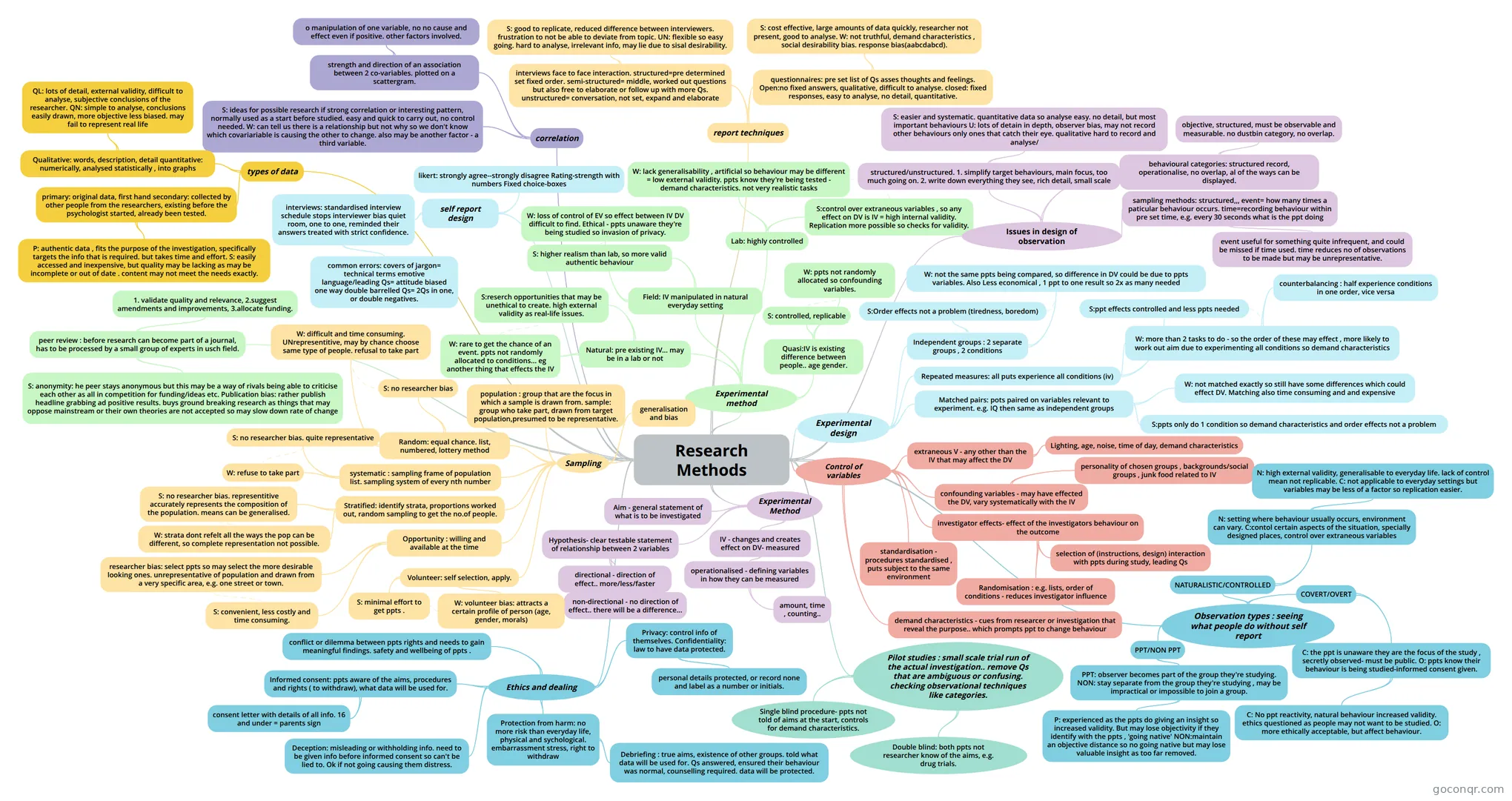
Mind map: Psychology research methods
Map content
Research Methods
Experimental Method
- Aim - general statement of what is to be investigated
- Hypothesis- clear testable statement of relationship between 2 variables
- directional - direction of effect.. more/less/faster
- non-directional - no direction of effect.. there will be a difference...
- IV - changes and creates effect on DV- measured
- operationalised - defining variables in how they can be measured
- amount, time , counting..
- operationalised - defining variables in how they can be measured
Control of variables
- extraneous V - any other than the IV that may affect the DV
- Lighting, age, noise, time of day, demand characteristics
- confounding variables - may have effected the DV, vary systematically with the IV
- personality of chosen groups , backgrounds/social groups , junk food related to IV
- demand characteristics - cues from researcer or investigation that reveal the purpose.. which prompts ppt to change behaviour
- investigator effects- effect of the investigators behaviour on the outcome
- selection of (instructions, design) interaction with ppts during study, leading Qs
- Randomisation : e.g. lists, order of conditions - reduces investigator influence
- standardisation - procedures standardised , puts subject to the same environment
- extraneous V - any other than the IV that may affect the DV
Experimental design
- Independent groups : 2 separate groups , 2 conditions
- S:Order effects not a problem (tiredness, boredom)
- W: not the same ppts being compared, so difference in DV could be due to ppts variables. Also Less economical , 1 ppt to one result so 2x as many needed
- Repeated measures: all puts experience all conditions (iv)
- S:ppt effects controlled and less ppts needed
- W: more than 2 tasks to do - so the order of these may effect , more likely to work out aim due to experimenting all conditions so demand characteristics
- counterbalancing : half experience conditions in one order, vice versa
- Matched pairs: pots paired on variables relevant to experiment. e.g. IQ then same as independent groups
- S:ppts only do 1 condition so demand characteristics and order effects not a problem
- W: not matched exactly so still have some differences which could effect DV. Matching also time consuming and and expensive
- Independent groups : 2 separate groups , 2 conditions
Experimental method
- Lab: highly controlled
- S:control over extraneous variables , so any effect on DV is IV = high internal validity. Replication more possible so checks for validity.
- W: lack generalisability , artificial so behaviour may be different = low external validity. ppts know they're being tested - demand characteristics. not very realistic tasks
- Field: IV manipulated in natural everyday setting
- S: higher realism than lab, so more valid authentic behaviour
- W: loss of control of EV so effect between IV DV difficult to find. Ethical - ppts unaware they're being studied so invasion of privacy.
- Natural: pre existing IV... may be in a lab or not
- S:reserch opportunities that may be unethical to create. high external validity as real-life issues.
- W: rare to get the chance of an event. ppts not randomly allocated to conditions... eg another thing that effects the IV
- Quasi:IV is existing difference between people.. age gender.
- S: controlled, replicable
- W: ppts not randomly allocated so confounding variables.
- Lab: highly controlled
Sampling
- population : group that are the focus in which a sample is drawn from. sample: group who take part, drawn from target population,presumed to be representative.
- generalisation and bias
- Random: equal chance. list, numbered, lottery method
- S: no researcher bias
- W: difficult and time consuming. UNrepresentitive, may by chance choose same type of people. refusal to take part
- systematic : sampling frame of population list. sampling system of every nth number
- S: no researcher bias. quite representative
- W: refuse to take part
- Stratified: identify strata, proportions worked out, random sampling to get the no.of people.
- S: no researcher bias. representitive accurately represents the composition of the population. means can be generalised.
- W: strata dont refelt all the ways the pop can be different, so complete representation not possible.
- Opportunity : willing and available at the time
- S: convenient, less costly and time consuming.
- researcher bias: select ppts so may select the more desirable looking ones. unrepresentative of population and drawn from a very specific area, e.g. one street or town.
- Volunteer: self selection, apply.
- S: minimal effort to get ppts .
- W: volunteer bias: attracts a certain profile of person (age, gender, morals)
Ethics and dealing
- conflict or dilemma between ppts rights and needs to gain meaningful findings. safety and wellbeing of ppts .
- Informed consent: ppts aware of the aims, procedures and rights ( to withdraw), what data will be used for.
- consent letter with details of all info. 16 and under = parents sign
- Deception: misleading or withholding info. need to be given info before informed consent so can't be lied to. Ok if not going causing them distress.
- Protection from harm: no more risk than everyday life, physical and sychological. embarrassment stress, right to withdraw
- Debriefing : true aims, existence of other groups. told what data will be used for. Qs answered, ensured their behaviour was normal, counselling required. data will be protected.
- Privacy: control info of themselves. Confidentiality: law to have data protected.
- personal details protected, or record none and label as a number or initials.
Pilot studies : small scale trial run of the actual investigation.. remove Qs that are ambiguous or confusing. checking observational techniques like categories.
- Single blind procedure- ppts not told of aims at the start, controls for demand characteristics.
- Double blind: both ppts not researcher know of the aims, e.g. drug trials.
Observation types : seeing what people do without self report
- COVERT/OVERT
- C: the ppt is unaware they are the focus of the study , secretly observed- must be public. O: ppts know their behaviour is being studied-informed consent given.
- C: No ppt reactivity, natural behaviour increased validity. ethics questioned as people may not want to be studied. O: more ethically acceptable, but affect behaviour.
- C: the ppt is unaware they are the focus of the study , secretly observed- must be public. O: ppts know their behaviour is being studied-informed consent given.
- NATURALISTIC/CONTROLLED
- N: setting where behaviour usually occurs, environment can vary. C:contol certain aspects of the situation, specially designed places, control over extraneous variables
- N: high external validity, generalisable to everyday life. lack of control mean not replicable. C: not applicable to everyday settings but variables may be less of a factor so replication easier.
- N: setting where behaviour usually occurs, environment can vary. C:contol certain aspects of the situation, specially designed places, control over extraneous variables
- PPT/NON PPT
- PPT: observer becomes part of the group they're studying. NON: stay separate from the group they're studying , may be impractical or impossible to join a group.
- P: experienced as the ppts do giving an insight so increased validity. But may lose objectivity if they identify with the ppts , 'going native' NON:maintain an objective distance so no going native but may lose valuable insight as too far removed.
- PPT: observer becomes part of the group they're studying. NON: stay separate from the group they're studying , may be impractical or impossible to join a group.
- COVERT/OVERT
Issues in design of observation
- structured/unstructured. 1. simplify target behaviours, main focus, too much going on. 2. write down everything they see, rich detail, small scale
- S: easier and systematic. quantitative data so analyse easy. no detail, but most important behaviours U: lots of detain in depth, observer bias, may not record other behaviours only ones that catch their eye. qualitative hard to record and analyse/
- behavioural categories: structured record, operationalise, no overlap, al of the ways can be displayed.
- objective, structured, must be observable and measurable. no dustbin category, no overlap.
- sampling methods: structured,,, event= how many times a paticular behaviour occurs. time=recording behaviour within pre set time, e.g. every 30 seconds what is the ppt doing
- event useful for something quite infrequent, and could be missed if time used. time reduces no of observations to be made but may be unrepresentative.
- structured/unstructured. 1. simplify target behaviours, main focus, too much going on. 2. write down everything they see, rich detail, small scale
report techniques
- questionnaires: pre set list of Qs asses thoughts and feelings. Open:no fixed answers, qualitative, difficult to analyse. closed: fixed responses, easy to analyse, no detail, quantitative.
- S: cost effective, large amounts of data quickly, researcher not present, good to analyse. W: not truthful, demand characteristics , social desirability bias. response bias(aabcdabcd).
- interviews face to face interaction. structured=pre determined set fixed order. semi-structured= middle, worked out questions but also free to elaborate or follow up with more Qs. unstructured= conversation, not set, expand and elaborate
- S: good to replicate, reduced difference between interviewers. frustration to not be able to deviate from topic. UN: flexible so easy going. hard to analyse, irrelevant info, may lie due to sisal desirability.
- questionnaires: pre set list of Qs asses thoughts and feelings. Open:no fixed answers, qualitative, difficult to analyse. closed: fixed responses, easy to analyse, no detail, quantitative.
self report design
- likert: strongly agree--strongly disagree Rating-strength with numbers Fixed choice-boxes
- interviews: standardised interview schedule stops interviewer bias quiet room, one to one, reminded their answers treated with strict confidence.
- common errors: covers of jargon= technical terms emotive language/leading Qs= attitude biased one way double barrelled Qs= 2Qs in one, or double negatives.
correlation
- strength and direction of an association between 2 co-variables. plotted on a scattergram.
- o manipulation of one variable, no no cause and effect even if positive. other factors involved.
- S: ideas for possible research if strong correlation or interesting pattern, normally used as a start before studied. easy and quick to carry out, no control needed. W: can tell us there is a relationship but not why so we don't know which covariariable is causing the other to change. also may be another factor - a third variable.
- strength and direction of an association between 2 co-variables. plotted on a scattergram.
types of data
- Qualitative: words, description, detail quantitative: numerically, analysed statistically , into graphs
- QL: lots of detail, external validity, difficult to analyse, subjective conclusions of the researcher. QN: simple to analyse, conclusions easily drawn, more objective less biased. may fail to represent real life
- primary: original data, first hand secondary: collected by other people from the researchers, existing before the psychologist started, already been tested.
- P: authentic data , fits the purpose of the investigation, specifically targets the info that is required. but takes time and effort. S: easily accessed and inexpensive, but quality may be lacking as may be incomplete or out of date . content may not meet the needs exactly.
- Qualitative: words, description, detail quantitative: numerically, analysed statistically , into graphs
peer review : before research can become part of a journal, has to be processed by a small group of experts in usch field.
- 1. validate quality and relevance, 2.suggest amendments and improvements, 3.allocate funding.
- S: anonymity: he peer stays anonymous but this may be a way of rivals being able to criticise each other as all in competition for funding/ideas etc. Publication bias: rather publish headline grabbing ad positive results. buys ground breaking research as things that may oppose mainstream or their own theories are not accepted so may slow down rate of change
Information
- Description
- A level Psychology Mind Map on Research Methods, created by jodie middleton on 08/01/2018.
- Created by
- jodie middleton
- Views
- 4
- Tags
- Rating