
Mind map
Variation
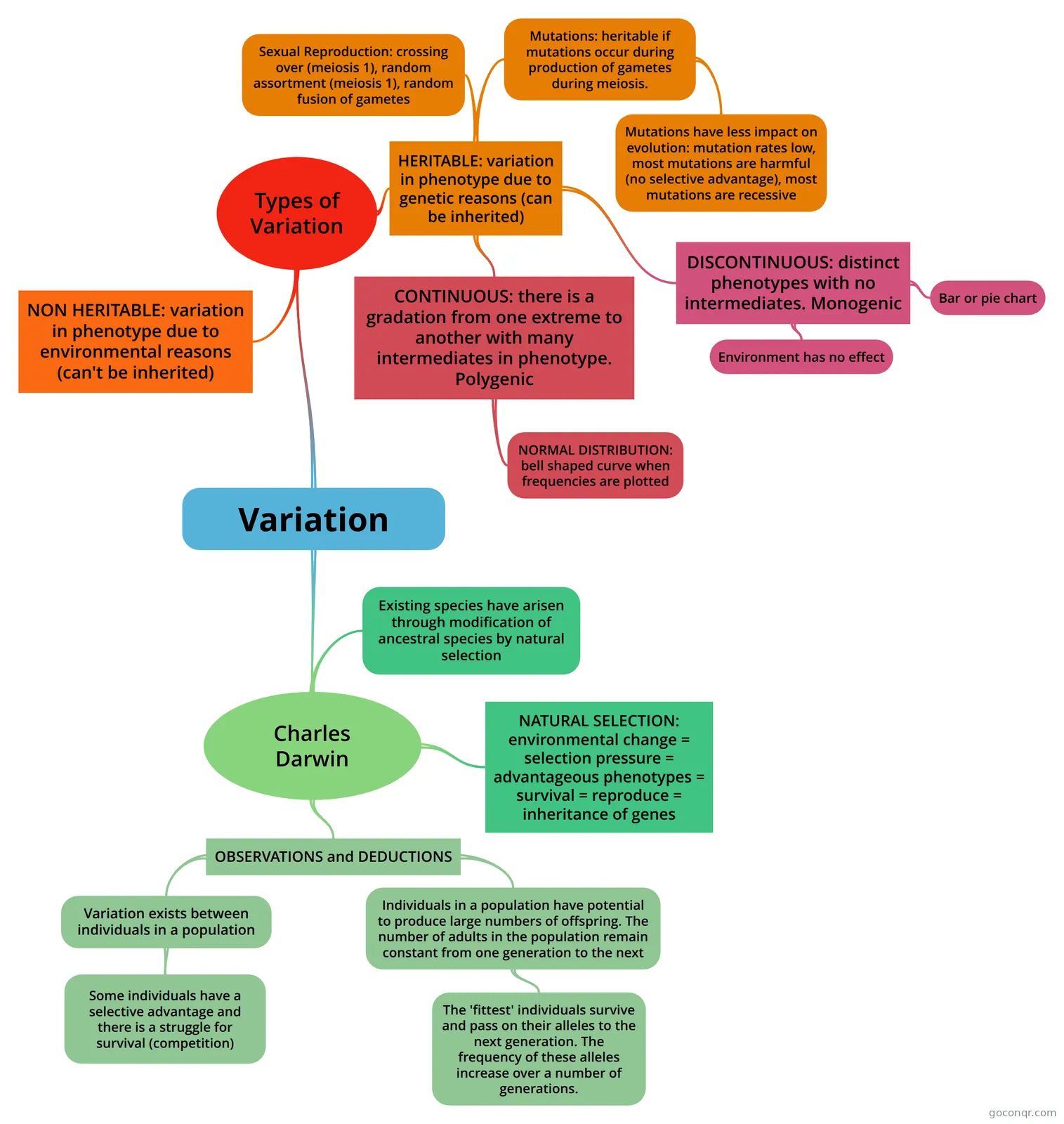
Mind map: Variation
Map content
Variation
Types of Variation
- HERITABLE: variation in phenotype due to genetic reasons (can be inherited)
- CONTINUOUS: there is a gradation from one extreme to another with many intermediates in phenotype. Polygenic
- NORMAL DISTRIBUTION: bell shaped curve when frequencies are plotted
- DISCONTINUOUS: distinct phenotypes with no intermediates. Monogenic
- Environment has no effect
- Bar or pie chart
- Sexual Reproduction: crossing over (meiosis 1), random assortment (meiosis 1), random fusion of gametes
- Mutations: heritable if mutations occur during production of gametes during meiosis.
- Mutations have less impact on evolution: mutation rates low, most mutations are harmful (no selective advantage), most mutations are recessive
- CONTINUOUS: there is a gradation from one extreme to another with many intermediates in phenotype. Polygenic
- NON HERITABLE: variation in phenotype due to environmental reasons (can't be inherited)
- HERITABLE: variation in phenotype due to genetic reasons (can be inherited)
Charles Darwin
- Existing species have arisen through modification of ancestral species by natural selection
- NATURAL SELECTION: environmental change = selection pressure = advantageous phenotypes = survival = reproduce = inheritance of genes
- OBSERVATIONS and DEDUCTIONS
- Variation exists between individuals in a population
- Some individuals have a selective advantage and there is a struggle for survival (competition)
- Individuals in a population have potential to produce large numbers of offspring. The number of adults in the population remain constant from one generation to the next
- The 'fittest' individuals survive and pass on their alleles to the next generation. The frequency of these alleles increase over a number of generations.
- Variation exists between individuals in a population
Information
- Description
- A level Biology Mind Map on Variation, created by Megan Thurm on 05/01/2019.
- Created by
- Megan Thurm
- Views
- 0
- Rating