
Mind map
falsification debate
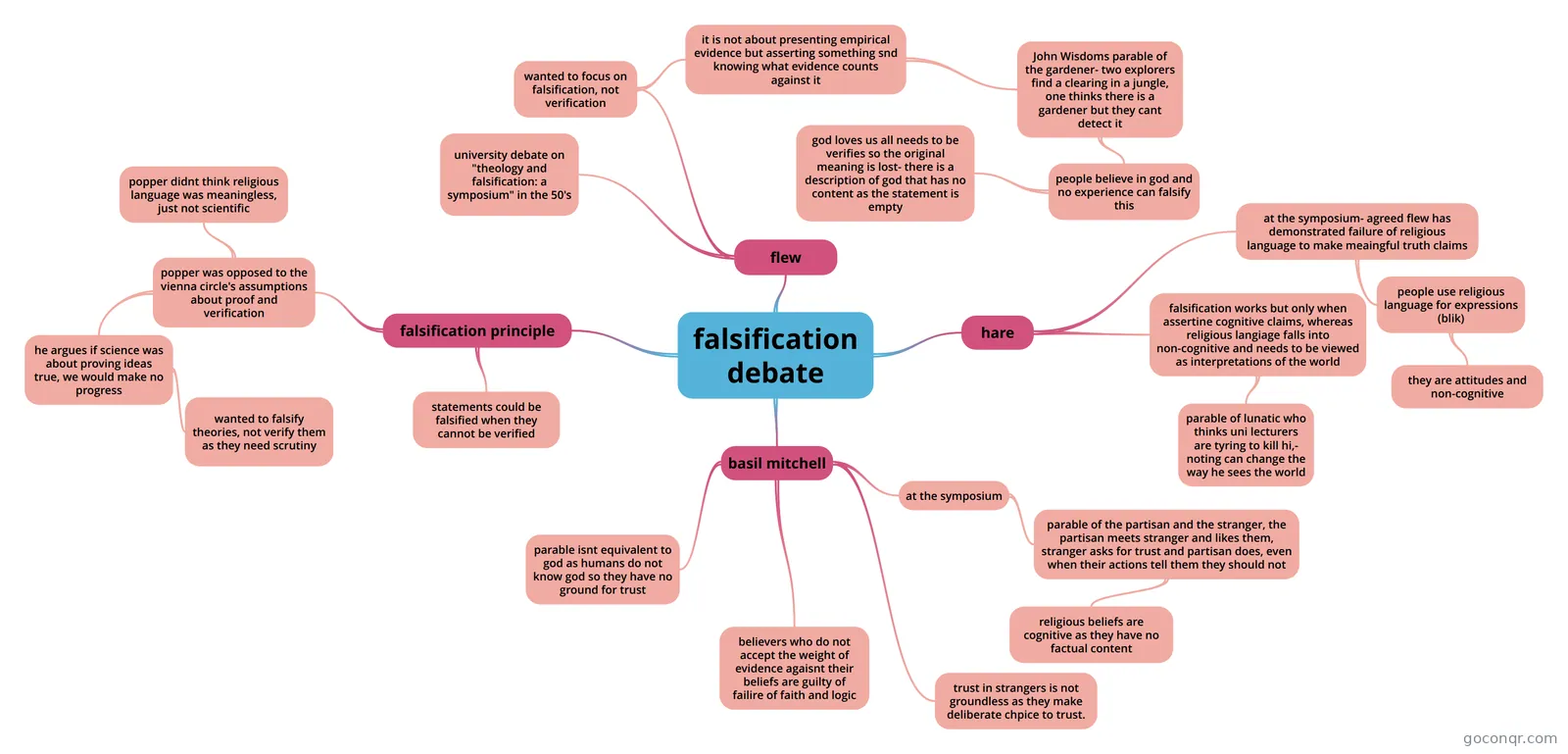
Mind map: falsification debate
Map content
falsification debate
falsification principle
- popper was opposed to the vienna circle's assumptions about proof and verification
- he argues if science was about proving ideas true, we would make no progress
- wanted to falsify theories, not verify them as they need scrutiny
- popper didnt think religious language was meaningless, just not scientific
- he argues if science was about proving ideas true, we would make no progress
- statements could be falsified when they cannot be verified
- popper was opposed to the vienna circle's assumptions about proof and verification
flew
- university debate on "theology and falsification: a symposium" in the 50's
- wanted to focus on falsification, not verification
- it is not about presenting empirical evidence but asserting something snd knowing what evidence counts against it
- John Wisdoms parable of the gardener- two explorers find a clearing in a jungle, one thinks there is a gardener but they cant detect it
- people believe in god and no experience can falsify this
- god loves us all needs to be verifies so the original meaning is lost- there is a description of god that has no content as the statement is empty
- people believe in god and no experience can falsify this
- John Wisdoms parable of the gardener- two explorers find a clearing in a jungle, one thinks there is a gardener but they cant detect it
- it is not about presenting empirical evidence but asserting something snd knowing what evidence counts against it
hare
- at the symposium- agreed flew has demonstrated failure of religious language to make meaingful truth claims
- people use religious language for expressions (blik)
- they are attitudes and non-cognitive
- people use religious language for expressions (blik)
- falsification works but only when assertine cognitive claims, whereas religious langiage falls into non-cognitive and needs to be viewed as interpretations of the world
- parable of lunatic who thinks uni lecturers are tyring to kill hi,- noting can change the way he sees the world
- at the symposium- agreed flew has demonstrated failure of religious language to make meaingful truth claims
basil mitchell
- at the symposium
- parable of the partisan and the stranger, the partisan meets stranger and likes them, stranger asks for trust and partisan does, even when their actions tell them they should not
- religious beliefs are cognitive as they have no factual content
- parable of the partisan and the stranger, the partisan meets stranger and likes them, stranger asks for trust and partisan does, even when their actions tell them they should not
- parable isnt equivalent to god as humans do not know god so they have no ground for trust
- trust in strangers is not groundless as they make deliberate chpice to trust.
- believers who do not accept the weight of evidence agaisnt their beliefs are guilty of failire of faith and logic
- at the symposium
Information
- Description
- PRS Mind Map on falsification debate, created by Holly Rose on 03/06/2019.
- Created by
- Holly Rose
- Views
- 0
- Rating
More on Verification and Falsification