
Mind map
Seperation Techniques advanced higher biology
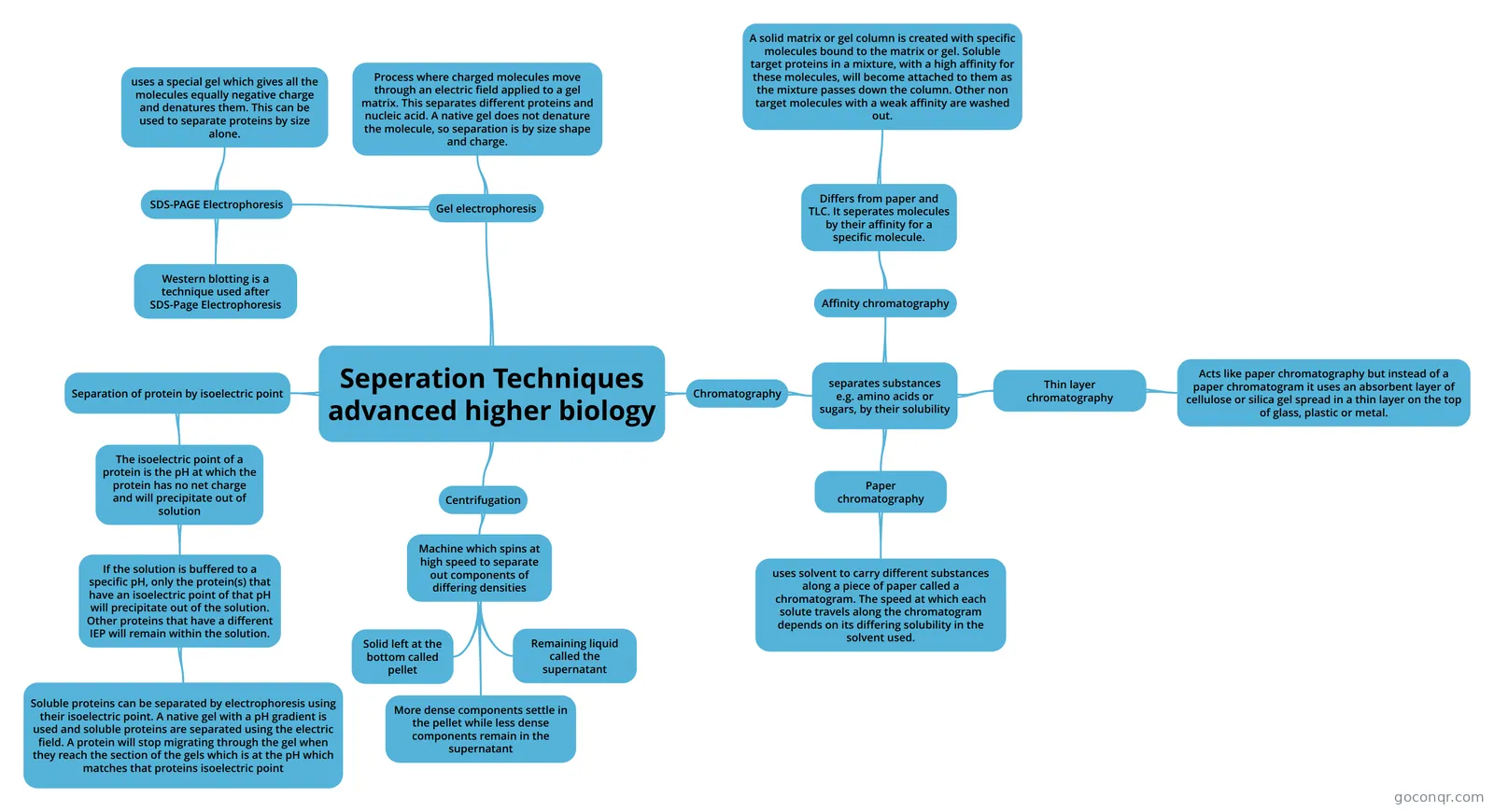
Mind map: Separation techniques advanced higher biology
Map content
Seperation Techniques advanced higher biology
Centrifugation
- Machine which spins at high speed to separate out components of differing densities
- Solid left at the bottom called pellet
- Remaining liquid called the supernatant
- More dense components settle in the pellet while less dense components remain in the supernatant
- Machine which spins at high speed to separate out components of differing densities
Chromatography
- separates substances e.g. amino acids or sugars, by their solubility
- Paper chromatography
- uses solvent to carry different substances along a piece of paper called a chromatogram. The speed at which each solute travels along the chromatogram depends on its differing solubility in the solvent used.
- Thin layer chromatography
- Acts like paper chromatography but instead of a paper chromatogram it uses an absorbent layer of cellulose or silica gel spread in a thin layer on the top of glass, plastic or metal.
- Affinity chromatography
- Differs from paper and TLC. It seperates molecules by their affinity for a specific molecule.
- A solid matrix or gel column is created with specific molecules bound to the matrix or gel. Soluble target proteins in a mixture, with a high affinity for these molecules, will become attached to them as the mixture passes down the column. Other non target molecules with a weak affinity are washed out.
- Differs from paper and TLC. It seperates molecules by their affinity for a specific molecule.
- Paper chromatography
- separates substances e.g. amino acids or sugars, by their solubility
Gel electrophoresis
- Process where charged molecules move through an electric field applied to a gel matrix. This separates different proteins and nucleic acid. A native gel does not denature the molecule, so separation is by size shape and charge.
- SDS-PAGE Electrophoresis
- uses a special gel which gives all the molecules equally negative charge and denatures them. This can be used to separate proteins by size alone.
- Western blotting is a technique used after SDS-Page Electrophoresis
Separation of protein by isoelectric point
- The isoelectric point of a protein is the pH at which the protein has no net charge and will precipitate out of solution
- If the solution is buffered to a specific pH, only the protein(s) that have an isoelectric point of that pH will precipitate out of the solution. Other proteins that have a different IEP will remain within the solution.
- Soluble proteins can be separated by electrophoresis using their isoelectric point. A native gel with a pH gradient is used and soluble proteins are separated using the electric field. A protein will stop migrating through the gel when they reach the section of the gels which is at the pH which matches that proteins isoelectric point
- If the solution is buffered to a specific pH, only the protein(s) that have an isoelectric point of that pH will precipitate out of the solution. Other proteins that have a different IEP will remain within the solution.
- The isoelectric point of a protein is the pH at which the protein has no net charge and will precipitate out of solution
Information
- Description
- National 5 Biology Mind Map on Seperation Techniques advanced higher biology, created by Sophie McGeough on 06/10/2019.
- Created by
- Sophie McGeough
- Views
- 9
- Rating