
Mind map
Penelope
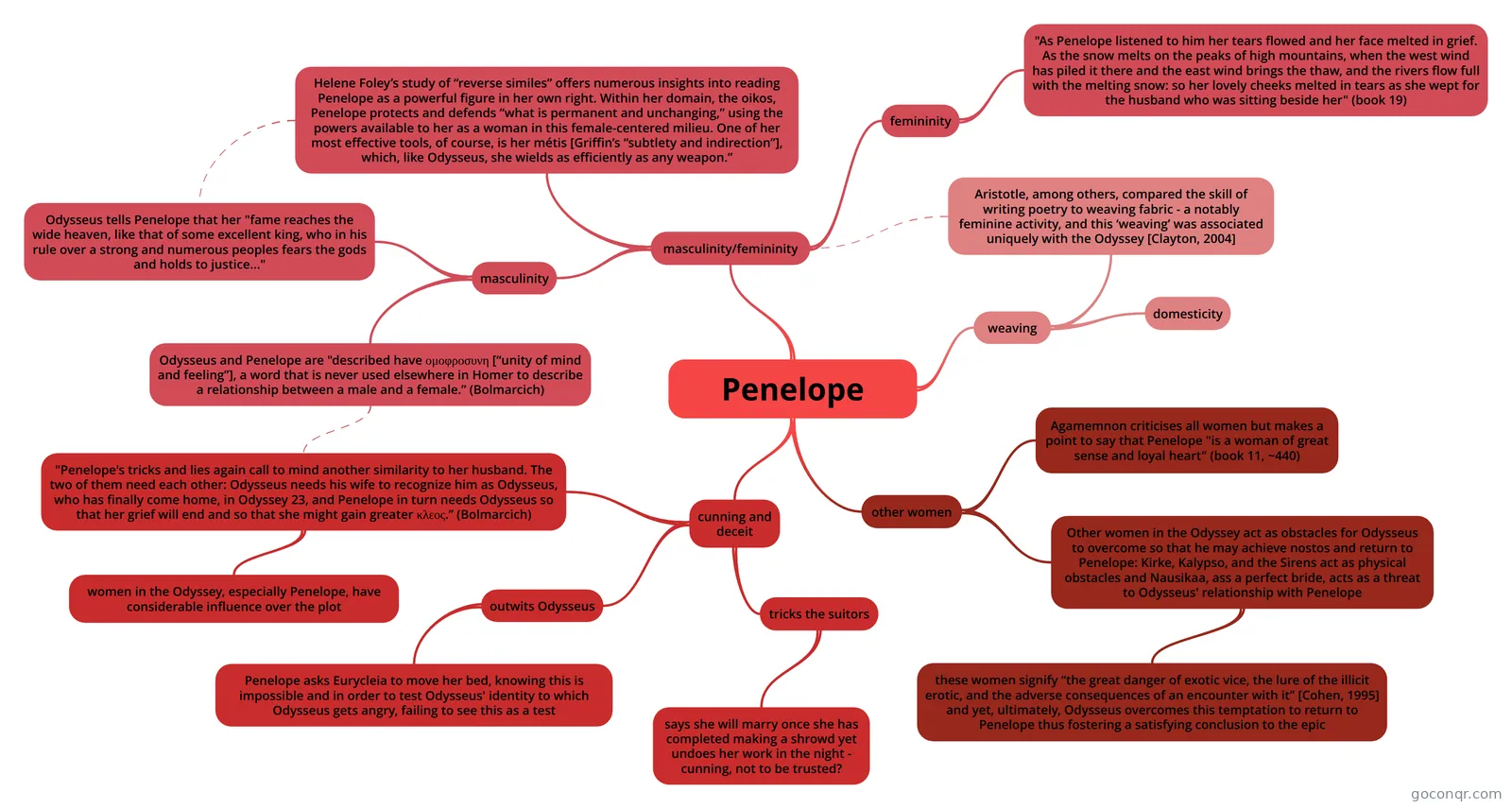
Mind map: Penelope in the Odyssey
Map content
Penelope
masculinity/femininity
- Helene Foley’s study of “reverse similes” offers numerous insights into reading Penelope as a powerful figure in her own right. Within her domain, the oikos, Penelope protects and defends “what is permanent and unchanging,” using the powers available to her as a woman in this female-centered milieu. One of her most effective tools, of course, is her métis [Griffin’s “subtlety and indirection”], which, like Odysseus, she wields as efficiently as any weapon.”
- masculinity
- Odysseus tells Penelope that her "fame reaches the wide heaven, like that of some excellent king, who in his rule over a strong and numerous peoples fears the gods and holds to justice..."
- Odysseus and Penelope are "described have ομοφροσυνη [“unity of mind and feeling”], a word that is never used elsewhere in Homer to describe a relationship between a male and a female.” (Bolmarcich)
- femininity
- "As Penelope listened to him her tears flowed and her face melted in grief. As the snow melts on the peaks of high mountains, when the west wind has piled it there and the east wind brings the thaw, and the rivers flow full with the melting snow: so her lovely cheeks melted in tears as she wept for the husband who was sitting beside her" (book 19)
cunning and deceit
- "Penelope's tricks and lies again call to mind another similarity to her husband. The two of them need each other: Odysseus needs his wife to recognize him as Odysseus, who has finally come home, in Odyssey 23, and Penelope in turn needs Odysseus so that her grief will end and so that she might gain greater κλεος.” (Bolmarcich)
- women in the Odyssey, especially Penelope, have considerable influence over the plot
- outwits Odysseus
- Penelope asks Eurycleia to move her bed, knowing this is impossible and in order to test Odysseus' identity to which Odysseus gets angry, failing to see this as a test
- tricks the suitors
- says she will marry once she has completed making a shrowd yet undoes her work in the night - cunning, not to be trusted?
- "Penelope's tricks and lies again call to mind another similarity to her husband. The two of them need each other: Odysseus needs his wife to recognize him as Odysseus, who has finally come home, in Odyssey 23, and Penelope in turn needs Odysseus so that her grief will end and so that she might gain greater κλεος.” (Bolmarcich)
other women
- Agamemnon criticises all women but makes a point to say that Penelope "is a woman of great sense and loyal heart" (book 11, ~440)
- Other women in the Odyssey act as obstacles for Odysseus to overcome so that he may achieve nostos and return to Penelope: Kirke, Kalypso, and the Sirens act as physical obstacles and Nausikaa, ass a perfect bride, acts as a threat to Odysseus' relationship with Penelope
- these women signify “the great danger of exotic vice, the lure of the illicit erotic, and the adverse consequences of an encounter with it” [Cohen, 1995] and yet, ultimately, Odysseus overcomes this temptation to return to Penelope thus fostering a satisfying conclusion to the epic
weaving
- Aristotle, among others, compared the skill of writing poetry to weaving fabric - a notably feminine activity, and this ‘weaving’ was associated uniquely with the Odyssey [Clayton, 2004]
- domesticity
Information
- Description
- The Odyssey Mind Map on Penelope, created by Michael Smith on 03/01/2020.
- Created by
- Michael Smith
- Views
- 27
- Rating
More on Characters in the Odyssey