
Mind map
The working memory model
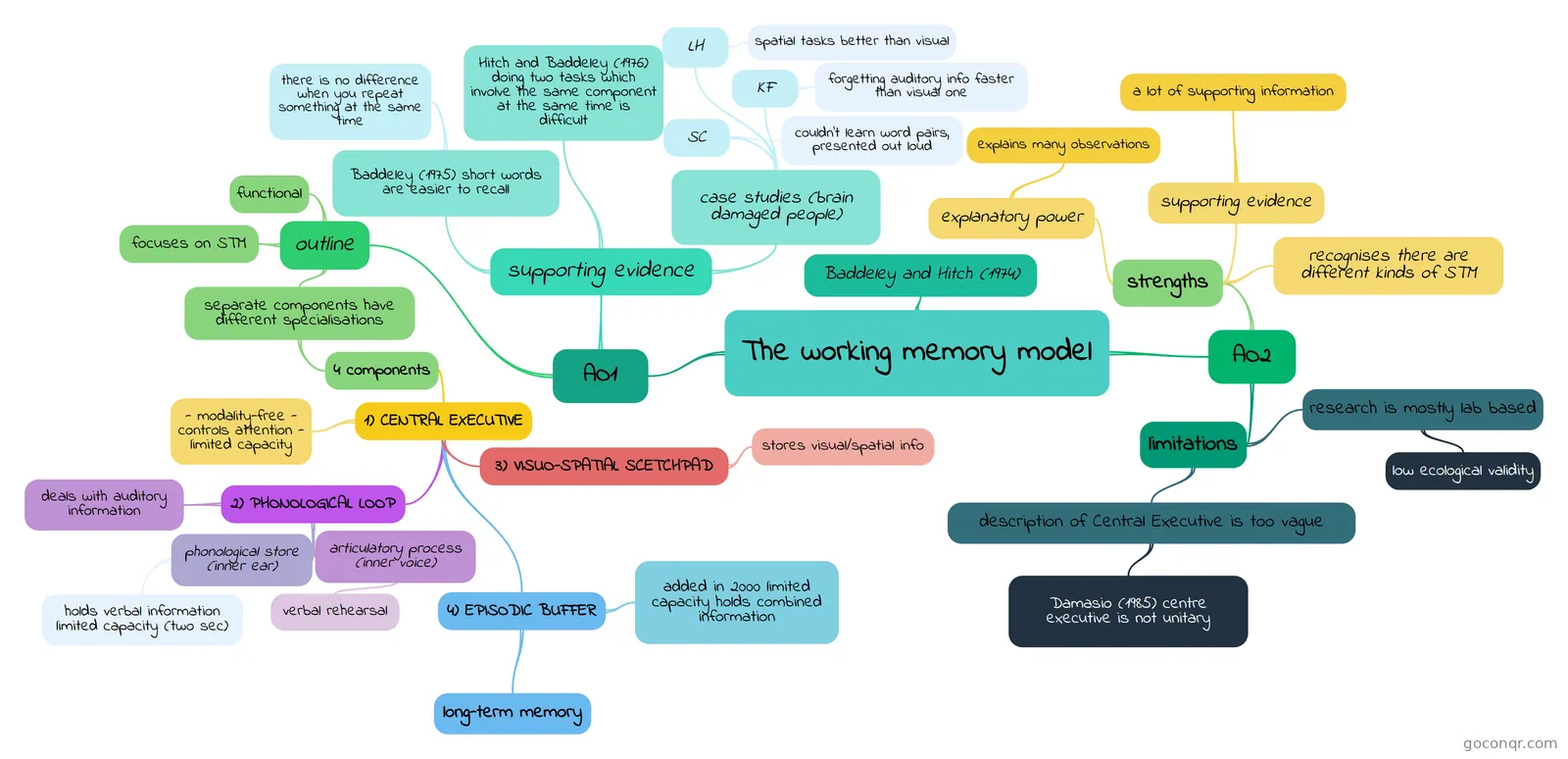
Mind map: The working memory model
Map content
The working memory model
AO1
- outline
- functional
- focuses on STM
- separate components have different specialisations
- 4 components
- 1) CENTRAL EXECUTIVE
- 3) VISUO-SPATIAL SCETCHPAD
- stores visual/spatial info
- 4) EPISODIC BUFFER
- long-term memory
- added in 2000 limited capacity holds combined information
- 2) PHONOLOGICAL LOOP
- phonological store (inner ear)
- holds verbal information limited capacity (two sec)
- articulatory process (inner voice)
- verbal rehearsal
- deals with auditory information
- phonological store (inner ear)
- - modality-free - controls attention - limited capacity
- 3) VISUO-SPATIAL SCETCHPAD
- 1) CENTRAL EXECUTIVE
- 4 components
- supporting evidence
- Baddeley (1975) short words are easier to recall
- there is no difference when you repeat something at the same time
- Hitch and Baddeley (1976) doing two tasks which involve the same component at the same time is difficult
- case studies (brain damaged people)
- KF
- forgetting auditory info faster than visual one
- SC
- couldn't learn word pairs, presented out loud
- LH
- spatial tasks better than visual
- KF
- Baddeley (1975) short words are easier to recall
- outline
AO2
- strengths
- explanatory power
- explains many observations
- supporting evidence
- a lot of supporting information
- recognises there are different kinds of STM
- explanatory power
- limitations
- description of Central Executive is too vague
- Damasio (1985) centre executive is not unitary
- research is mostly lab based
- low ecological validity
- description of Central Executive is too vague
- strengths
Baddeley and Hitch (1974)
Information
- Description
- I tried to make it as simple and small as possible for you to enjoy.
- Created by
- Lada Zhdanova
- Views
- 610
- Tags
- Rating