
Mind map
Identity
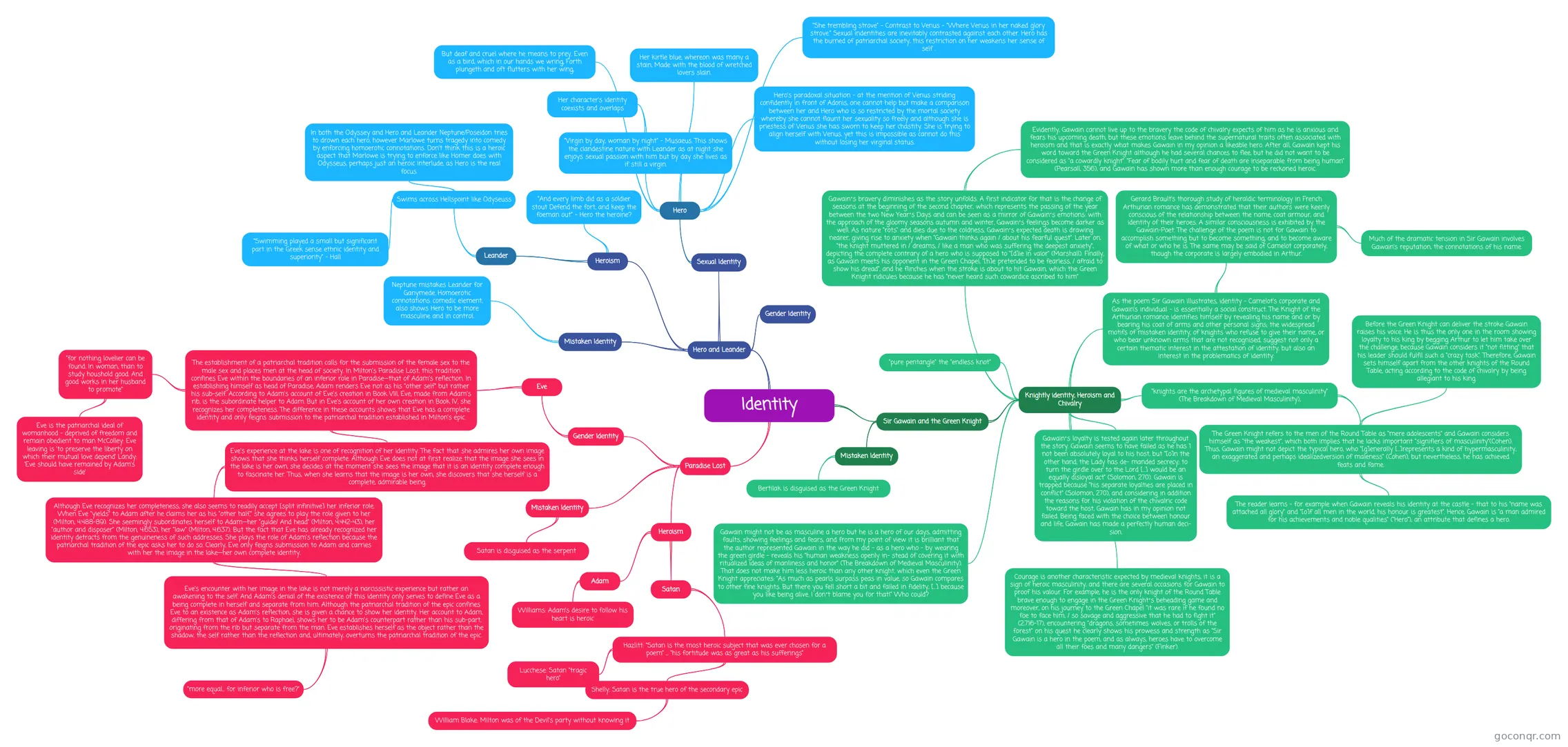
Mind map: Identity in literature
Map content
Identity
Hero and Leander
- Gender Identity
- Mistaken Identity
- Neptune mistakes Leander for Ganymede. Homoerotic connotations. comedic element, also shows Hero to be more masculine and in control.
- Sexual Identity
- Hero
- "Virgin by day, woman by night" - Musaeus. This shows the clandestine nature with Leander as at night she enjoys sexual passion with him but by day she lives as if still a virgin.
- Her character's identity coexists and overlaps
- Hero's paradoxal situation - at the mention of Venus striding confidently in front of Adonis, one cannot help but make a comparison between her and Hero who is so restricted by the mortal society whereby she cannot flaunt her sexuality so freely and although she is priestess of Venus she has sworn to keep her chastity. She is trying to align herself with Venus, yet this is impossible as cannot do this without losing her virginal status.
- Her kirtle blue, whereon was many a stain, Made with the blood of wretched lovers slain.
- But deaf and cruel where he means to prey. Even as a bird, which in our hands we wring, Forth plungeth and oft flutters with her wing,
- "She trembling strove" - Contrast to Venus - "Where Venus in her naked glory strove." Sexual indentities are inevitably contrasted against each other. Hero has the burned of patriarchal society, this restriction on her weakens her sense of self .
- "Virgin by day, woman by night" - Musaeus. This shows the clandestine nature with Leander as at night she enjoys sexual passion with him but by day she lives as if still a virgin.
- Hero
- Heroism
- Leander
- Swims across Hellspoint like Odyseuss
- "Swimming played a small but significant part in the Greek sense ethnic identity and superiority" - Hall
- In both the Odyssey and Hero and Leander Neptune/Poseidon tries to drown each hero, however Marlowe turns tragedy into comedy by enforcing homoerotic connotations. Don't think this is a heroic aspect that Marlowe is trying to enforce like Homer does with Odysseus, perhaps just an heroic interlude, as Hero is the real focus.
- Swims across Hellspoint like Odyseuss
- "And every limb did as a soldier stout Defend the fort, and keep the foeman out" - Hero the heroine?
- Leander
Sir Gawain and the Green Knight
- Knightly identity, Heroism and Chivalry
- As the poem Sir Gawain illustrates, identity – Camelot’s corporate and Gawain’s individual – is essentially a social construct. The Knight of the Arthurian romance identifies himself by revealing his name and or by bearing his coat of arms and other personal signs; the widespread motifs of mistaken identity, of knights who refuse to give their name, or who bear unknown arms that are not recognised, suggest not only a certain thematic interest in the attestation of identity, but also an interest in the problematics of identity.
- Gerard Brault’s thorough study of heraldic terminology in French Arthurian romance has demonstrated that their authors were keenly conscious of the relationship between the name, coat armour, and identity of their heroes. A similar consciousness is exhibited by the Gawain-Poet. The challenge of the poem is not for Gawain to accomplish something but to become something, and to become aware of what or who he is. The same may be said of Camelot corporately, though the corporate is largely embodied in Arthur.
- Much of the dramatic tension in Sir Gawain involves Gawain’s reputation, the connotations of his name.
- Gerard Brault’s thorough study of heraldic terminology in French Arthurian romance has demonstrated that their authors were keenly conscious of the relationship between the name, coat armour, and identity of their heroes. A similar consciousness is exhibited by the Gawain-Poet. The challenge of the poem is not for Gawain to accomplish something but to become something, and to become aware of what or who he is. The same may be said of Camelot corporately, though the corporate is largely embodied in Arthur.
- “knights are the archetypal figures of medieval masculinity“ (The Breakdown of Medieval Masculinity),
- The Green Knight refers to the men of the Round Table as “mere adolescents“ and Gawain considers himself as “the weakest“, which both implies that he lacks important “signifiers of masculinity“(Cohen). Thus, Gawain might not depict the typical hero, who “[g]enerally [...]represents a kind of hypermasculinity, an exaggerated and perhaps idealizedversion of maleness“ (Cohen), but nevertheless, he has achieved feats and fame.
- The reader learns - for example when Gawain reveals his identity at the castle - that to his “name was attached all glory“ and “[o]f all men in the world, his honour is greatest“. Hence, Gawain is “a man admired for his achievements and noble qualities“ (“Hero“), an attribute that defines a hero.
- Before the Green Knight can deliver the stroke Gawain raises his voice. He is thus the only one in the room showing loyalty to his king by begging Arthur to let him take over the challenge, because Gawain considers it “not fitting“ that his leader should fulfil such a “crazy task“. Therefore, Gawain sets himself apart from the other knights of the Round Table, acting according to the code of chivalry by being allegiant to his king.
- The Green Knight refers to the men of the Round Table as “mere adolescents“ and Gawain considers himself as “the weakest“, which both implies that he lacks important “signifiers of masculinity“(Cohen). Thus, Gawain might not depict the typical hero, who “[g]enerally [...]represents a kind of hypermasculinity, an exaggerated and perhaps idealizedversion of maleness“ (Cohen), but nevertheless, he has achieved feats and fame.
- Gawainʻs loyalty is tested again later throughout the story. Gawain seems to have failed as he has 1 not been absolutely loyal to his host, but “[o]n the other hand, the Lady has de- manded secrecy; to turn the girdle over to the Lord [...] would be an equally disloyal act“ (Solomon, 270). Gawain is trapped because “his separate loyalties are placed in conflict“ (Solomon, 270), and considering in addition the reasons for his violation of the chivalric code toward the host, Gawain has in my opinion not failed. Being faced with the choice between honour and life, Gawain has made a perfectly human deci- sion.
- Courage is another characteristic expected by medieval knights, it is a sign of heroic masculinity, and there are several occasions for Gawain to proof his valour. For example, he is the only knight of the Round Table brave enough to engage in the Green Knightʻs beheading game and moreover, on his journey to the Green Chapel “it was rare if he found no foe to face him, / so savage and aggressive that he had to fight it“ (2.716-17), encountering "dragons, sometimes wolves, or trolls of the forest" on his quest he clearly shows his prowess and strength as “Sir Gawain is a hero in the poem, and as always, heroes have to overcome all their foes and many dangers“ (Finker).
- "pure pentangle" the "endless knot"
- Gawainʻs bravery diminishes as the story unfolds. A first indicator for that is the change of seasons at the beginning of the second chapter, which represents the passing of the year between the two New Yearʻs Days and can be seen as a mirror of Gawainʻs emotions: with the approach of the gloomy seasons autumn and winter, Gawainʻs feelings become darker as well. As nature “rots“ and dies due to the coldness, Gawainʻs expected death is drawing nearer, giving rise to anxiety when “Gawain thinks again / about his fearful quest“. Later on, “the knight muttered in / dreams, / like a man who was suffering the deepest anxiety“, depicting the complete contrary of a hero who is supposed to “[d]ie in valor“ (Marshall). Finally, as Gawain meets his opponent in the Green Chapel, “[h]e pretended to be fearless, / afraid to show his dread“, and he flinches when the stroke is about to hit Gawain, which the Green Knight ridicules because he has “never heard such cowardice ascribed to him"
- Evidently, Gawain cannot live up to the bravery the code of chivalry expects of him as he is anxious and fears his upcoming death, but these emotions leave behind the supernatural traits often associated with heroism and that is exactly what makes Gawain in my opinion a likeable hero. After all, Gawain kept his word toward the Green Knight although he had several chances to flee, but he did not want to be considered as “a cowardly knight“. “Fear of bodily hurt and fear of death are inseparable from being human“ (Pearsall, 356), and Gawain has shown more than enough courage to be reckoned heroic.
- Gawain might not be as masculine a hero but he is a hero of our days, admitting faults, showing feelings and fears, and from my point of view it is brilliant that the author represented Gawain in the way he did - as a hero who - by wearing the green girdle - reveals his “human weakness openly in- stead of covering it with ritualized ideas of manliness and honor“ (The Breakdown of Medieval Masculinity). That does not make him less heroic than any other knight, which even the Green Knight appreciates: “As much as pearls surpass peas in value, so Gawain compares to other fine knights. But there you fell short a bit and failed in fidelity, [...] because you like being alive. I donʻt blame you for that!“ Who could?
- As the poem Sir Gawain illustrates, identity – Camelot’s corporate and Gawain’s individual – is essentially a social construct. The Knight of the Arthurian romance identifies himself by revealing his name and or by bearing his coat of arms and other personal signs; the widespread motifs of mistaken identity, of knights who refuse to give their name, or who bear unknown arms that are not recognised, suggest not only a certain thematic interest in the attestation of identity, but also an interest in the problematics of identity.
- Mistaken Identity
- Bertilak is disguised as the Green Knight
- Knightly identity, Heroism and Chivalry
Paradise Lost
- Mistaken Identity
- Satan is disguised as the serpent
- Gender Identity
- Eve
- The establishment of a patriarchal tradition calls for the submission of the female sex to the male sex and places men at the head of society. In Milton's Paradise Lost, this tradition confines Eve within the boundaries of an inferior role in Paradise—that of Adam's reflection. In establishing himself as head of Paradise, Adam renders Eve not as his "other self" but rather his sub-self. According to Adam's account of Eve's creation in Book VIII, Eve, made from Adam's rib, is the subordinate helper to Adam. But in Eve's account of her own creation in Book IV, she recognizes her completeness. The difference in these accounts shows that Eve has a complete identity and only feigns submission to the patriarchal tradition established in Milton's epic.
- Eve's experience at the lake is one of recognition of her identity. The fact that she admires her own image shows that she thinks herself complete. Although Eve does not at first realize that the image she sees in the lake is her own, she decides at the moment she sees the image that it is an identity complete enough to fascinate her. Thus, when she learns that the image is her own, she discovers that she herself is a complete, admirable being.
- Although Eve recognizes her completeness, she also seems to readily accept [split infinitive] her inferior role. When Eve "yields" to Adam after he claims her as his "other half," she agrees to play the role given to her (Milton, 4.488-89). She seemingly subordinates herself to Adam—her "guide/ And head" (Milton, 4.442-43), her "author and disposer" (Milton, 4.653), her "law" (Milton, 4.637). But the fact that Eve has already recognized her identity detracts from the genuineness of such addresses. She plays the role of Adam's reflection because the patriarchal tradition of the epic asks her to do so. Clearly, Eve only feigns submission to Adam and carries with her the image in the lake—her own complete identity.
- Eve's encounter with her image in the lake is not merely a narcissistic experience but rather an awakening to the self. And Adam's denial of the existence of this identity only serves to define Eve as a being complete in herself and separate from him. Although the patriarchal tradition of the epic confines Eve to an existence as Adam's reflection, she is given a chance to show her identity. Her account to Adam, differing from that of Adam's to Raphael, shows her to be Adam's counterpart rather than his sub-part, originating from the rib but separate from the man. Eve establishes herself as the object rather than the shadow, the self rather than the reflection and, ultimately, overturns the patriarchal tradition of the epic.
- "more equal... for inferior who is free?"
- Eve's encounter with her image in the lake is not merely a narcissistic experience but rather an awakening to the self. And Adam's denial of the existence of this identity only serves to define Eve as a being complete in herself and separate from him. Although the patriarchal tradition of the epic confines Eve to an existence as Adam's reflection, she is given a chance to show her identity. Her account to Adam, differing from that of Adam's to Raphael, shows her to be Adam's counterpart rather than his sub-part, originating from the rib but separate from the man. Eve establishes herself as the object rather than the shadow, the self rather than the reflection and, ultimately, overturns the patriarchal tradition of the epic.
- Although Eve recognizes her completeness, she also seems to readily accept [split infinitive] her inferior role. When Eve "yields" to Adam after he claims her as his "other half," she agrees to play the role given to her (Milton, 4.488-89). She seemingly subordinates herself to Adam—her "guide/ And head" (Milton, 4.442-43), her "author and disposer" (Milton, 4.653), her "law" (Milton, 4.637). But the fact that Eve has already recognized her identity detracts from the genuineness of such addresses. She plays the role of Adam's reflection because the patriarchal tradition of the epic asks her to do so. Clearly, Eve only feigns submission to Adam and carries with her the image in the lake—her own complete identity.
- "for nothing lovelier can be found. In woman, than to study houshold good. And good works in her husband to promote"
- Eve is the patriarchal ideal of womanhood - deprived of freedom and remain obedient to man McColley: Eve leaving is ‘to preserve the liberty on which their mutual love depend’ Landy: ‘Eve should have remained by Adam’s side’
- Eve's experience at the lake is one of recognition of her identity. The fact that she admires her own image shows that she thinks herself complete. Although Eve does not at first realize that the image she sees in the lake is her own, she decides at the moment she sees the image that it is an identity complete enough to fascinate her. Thus, when she learns that the image is her own, she discovers that she herself is a complete, admirable being.
- The establishment of a patriarchal tradition calls for the submission of the female sex to the male sex and places men at the head of society. In Milton's Paradise Lost, this tradition confines Eve within the boundaries of an inferior role in Paradise—that of Adam's reflection. In establishing himself as head of Paradise, Adam renders Eve not as his "other self" but rather his sub-self. According to Adam's account of Eve's creation in Book VIII, Eve, made from Adam's rib, is the subordinate helper to Adam. But in Eve's account of her own creation in Book IV, she recognizes her completeness. The difference in these accounts shows that Eve has a complete identity and only feigns submission to the patriarchal tradition established in Milton's epic.
- Eve
- Heroism
- Adam
- Williams: Adam’s desire to follow his heart is heroic
- Satan
- Hazlitt: “Satan is the most heroic subject that was ever chosen for a poem” ... “his fortitude was as great as his sufferings”
- Shelly: Satan is the true hero of the secondary epic
- William Blake: Milton was of the Devil's party without knowing it
- Lucchese: Satan “tragic hero”
- Shelly: Satan is the true hero of the secondary epic
- Hazlitt: “Satan is the most heroic subject that was ever chosen for a poem” ... “his fortitude was as great as his sufferings”
- Adam
- Mistaken Identity
Information
- Description
- Mind Map on Identity, created by Imi Gammidge on 05/05/2015.
- Created by
- Imi Gammidge
- Views
- 1
- Rating