
Mind map
Classification:Species
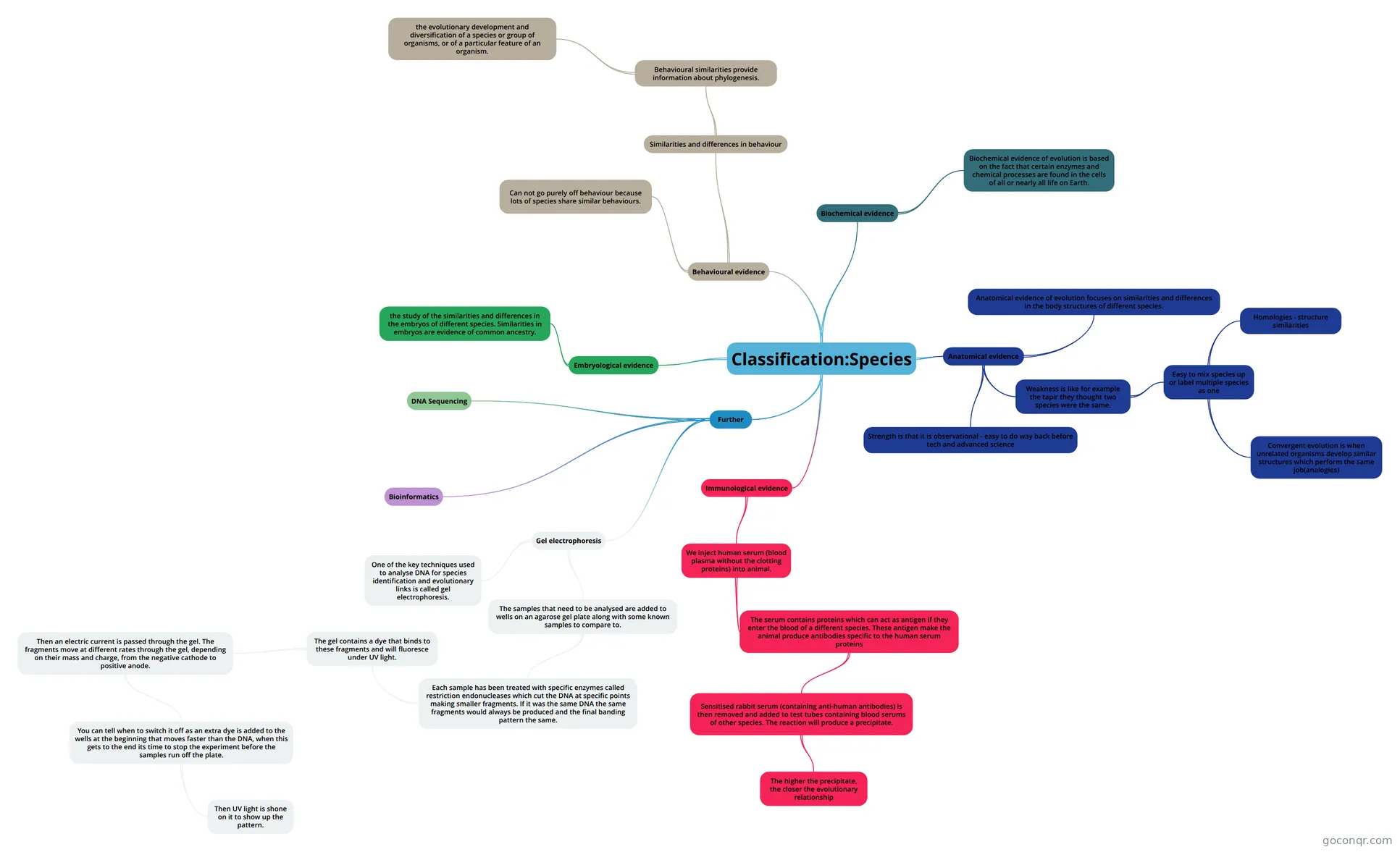
Mind map: classification of species
Map content
Classification:Species
Anatomical evidence
- Anatomical evidence of evolution focuses on similarities and differences in the body structures of different species.
- Strength is that it is observational - easy to do way back before tech and advanced science
- Weakness is like for example the tapir they thought two species were the same.
- Easy to mix species up or label multiple species as one
- Convergent evolution is when unrelated organisms develop similar structures which perform the same job(analogies)
- Homologies - structure similarities
- Easy to mix species up or label multiple species as one
Embryological evidence
- the study of the similarities and differences in the embryos of different species. Similarities in embryos are evidence of common ancestry.
Biochemical evidence
- Biochemical evidence of evolution is based on the fact that certain enzymes and chemical processes are found in the cells of all or nearly all life on Earth.
Immunological evidence
- We inject human serum (blood plasma without the clotting proteins) into animal.
- The serum contains proteins which can act as antigen if they enter the blood of a different species. These antigen make the animal produce antibodies specific to the human serum proteins
- Sensitised rabbit serum (containing anti-human antibodies) is then removed and added to test tubes containing blood serums of other species. The reaction will produce a precipitate.
- The higher the precipitate, the closer the evolutionary relationship
- Sensitised rabbit serum (containing anti-human antibodies) is then removed and added to test tubes containing blood serums of other species. The reaction will produce a precipitate.
- The serum contains proteins which can act as antigen if they enter the blood of a different species. These antigen make the animal produce antibodies specific to the human serum proteins
- We inject human serum (blood plasma without the clotting proteins) into animal.
Behavioural evidence
- Similarities and differences in behaviour
- Behavioural similarities provide information about phylogenesis.
- the evolutionary development and diversification of a species or group of organisms, or of a particular feature of an organism.
- Behavioural similarities provide information about phylogenesis.
- Can not go purely off behaviour because lots of species share similar behaviours.
- Similarities and differences in behaviour
Further
- DNA Sequencing
- Gel electrophoresis
- The samples that need to be analysed are added to wells on an agarose gel plate along with some known samples to compare to.
- Each sample has been treated with specific enzymes called restriction endonucleases which cut the DNA at specific points making smaller fragments. If it was the same DNA the same fragments would always be produced and the final banding pattern the same.
- The gel contains a dye that binds to these fragments and will fluoresce under UV light.
- Then an electric current is passed through the gel. The fragments move at different rates through the gel, depending on their mass and charge, from the negative cathode to positive anode.
- You can tell when to switch it off as an extra dye is added to the wells at the beginning that moves faster than the DNA, when this gets to the end its time to stop the experiment before the samples run off the plate.
- Then UV light is shone on it to show up the pattern.
- You can tell when to switch it off as an extra dye is added to the wells at the beginning that moves faster than the DNA, when this gets to the end its time to stop the experiment before the samples run off the plate.
- Then an electric current is passed through the gel. The fragments move at different rates through the gel, depending on their mass and charge, from the negative cathode to positive anode.
- The gel contains a dye that binds to these fragments and will fluoresce under UV light.
- Each sample has been treated with specific enzymes called restriction endonucleases which cut the DNA at specific points making smaller fragments. If it was the same DNA the same fragments would always be produced and the final banding pattern the same.
- One of the key techniques used to analyse DNA for species identification and evolutionary links is called gel electrophoresis.
- The samples that need to be analysed are added to wells on an agarose gel plate along with some known samples to compare to.
- Bioinformatics
Information
- Description
- A level Biology Mind Map on Classification:Species, created by Skye O'Donnell-Shaw on 15/01/2021.
- Created by
- Skye O'Donnell-Shaw
- Views
- 0
- Rating
More on Evidence for Evolution