
Mind map
Nutrition
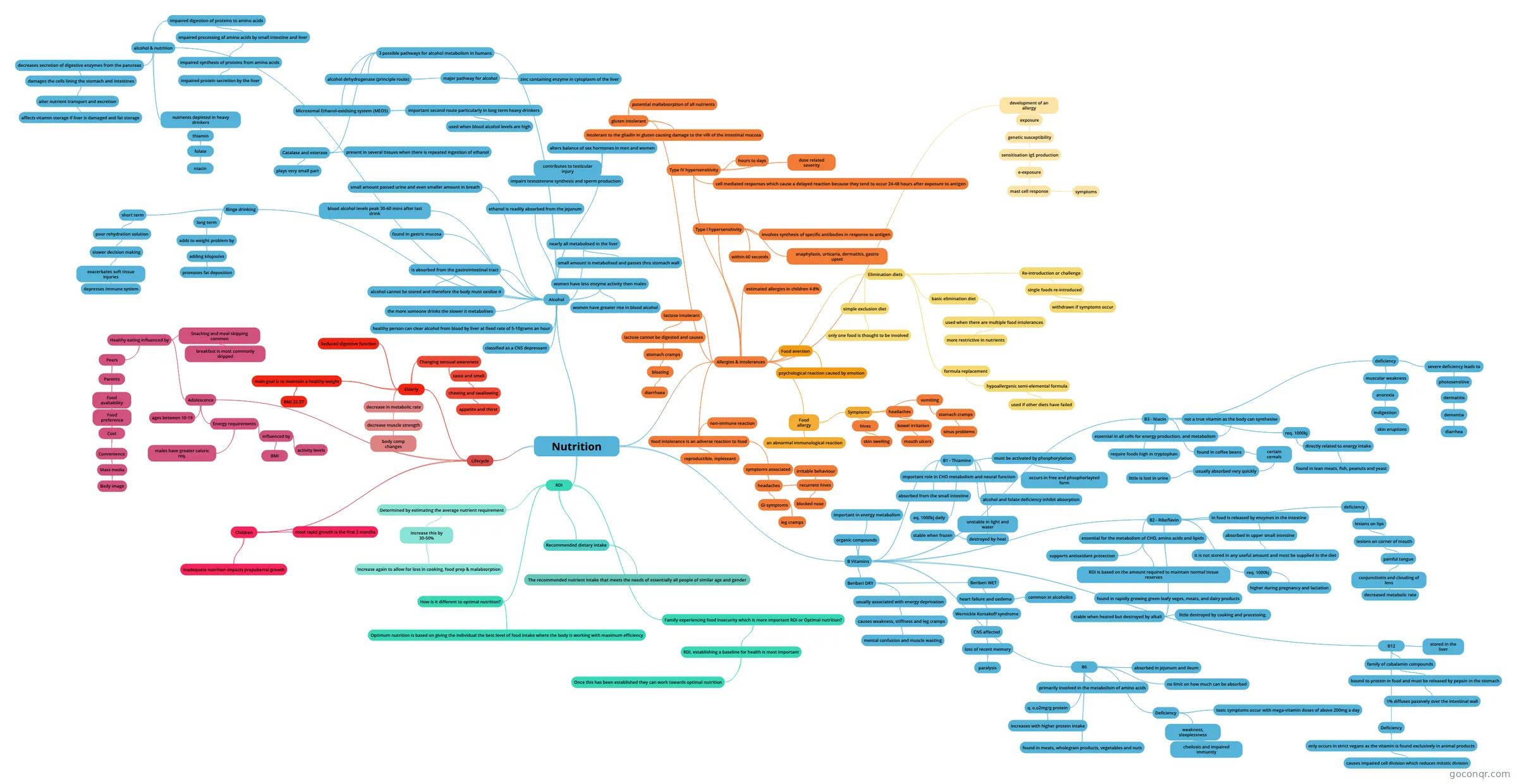
Mind map: nutrition
Map content
Nutrition
B Vitamins
- organic compounds
- important in energy metabolism
- B1 - Thiamine
- important role in CHO metabolism and neural function
- must be activated by phosphorylation.
- occurs in free and phsophorlayted form
- absorbed from the small intestine
- alcohol and folate deficiency inhibit absorption
- eq. 1000kj daily
- unstable in light and water
- destroyed by heat
- stable when frozen
- destroyed by heat
- Beriberi DRY
- usually associated with energy deprivation
- causes weakness, stiffness and leg cramps
- mental confusion and muscle wasting
- causes weakness, stiffness and leg cramps
- Beriberi WET
- heart faliure and oedema
- Wernickle Korsakoff syndrome
- CNS affected
- loss of recent memory
- paralysis
- loss of recent memory
- CNS affected
- common in alcoholics
- Wernickle Korsakoff syndrome
- heart faliure and oedema
- usually associated with energy deprivation
- B2 - Riboflavin
- essential for the metabolism of CHO, amino acids and lipids
- supports antioxidant protection
- RDI is based on the amount required to maintain normal tissue reserves
- in food is released by enzymes in the intestine
- absorbed in upper small intestine
- it is not stored in any useful amount and most be supplied in the diet
- absorbed in upper small intestine
- req. 1000kj
- higher during pregnancy and lactation
- found in rapidly growing green leafy veges, meats, and dairy products
- stable when heated but destroyed by alkali
- little destroyed by cooking and processing.
- stable when heated but destroyed by alkali
- deficiency
- lesions on lips
- lesions on corner of mouth
- painful tongue
- conjunctivitis and clouding of lens
- decreased metabolic rate
- conjunctivitis and clouding of lens
- painful tongue
- lesions on corner of mouth
- lesions on lips
- essential for the metabolism of CHO, amino acids and lipids
- B3 - Niacin
- essential in all cells for energy production. and metabolism
- not a true vitamin as the body can synthesise
- require foods high in tryptophan
- found in coffee beans
- certain cereals
- usually absorbed very quickly
- little is lost in urine
- usually absorbed very quickly
- certain cereals
- req. 1000kj
- directly related to energy intake
- found in lean meats, fish, peanuts and yeast
- directly related to energy intake
- deficiency
- muscular weakness
- anorexia
- indigestion
- skin eruptions
- indigestion
- anorexia
- severe deficiency leads to
- photosensitive
- dermatitis
- dementia
- diarrhea
- dementia
- dermatitis
- photosensitive
- muscular weakness
- essential in all cells for energy production. and metabolism
- B6
- primarily involved in the metabolism of amino acids
- absorbed in jejunum and ileum
- no limit on how much can be absorbed
- q. o.o2mg/g protein
- increases with higher protein intake
- found in meats, wholegrain products, vegetables and nuts
- Deficiency
- weakness, sleeplessness
- cheilosis and impaired immuntiy
- toxic symptoms occur with mega-vitamin doses of above 200mg a day
- weakness, sleeplessness
- B12
- family of cobalamin compounds
- bound to protein in food and must be released by pepsin in the stomach
- 1% diffuses passively over the intestinal wall
- bound to protein in food and must be released by pepsin in the stomach
- stored in the liver
- Deficiency
- only occurs in strict vegans as the vitamin is found exclusively in animal products
- causes impaired cell division which reduces mitotic division
- only occurs in strict vegans as the vitamin is found exclusively in animal products
- family of cobalamin compounds
RDI
- Recommended dietary intake
- The recommended nutrient intake that meets the needs of essentially all people of similar age and gender
- Determined by estimating the average nutrient requirement
- Increase this by 30-50%
- Increase again to allow for loss in cooking, food prep & malabsorption
- Increase this by 30-50%
- How is it different to optimal nutrition?
- Optimum nutrition is based on giving the individual the best level of food intake where the body is working with maximum efficiency
- Family experiencing food insecurity which is more important RDI or Optimal nutrition?
- RDI, establishing a baseline for health is most important
- Once this has been established they can work towards optimal nutrition
- RDI, establishing a baseline for health is most important
- Recommended dietary intake
Lifecycle
- Elderly
- decrease in metabolic rate
- decrease muscle strength
- body comp changes
- decrease muscle strength
- Changing sensual awareness
- taste and smell
- chewing and swallowing
- appetite and thirst
- chewing and swallowing
- taste and smell
- Reduced digestive function
- main goal is to maintain a healthy weight
- BMI 22-27
- decrease in metabolic rate
- Children
- inadequate nutrition impacts prepubertal growth
- most rapid growth is the first 2 months
- Adolescence
- ages between 10-19
- Healthy eating influenced by
- Peers
- Parents
- Food avaliability
- Food preference
- Cost
- Convenience
- Mass media
- Body image
- Mass media
- Convenience
- Cost
- Food preference
- Food avaliability
- Parents
- Snacking and meal skipping common
- breakfast is most commonly skipped
- Peers
- Energy requirements
- influenced by
- activity levels
- BMI
- males have greater caloric req.
- influenced by
- Elderly
Alcohol
- is absorbed from the gastrointestinal tract
- alcohol cannot be stored and therefore the body must oxidize it
- ethanol is readily absorbed from the jejunum
- nearly all metabolised in the liver
- small amount is metabolised and passes thro stomach wall
- found in gastric mucosa
- small amount passed urine and even smaller amount in breath
- blood alcohol levels peak 30-60 mins after last drink
- 3 possible pathways for alcohol metabolism in humans
- alcohol dehydrogenase (principle route)
- major pathway for alcohol
- zinc containing enzyme in cytoplasm of the liver
- major pathway for alcohol
- Microsomal Ethanol-oxidising system (MEOS)
- important second route particularly in long term heavy drinkers
- used when blood alcohol levels are high
- important second route particularly in long term heavy drinkers
- Catalase and esterase
- present in several tissues when there is repeated ingestion of ethanol
- plays very small part
- alcohol dehydrogenase (principle route)
- the more someone drinks the slower it metabolises
- women have less enzyme activity then males
- women have greater rise in blood alcohol
- healthy person can clear alcohol from blood by liver at fixed rate of 5-10grams an hour
- alters balance of sex hormones in men and women
- contributes to testicular injury
- impairs testosterone synthesis and sperm production
- contributes to testicular injury
- classified as a CNS depressant
- Binge drinking
- short term
- poor rehydration solution
- slower decision making
- exacerbates soft tissue injuries
- depresses immune system
- exacerbates soft tissue injuries
- slower decision making
- poor rehydration solution
- long term
- adds to weight problem by
- adding kilojoules
- promotes fat deposition
- adding kilojoules
- adds to weight problem by
- short term
- alcohol & nutrition
- decreases secretion of digestive enzymes from the pancreas
- damages the cells lining the stomach and intestines
- alter nutrient transport and excretion
- affects vitamin storage if liver is damaged and fat storage
- alter nutrient transport and excretion
- damages the cells lining the stomach and intestines
- impaired digestion of proteins to amino acids
- impaired processing of amino acids by small intestine and liver
- impaired synthesis of proteins from amino acids
- impaired protein secretion by the liver
- impaired synthesis of proteins from amino acids
- impaired processing of amino acids by small intestine and liver
- nutrients depleted in heavy drinkers
- thiamin
- folate
- niacin
- folate
- thiamin
- decreases secretion of digestive enzymes from the pancreas
- is absorbed from the gastrointestinal tract
Allergies & intolerances
- estimated allergies in children 4-8%
- food intolerance is an adverse reaction to food
- reproductible, inpleseant
- non-immune reaction
- symptoms associated
- headaches
- recurrent hives
- blocked nose
- irritable behaviour
- GI symptoms
- leg cramps
- recurrent hives
- headaches
- Food allergy
- an abnormal immunological reaction
- Symptoms
- hives
- skin swelling
- headaches
- bowel irritation
- mouth ulcers
- bowel irritation
- vomiting
- stomach cramps
- sinus problems
- stomach cramps
- hives
- Food aversion
- psychological reaction caused by emotion
- Elimination diets
- simple exclusion diet
- only one food is thought to be involved
- basic elimination diet
- used when there are multiple food intolerances
- more restrictive in nutrients
- used when there are multiple food intolerances
- formula replacement
- hypoallergenic semi-elemental formula
- used if other diets have failed
- hypoallergenic semi-elemental formula
- Re-introduction or challenge
- single foods re-introduced
- withdrawn if symptoms occur
- single foods re-introduced
- simple exclusion diet
- Type I hypersensitivity
- involves synthesis of specific antibodies in response to antigen
- within 60 seconds
- anaphylaxis, urticaria, dermatitis, gastro upset
- Type IV hypersensitivity
- cell mediated responses which cause a delayed reaction because they tend to occur 24-48 hours after exposure to antigen
- hours to days
- dose related severity
- development of an allergy
- exposure
- genetic susceptibility
- sensitisation IgE production
- e-exposure
- mast cell response
- symptoms
- mast cell response
- e-exposure
- sensitisation IgE production
- genetic susceptibility
- exposure
- lactose intolerant
- lactose cannot be digested and causes
- stomach cramps
- bloating
- diarrhoea
- bloating
- stomach cramps
- lactose cannot be digested and causes
- gluten intolerant
- intolerant to the gliadin in gluten causing damage to the villi of the intestinal mucosa
- potential mallabsorption of all nutrients
Information
- Description
- Mind Map on Nutrition, created by Meghan Mounsey on 12/06/2022.
- Created by
- Meghan Mounsey
- Views
- 2
- Rating