
Mind map
Membrane structure & function
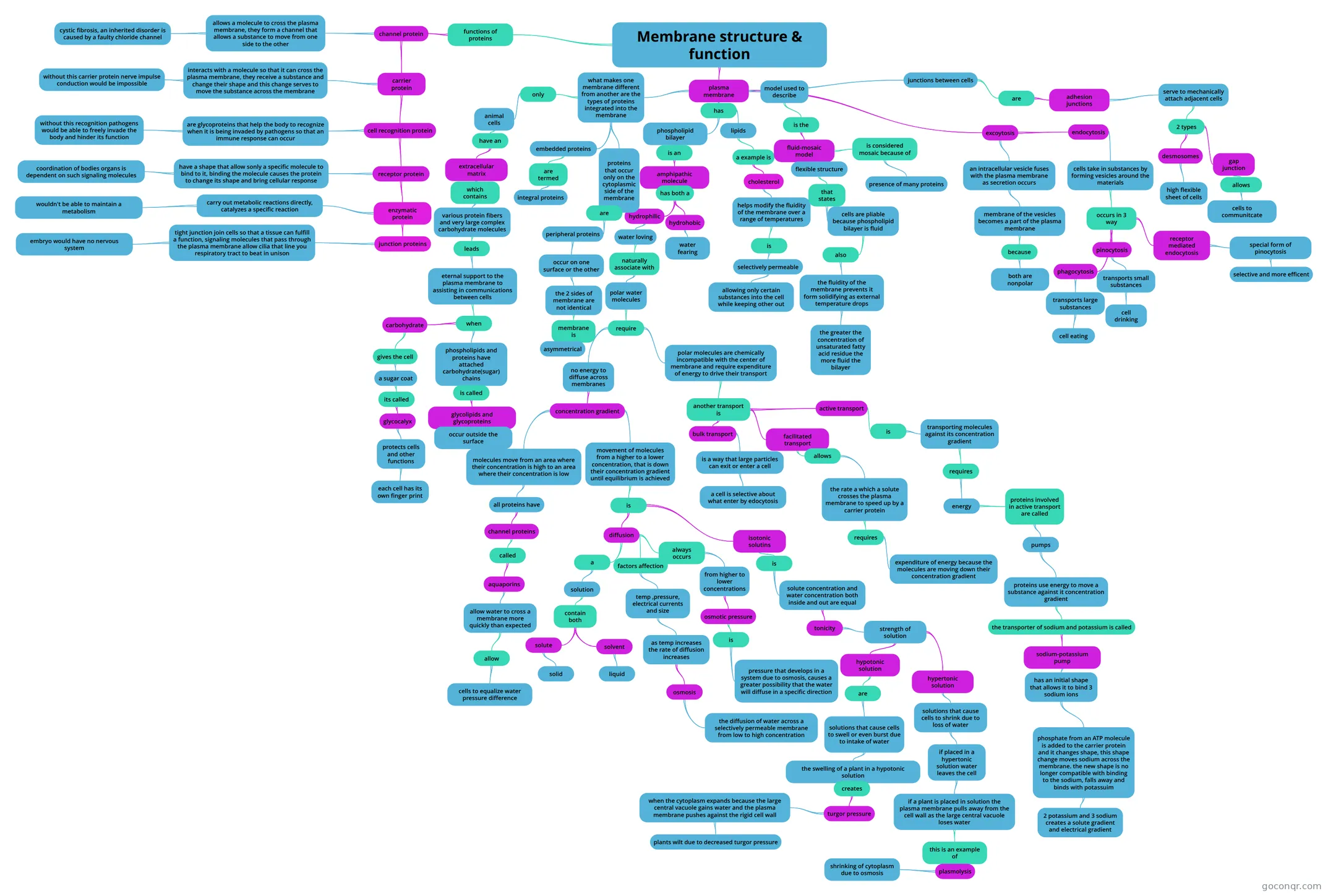
Mind map: membrane structure and function
Map content
Membrane structure & function
plasma membrane
- has
- lipids
- a example is
- cholesterol
- helps modify the fluidity of the membrane over a range of temperatures
- is
- selectively permeable
- allowing only certain substances into the cell while keeping other out
- selectively permeable
- is
- helps modify the fluidity of the membrane over a range of temperatures
- cholesterol
- a example is
- phospholipid bilayer
- is an
- amphipathic molecule
- has both a
- hydrophilic
- water loving
- naturally associate with
- polar water molecules
- require
- no energy to diffuse across membranes
- concentration gradient
- molecules move from an area where their concentration is high to an area where their concentration is low
- all proteins have
- channel proteins
- called
- aquaporins
- allow water to cross a membrane more quickly than expected
- allow
- cells to equalize water pressure difference
- allow
- allow water to cross a membrane more quickly than expected
- aquaporins
- called
- channel proteins
- all proteins have
- movement of molecules from a higher to a lower concentration, that is down their concentration gradient until equilibrium is achieved
- is
- diffusion
- a
- solution
- contain both
- solute
- solid
- solvent
- liquid
- solute
- contain both
- solution
- factors affection
- temp ,pressure, electrical currents and size
- as temp increases the rate of diffusion increases
- osmosis
- the diffusion of water across a selectively permeable membrane from low to high concentration
- osmosis
- as temp increases the rate of diffusion increases
- temp ,pressure, electrical currents and size
- always occurs
- from higher to lower concentrations
- osmotic pressure
- is
- pressure that develops in a system due to osmosis, causes a greater possibility that the water will diffuse in a specific direction
- is
- osmotic pressure
- from higher to lower concentrations
- a
- isotonic solutins
- is
- solute concentration and water concentration both inside and out are equal
- tonicity
- strength of solution
- hypotonic solution
- are
- solutions that cause cells to swell or even burst due to intake of water
- the swelling of a plant in a hypotonic solution
- creates
- turgor pressure
- when the cytoplasm expands because the large central vacuole gains water and the plasma membrane pushes against the rigid cell wall
- plants wilt due to decreased turgor pressure
- when the cytoplasm expands because the large central vacuole gains water and the plasma membrane pushes against the rigid cell wall
- turgor pressure
- creates
- the swelling of a plant in a hypotonic solution
- solutions that cause cells to swell or even burst due to intake of water
- are
- hypertonic solution
- solutions that cause cells to shrink due to loss of water
- if placed in a hypertonic solution water leaves the cell
- if a plant is placed in solution the plasma membrane pulls away from the cell wall as the large central vacuole loses water
- this is an example of
- plasmolysis
- shrinking of cytoplasm due to osmosis
- plasmolysis
- this is an example of
- if a plant is placed in solution the plasma membrane pulls away from the cell wall as the large central vacuole loses water
- if placed in a hypertonic solution water leaves the cell
- solutions that cause cells to shrink due to loss of water
- hypotonic solution
- strength of solution
- tonicity
- solute concentration and water concentration both inside and out are equal
- is
- diffusion
- is
- molecules move from an area where their concentration is high to an area where their concentration is low
- concentration gradient
- polar molecules are chemically incompatible with the center of membrane and require expenditure of energy to drive their transport
- another transport is
- bulk transport
- is a way that large particles can exit or enter a cell
- a cell is selective about what enter by edocytosis
- is a way that large particles can exit or enter a cell
- facilitated transport
- allows
- the rate a which a solute crosses the plasma membrane to speed up by a carrier protein
- requires
- expenditure of energy because the molecules are moving down their concentration gradient
- requires
- the rate a which a solute crosses the plasma membrane to speed up by a carrier protein
- allows
- active transport
- is
- transporting molecules against its concentration gradient
- requires
- energy
- proteins involved in active transport are called
- pumps
- proteins use energy to move a substance against it concentration gradient
- the transporter of sodium and potassium is called
- sodium-potassium pump
- has an initial shape that allows it to bind 3 sodium ions
- phosphate from an ATP molecule is added to the carrier protein and it changes shape, this shape change moves sodium across the membrane. the new shape is no longer compatible with binding to the sodium, falls away and binds with potassuim
- 2 potassium and 3 sodium creates a solute gradient and electrical gradient
- phosphate from an ATP molecule is added to the carrier protein and it changes shape, this shape change moves sodium across the membrane. the new shape is no longer compatible with binding to the sodium, falls away and binds with potassuim
- has an initial shape that allows it to bind 3 sodium ions
- sodium-potassium pump
- the transporter of sodium and potassium is called
- proteins use energy to move a substance against it concentration gradient
- pumps
- proteins involved in active transport are called
- energy
- requires
- transporting molecules against its concentration gradient
- is
- bulk transport
- another transport is
- no energy to diffuse across membranes
- require
- polar water molecules
- naturally associate with
- water loving
- hydrohobic
- water fearing
- hydrophilic
- has both a
- amphipathic molecule
- is an
- lipids
- what makes one membrane different from another are the types of proteins integrated into the membrane
- embedded proteins
- are termed
- integral proteins
- are termed
- proteins that occur only on the cytoplasmic side of the membrane
- are
- peripheral proteins
- occur on one surface or the other
- the 2 sides of membrane are not identical
- membrane is
- asymmetrical
- membrane is
- the 2 sides of membrane are not identical
- occur on one surface or the other
- peripheral proteins
- are
- only
- animal cells
- have an
- extracellular matrix
- which contains
- various protein fibers and very large complex carbohydrate molecules
- leads
- eternal support to the plasma membrane to assisting in communications between cells
- when
- phospholipids and proteins have attached carbohydrate(sugar) chains
- is called
- glycolipids and glycoproteins
- occur outside the surface
- glycolipids and glycoproteins
- is called
- carbohydrate
- gives the cell
- a sugar coat
- its called
- glycocalyx
- protects cells and other functions
- each cell has its own finger print
- protects cells and other functions
- glycocalyx
- its called
- a sugar coat
- gives the cell
- phospholipids and proteins have attached carbohydrate(sugar) chains
- when
- eternal support to the plasma membrane to assisting in communications between cells
- leads
- various protein fibers and very large complex carbohydrate molecules
- which contains
- extracellular matrix
- have an
- animal cells
- embedded proteins
- model used to describe
- is the
- fluid-mosaic model
- flexible structure
- that states
- cells are pliable because phospholipid bilayer is fluid
- also
- the fluidity of the membrane prevents it form solidifying as external temperature drops
- the greater the concentration of unsaturated fatty acid residue the more fluid the bilayer
- the fluidity of the membrane prevents it form solidifying as external temperature drops
- also
- cells are pliable because phospholipid bilayer is fluid
- that states
- is considered mosaic because of
- presence of many proteins
- flexible structure
- fluid-mosaic model
- is the
- excoytosis
- an intracellular vesicle fuses with the plasma membrane as secretion occurs
- membrane of the vesicles becomes a part of the plasma membrane
- because
- both are nonpolar
- because
- membrane of the vesicles becomes a part of the plasma membrane
- endocytosis
- cells take in substances by forming vesicles around the materials
- occurs in 3 way
- phagocytosis
- transports large substances
- cell eating
- transports large substances
- pinocytosis
- transports small substances
- cell drinking
- transports small substances
- receptor mediated endocytosis
- special form of pinocytosis
- selective and more efficent
- special form of pinocytosis
- phagocytosis
- occurs in 3 way
- cells take in substances by forming vesicles around the materials
- an intracellular vesicle fuses with the plasma membrane as secretion occurs
- junctions between cells
- are
- adhesion junctions
- serve to mechanically attach adjacent cells
- 2 types
- desmosomes
- high flexible sheet of cells
- gap junction
- allows
- cells to communitcate
- allows
- desmosomes
- 2 types
- serve to mechanically attach adjacent cells
- adhesion junctions
- are
- has
functions of proteins
- channel protein
- allows a molecule to cross the plasma membrane, they form a channel that allows a substance to move from one side to the other
- cystic fibrosis, an inherited disorder is caused by a faulty chloride channel
- carrier protein
- interacts with a molecule so that it can cross the plasma membrane, they receive a substance and change their shape and this change serves to move the substance across the membrane
- without this carrier protein nerve impulse conduction would be impossible
- cell recognition protein
- are glycoproteins that help the body to recognize when it is being invaded by pathogens so that an immune response can occur
- without this recognition pathogens would be able to freely invade the body and hinder its function
- receptor protein
- have a shape that allow sonly a specific molecule to bind to it, binding the molecule causes the protein to change its shape and bring cellular response
- coordination of bodies organs is dependent on such signaling molecules
- enzymatic protein
- carry out metabolic reactions directly, catalyzes a specific reaction
- wouldn't be able to maintain a metabolism
- junction proteins
- tight junction join cells so that a tissue can fulfill a function, signaling molecules that pass through the plasma membrane allow cilia that line you respiratory tract to beat in unison
- embryo would have no nervous system
- tight junction join cells so that a tissue can fulfill a function, signaling molecules that pass through the plasma membrane allow cilia that line you respiratory tract to beat in unison
- carry out metabolic reactions directly, catalyzes a specific reaction
- have a shape that allow sonly a specific molecule to bind to it, binding the molecule causes the protein to change its shape and bring cellular response
- are glycoproteins that help the body to recognize when it is being invaded by pathogens so that an immune response can occur
- interacts with a molecule so that it can cross the plasma membrane, they receive a substance and change their shape and this change serves to move the substance across the membrane
- allows a molecule to cross the plasma membrane, they form a channel that allows a substance to move from one side to the other
- channel protein