
Mind map
Christian Ethics
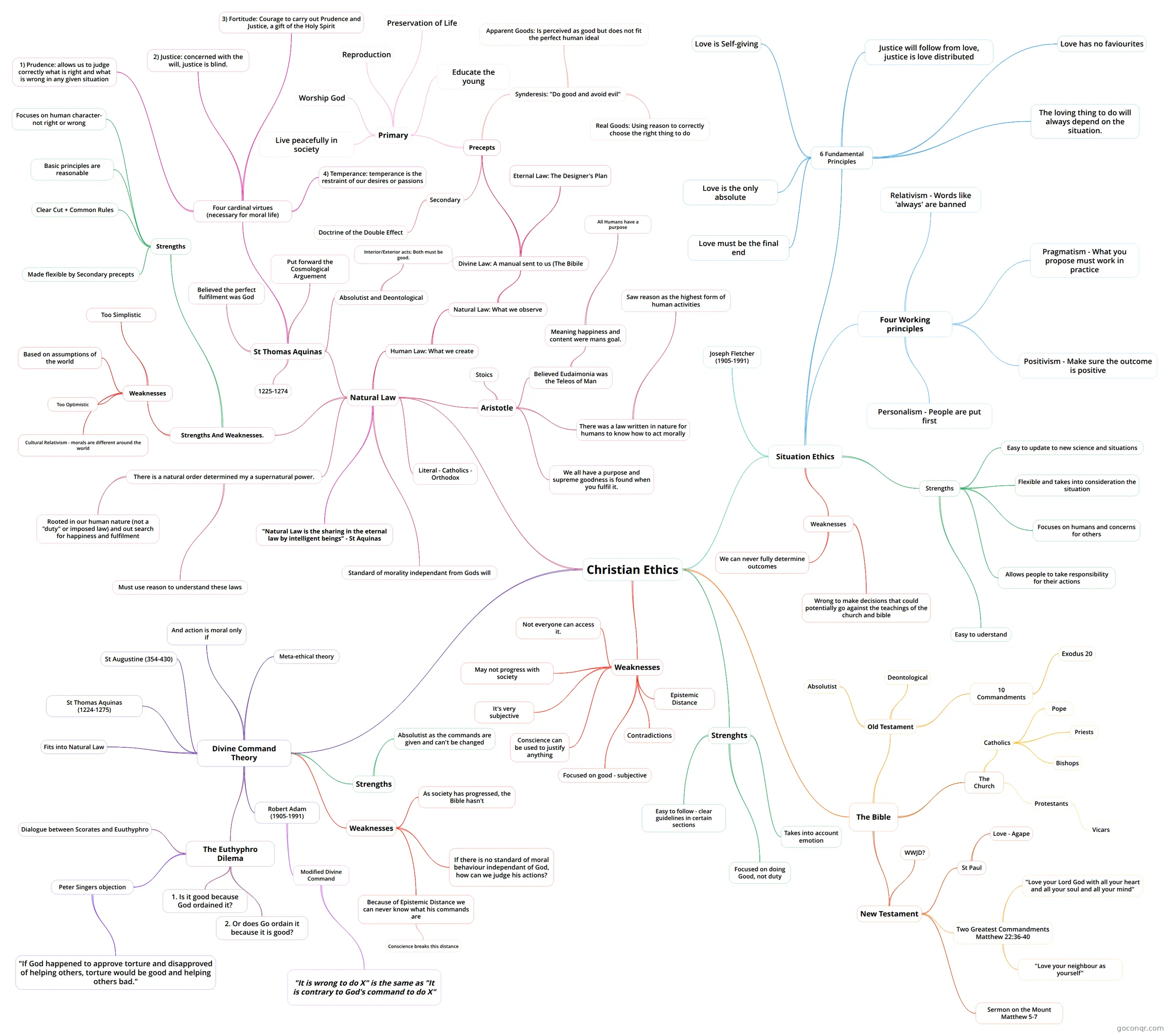
Mind map: Christian ethics
Map content
Christian Ethics
Natural Law
- St Thomas Aquinas
- Believed the perfect fulfilment was God
- 1225-1274
- Put forward the Cosmological Arguement
- Absolutist and Deontological
- Interior/Exterior acts: Both must be good.
- Four cardinal virtues (necessary for moral life)
- 4) Temperance: temperance is the restraint of our desires or passions
- 3) Fortitude: Courage to carry out Prudence and Justice, a gift of the Holy Spirit
- 1) Prudence: allows us to judge correctly what is right and what is wrong in any given situation
- 2) Justice: concerned with the will, justice is blind.
- Aristotle
- Stoics
- Believed Eudaimonia was the Teleos of Man
- Meaning happiness and content were mans goal.
- All Humans have a purpose
- Meaning happiness and content were mans goal.
- We all have a purpose and supreme goodness is found when you fulfil it.
- There was a law written in nature for humans to know how to act morally
- Saw reason as the highest form of human activities
- "Natural Law is the sharing in the eternal law by intelligent beings" - St Aquinas
- There is a natural order determined my a supernatural power.
- Rooted in our human nature (not a "duty" or imposed law) and out search for happiness and fulfilment
- Must use reason to understand these laws
- Human Law: What we create
- Natural Law: What we observe
- Divine Law: A manual sent to us (The Bibile
- Precepts
- Secondary
- Doctrine of the Double Effect
- Primary
- Preservation of Life
- Worship God
- Live peacefully in society
- Educate the young
- Reproduction
- Synderesis: "Do good and avoid evil"
- Real Goods: Using reason to correctly choose the right thing to do
- Apparent Goods: Is perceived as good but does not fit the perfect human ideal
- Secondary
- Eternal Law: The Designer's Plan
- Precepts
- Divine Law: A manual sent to us (The Bibile
- Natural Law: What we observe
- Literal - Catholics - Orthodox
- Standard of morality independant from Gods will
- Strengths And Weaknesses.
- Strengths
- Clear Cut + Common Rules
- Made flexible by Secondary precepts
- Basic principles are reasonable
- Focuses on human character- not right or wrong
- Weaknesses
- Based on assumptions of the world
- Too Simplistic
- Cultural Relativism - morals are different around the world
- Too Optimistic
- Strengths
- St Thomas Aquinas
Situation Ethics
- Joseph Fletcher (1905-1991)
- 6 Fundamental Principles
- Love is the only absolute
- Love is Self-giving
- Justice will follow from love, justice is love distributed
- Love has no faviourites
- Love must be the final end
- The loving thing to do will always depend on the situation.
- Four Working principles
- Relativism - Words like 'always' are banned
- Positivism - Make sure the outcome is positive
- Pragmatism - What you propose must work in practice
- Personalism - People are put first
- Strengths
- Easy to uderstand
- Easy to update to new science and situations
- Flexible and takes into consideration the situation
- Focuses on humans and concerns for others
- Allows people to take responsibility for their actions
- Weaknesses
- Wrong to make decisions that could potentially go against the teachings of the church and bible
- We can never fully determine outcomes
Divine Command Theory
- Meta-ethical theory
- And action is moral only if
- St Augustine (354-430)
- St Thomas Aquinas (1224-1275)
- Robert Adam (1905-1991)
- Modified Divine Command
- "It is wrong to do X" is the same as "It is contrary to God's command to do X"
- Modified Divine Command
- The Euthyphro Dilema
- Dialogue between Scorates and Euuthyphro
- 1. Is it good because God ordained it?
- 2. Or does Go ordain it because it is good?
- Peter Singers objection
- "If God happened to approve torture and disapproved of helping others, torture would be good and helping others bad."
- Fits into Natural Law
- Strengths
- Absolutist as the commands are given and can't be changed
- Weaknesses
- Because of Epistemic Distance we can never know what his commands are
- Conscience breaks this distance
- As society has progressed, the Bible hasn't
- If there is no standard of moral behaviour independant of God, how can we judge his actions?
- Because of Epistemic Distance we can never know what his commands are
The Bible
- Old Testament
- 10 Commandments
- Exodus 20
- Deontological
- Absolutist
- 10 Commandments
- The Church
- Catholics
- Pope
- Bishops
- Priests
- Protestants
- Vicars
- Catholics
- New Testament
- WWJD?
- St Paul
- Love - Agape
- Two Greatest Commandments Matthew 22:36-40
- "Love your Lord God with all your heart and all your soul and all your mind"
- "Love your neighbour as yourself"
- Sermon on the Mount Matthew 5-7
- Old Testament
Strenghts
- Easy to follow - clear guidelines in certain sections
- Takes into account emotion
- Focused on doing Good, not duty
Weaknesses
- Not everyone can access it.
- May not progress with society
- It's very subjective
- Conscience can be used to justify anything
- Epistemic Distance
- Contradictions
- Focused on good - subjective
Information
- Description
- Mind map on AS level Christian Ethics - including strengths and weaknesses
- Created by
- Alexa Smith
- Views
- 78
- Tags
- Rating