
Mind map
Evolution
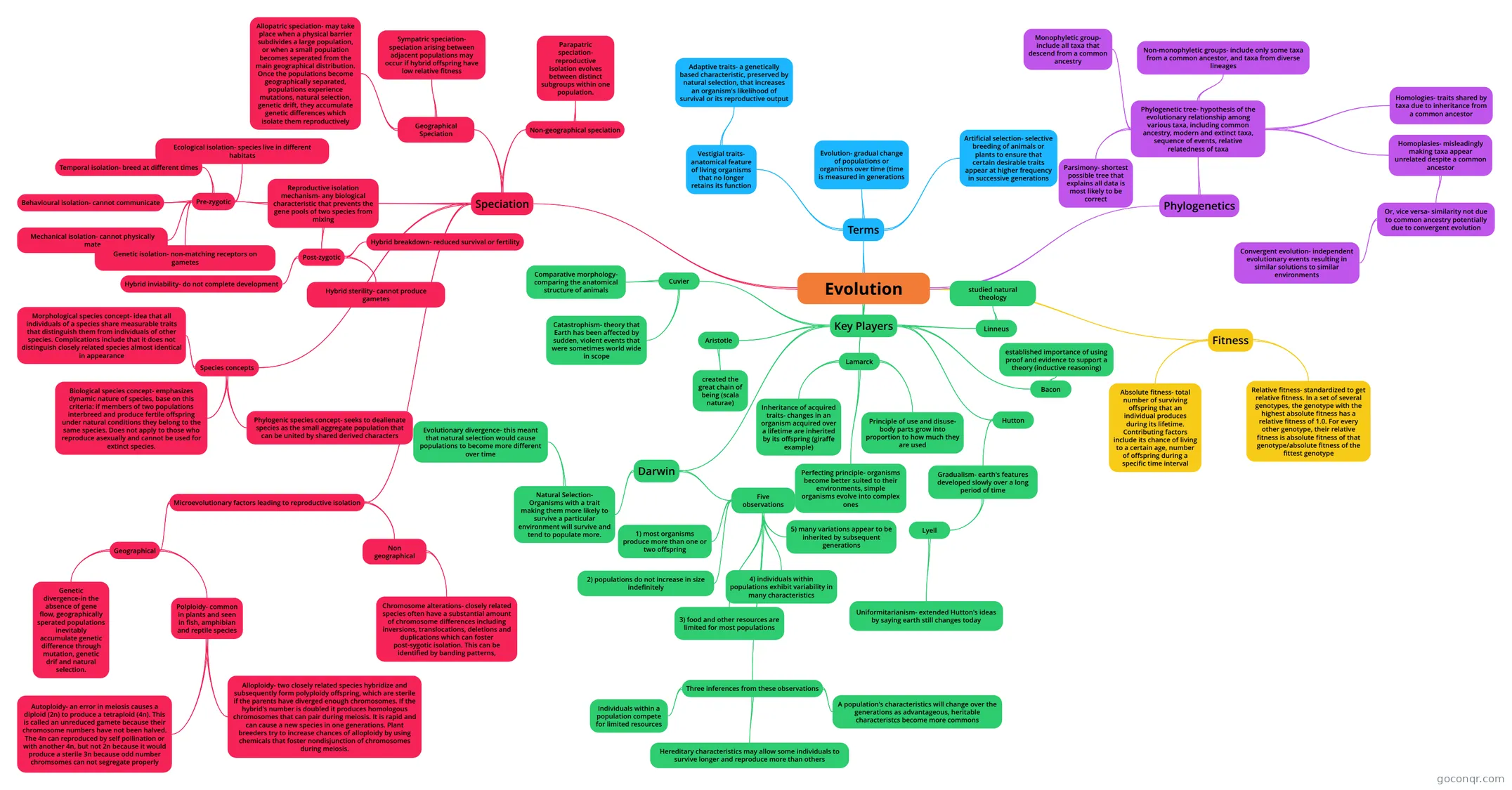
Mind map: Evolution
Map content
Evolution
Lamarck
- Inheritance of acquired traits- changes in an organism acquired over a lifetime are inherited by its offspring (giraffe example)
- Principle of use and disuse- body parts grow into proportion to how much they are used
- Perfecting principle- organisms become better suited to their environments, simple organisms evolve into complex ones
Key Players
- Aristotle
- created the great chain of being (scala naturae)
- Linneus
- studied natural theology
- Bacon
- established importance of using proof and evidence to support a theory (inductive reasoning)
- Cuvier
- Catastrophism- theory that Earth has been affected by sudden, violent events that were sometimes world wide in scope
- Comparative morphology- comparing the anatomical structure of animals
- Hutton
- Gradualism- earth's features developed slowly over a long period of time
- Lyell
- Uniformitarianism- extended Hutton's ideas by saying earth still changes today
- Lyell
- Gradualism- earth's features developed slowly over a long period of time
- Darwin
- Natural Selection- Organisms with a trait making them more likely to survive a particular environment will survive and tend to populate more.
- Evolutionary divergence- this meant that natural selection would cause populations to become more different over time
- Five observations
- 1) most organisms produce more than one or two offspring
- 2) populations do not increase in size indefinitely
- 3) food and other resources are limited for most populations
- 4) individuals within populations exhibit variability in many characteristics
- 5) many variations appear to be inherited by subsequent generations
- Three inferences from these observations
- Individuals within a population compete for limited resources
- Hereditary characteristics may allow some individuals to survive longer and reproduce more than others
- A population's characteristics will change over the generations as advantageous, heritable characteristcs become more commons
- Natural Selection- Organisms with a trait making them more likely to survive a particular environment will survive and tend to populate more.
- Aristotle
Terms
- Vestigial traits- anatomical feature of living organisms that no longer retains its function
- Adaptive traits- a genetically based characteristic, preserved by natural selection, that increases an organism's likelihood of survival or its reproductive output
- Evolution- gradual change of populations or organisms over time (time is measured in generations
- Artificial selection- selective breeding of animals or plants to ensure that certain desirable traits appear at higher frequency in successive generations
- Vestigial traits- anatomical feature of living organisms that no longer retains its function
Phylogenetics
- Phylogenetic tree- hypothesis of the evolutionary relationship among various taxa, including common ancestry, modern and extinct taxa, sequence of events, relative relatedness of taxa
- Monophyletic group- include all taxa that descend from a common ancestry
- Non-monophyletic groups- include only some taxa from a common ancestor, and taxa from diverse lineages
- Parsimony- shortest possible tree that explains all data is most likely to be correct
- Homologies- traits shared by taxa due to inheritance from a common ancestor
- Homoplasies- misleadingly making taxa appear unrelated despite a common ancestor
- Or, vice versa- similarity not due to common ancestry potentially due to convergent evolution
- Convergent evolution- independent evolutionary events resulting in similar solutions to similar environments
- Or, vice versa- similarity not due to common ancestry potentially due to convergent evolution
- Phylogenetic tree- hypothesis of the evolutionary relationship among various taxa, including common ancestry, modern and extinct taxa, sequence of events, relative relatedness of taxa
Speciation
- Geographical Speciation
- Allopatric speciation- may take place when a physical barrier subdivides a large population, or when a small population becomes seperated from the main geographical distribution. Once the populations become geographically separated, populations experience mutations, natural selection, genetic drift, they accumulate genetic differences which isolate them reproductively
- Sympatric speciation- speciation arising between adjacent populations may occur if hybrid offspring have low relative fitness
- Non-geographical speciation
- Parapatric speciation- reproductive isolation evolves between distinct subgroups within one population.
- Reproductive isolation mechanism- any biological characteristic that prevents the gene pools of two species from mixing
- Pre-zygotic
- Ecological isolation- species live in different habitats
- Temporal isolation- breed at different times
- Behavioural isolation- cannot communicate
- Mechanical isolation- cannot physically mate
- Genetic isolation- non-matching receptors on gametes
- Post-zygotic
- Hybrid inviability- do not complete development
- Hybrid sterility- cannot produce gametes
- Hybrid breakdown- reduced survival or fertility
- Pre-zygotic
- Species concepts
- Morphological species concept- idea that all individuals of a species share measurable traits that distinguish them from individuals of other species. Complications include that it does not distinguish closely related species almost identical in appearance
- Biological species concept- emphasizes dynamic nature of species, base on this criteria: if members of two populations interbreed and produce fertile offspring under natural conditions they belong to the same species. Does not apply to those who reproduce asexually and cannot be used for extinct species.
- Phylogenic species concept- seeks to dealienate species as the small aggregate population that can be united by shared derived characters
- Microevolutionary factors leading to reproductive isolation
- Geographical
- Genetic divergence-in the absence of gene flow, geographically sperated populations inevitably accumulate genetic difference through mutation, genetic drif and natural selection.
- Polploidy- common in plants and seen in fish, amphibian and reptile species
- Autoploidy- an error in meiosis causes a diploid (2n) to produce a tetraploid (4n). This is called an unreduced gamete because their chromosome numbers have not been halved. The 4n can reproduced by self pollination or with another 4n, but not 2n because it would produce a sterile 3n because odd number chromsomes can not segregate properly
- Alloploidy- two closely related species hybridize and subsequently form polyploidy offspring, which are sterile if the parents have diverged enough chromosomes. If the hybrid's number is doubled it produces homologous chromosomes that can pair during meiosis. It is rapid and can cause a new species in one generations. Plant breeders try to increase chances of alloploidy by using chemicals that foster nondisjunction of chromosomes during meiosis.
- Non geographical
- Chromosome alterations- closely related species often have a substantial amount of chromosome differences including inversions, translocations, deletions and duplications which can foster post-sygotic isolation. This can be identified by banding patterns,
- Geographical
- Geographical Speciation
Fitness
- Absolute fitness- total number of surviving offspring that an individual produces during its lifetime. Contributing factors include its chance of living to a certain age, number of offspring during a specific time interval
- Relative fitness- standardized to get relative fitness. In a set of several genotypes, the genotype with the highest absolute fitness has a relative fitness of 1.0. For every other genotype, their relative fitness is absolute fitness of that genotype/absolute fitness of the fittest genotype
Information
- Description
- Mind Map on Evolution, created by Julia Krason on 10/12/2015.
- Created by
- Julia Krason
- Views
- 1
- Rating