
Mind map
Negligence
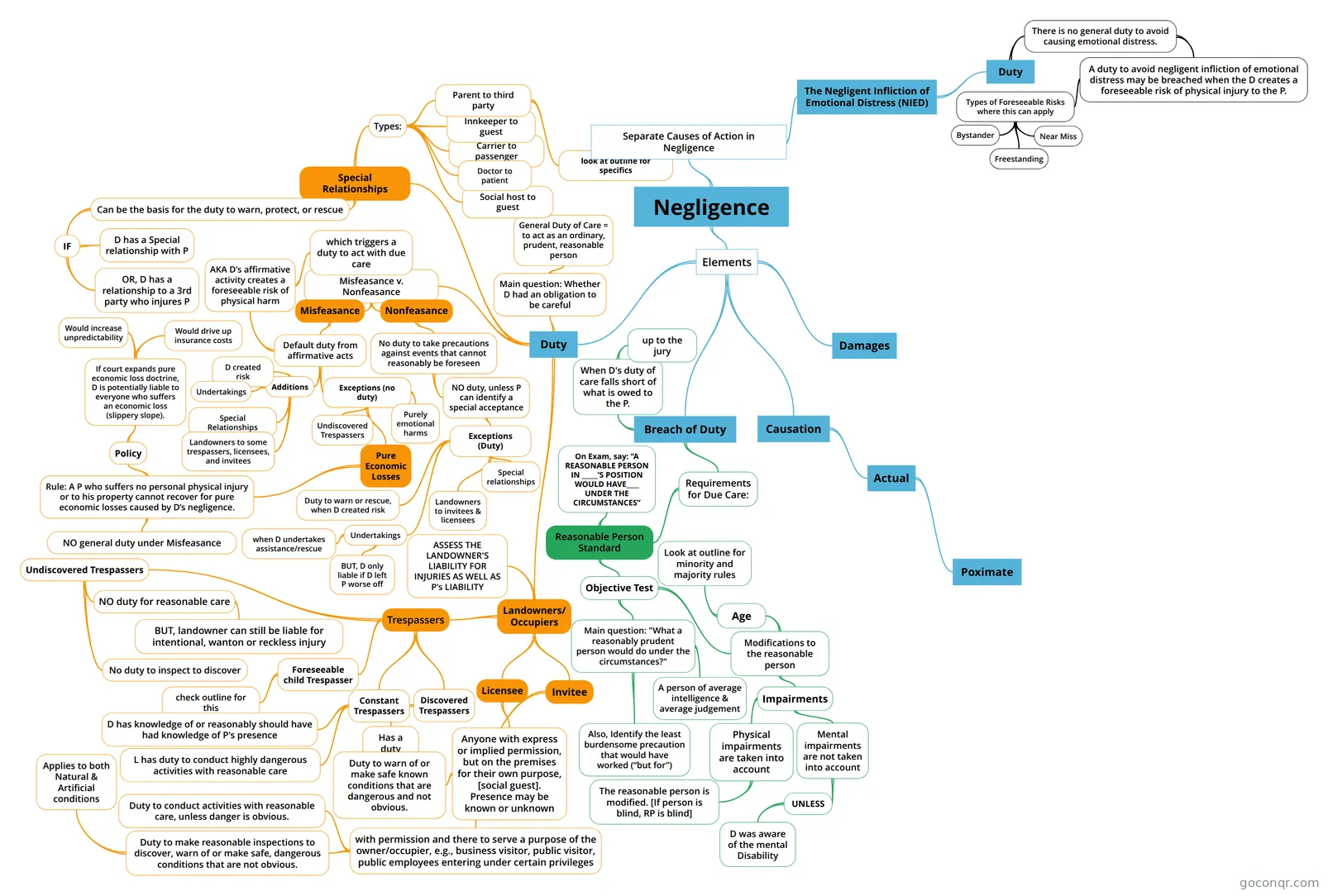
Mind map: Negligence
Map content
Negligence
Elements
- Duty
- Main question: Whether D had an obligation to be careful
- General Duty of Care = to act as an ordinary, prudent, reasonable person
- Misfeasance v. Nonfeasance
- Misfeasance
- Default duty from affirmative acts
- AKA D's affirmative activity creates a foreseeable risk of physical harm
- which triggers a duty to act with due care
- Additions
- D created risk
- Undertakings
- Special Relationships
- Landowners to some trespassers, licensees, and invitees
- Exceptions (no duty)
- Undiscovered Trespassers
- Pure Economic Losses
- Rule: A P who suffers no personal physical injury or to his property cannot recover for pure economic losses caused by D’s negligence.
- NO general duty under Misfeasance
- Policy
- If court expands pure economic loss doctrine, D is potentially liable to everyone who suffers an economic loss (slippery slope).
- Would drive up insurance costs
- Would increase unpredictability
- If court expands pure economic loss doctrine, D is potentially liable to everyone who suffers an economic loss (slippery slope).
- Rule: A P who suffers no personal physical injury or to his property cannot recover for pure economic losses caused by D’s negligence.
- Purely emotional harms
- AKA D's affirmative activity creates a foreseeable risk of physical harm
- Default duty from affirmative acts
- Nonfeasance
- No duty to take precautions against events that cannot reasonably be foreseen
- NO duty, unless P can identify a special acceptance
- Exceptions (Duty)
- Duty to warn or rescue, when D created risk
- Undertakings
- BUT, D only liable if D left P worse off
- when D undertakes assistance/rescue
- Special relationships
- Landowners to invitees & licensees
- Exceptions (Duty)
- NO duty, unless P can identify a special acceptance
- No duty to take precautions against events that cannot reasonably be foreseen
- Misfeasance
- Special Relationships
- Can be the basis for the duty to warn, protect, or rescue
- IF
- D has a Special relationship with P
- OR, D has a relationship to a 3rd party who injures P
- IF
- Types:
- Carrier to passenger
- Innkeeper to guest
- Social host to guest
- Doctor to patient
- Parent to third party
- look at outline for specifics
- Can be the basis for the duty to warn, protect, or rescue
- Landowners/ Occupiers
- Trespassers
- Undiscovered Trespassers
- No duty to inspect to discover
- NO duty for reasonable care
- BUT, landowner can still be liable for intentional, wanton or reckless injury
- Foreseeable child Trespasser
- check outline for this
- Constant Trespassers
- D has knowledge of or reasonably should have had knowledge of P's presence
- L has duty to conduct highly dangerous activities with reasonable care
- Discovered Trespassers
- Has a duty
- Undiscovered Trespassers
- ASSESS THE LANDOWNER'S LIABILITY FOR INJURIES AS WELL AS P's LIABILITY
- Licensee
- Anyone with express or implied permission, but on the premises for their own purpose, [social guest]. Presence may be known or unknown
- Duty to warn of or make safe known conditions that are dangerous and not obvious.
- Anyone with express or implied permission, but on the premises for their own purpose, [social guest]. Presence may be known or unknown
- Invitee
- with permission and there to serve a purpose of the owner/occupier, e.g., business visitor, public visitor, public employees entering under certain privileges
- Duty to conduct activities with reasonable care, unless danger is obvious.
- Duty to make reasonable inspections to discover, warn of or make safe, dangerous conditions that are not obvious.
- Applies to both Natural & Artificial conditions
- with permission and there to serve a purpose of the owner/occupier, e.g., business visitor, public visitor, public employees entering under certain privileges
- Trespassers
- Main question: Whether D had an obligation to be careful
- Breach of Duty
- When D's duty of care falls short of what is owed to the P.
- up to the jury
- Requirements for Due Care:
- Reasonable Person Standard
- On Exam, say: “A REASONABLE PERSON IN _____’S POSITION WOULD HAVE____ UNDER THE CIRCUMSTANCES”
- Objective Test
- Main question: "What a reasonably prudent person would do under the circumstances?"
- A person of average intelligence & average judgement
- Also, Identify the least burdensome precaution that would have worked (“but for”)
- Modifications to the reasonable person
- Impairments
- Physical impairments are taken into account
- The reasonable person is modified. [If person is blind, RP is blind]
- Mental impairments are not taken into account
- UNLESS
- D was aware of the mental Disability
- UNLESS
- Physical impairments are taken into account
- Age
- Look at outline for minority and majority rules
- Impairments
- Main question: "What a reasonably prudent person would do under the circumstances?"
- Reasonable Person Standard
- When D's duty of care falls short of what is owed to the P.
- Causation
- Actual
- Poximate
- Actual
- Damages
- Duty
Separate Causes of Action in Negligence
- The Negligent Infliction of Emotional Distress (NIED)
- Duty
- There is no general duty to avoid causing emotional distress.
- A duty to avoid negligent infliction of emotional distress may be breached when the D creates a foreseeable risk of physical injury to the P.
- Types of Foreseeable Risks where this can apply
- Near Miss
- Bystander
- Freestanding
- Types of Foreseeable Risks where this can apply
- A duty to avoid negligent infliction of emotional distress may be breached when the D creates a foreseeable risk of physical injury to the P.
- There is no general duty to avoid causing emotional distress.
- Duty
- The Negligent Infliction of Emotional Distress (NIED)
Information
- Description
- Mind Map on Negligence, created by carpey0706 on 10/12/2015.
- Created by
- carpey0706
- Views
- 0
- Rating