
Mind map
Viruses #1
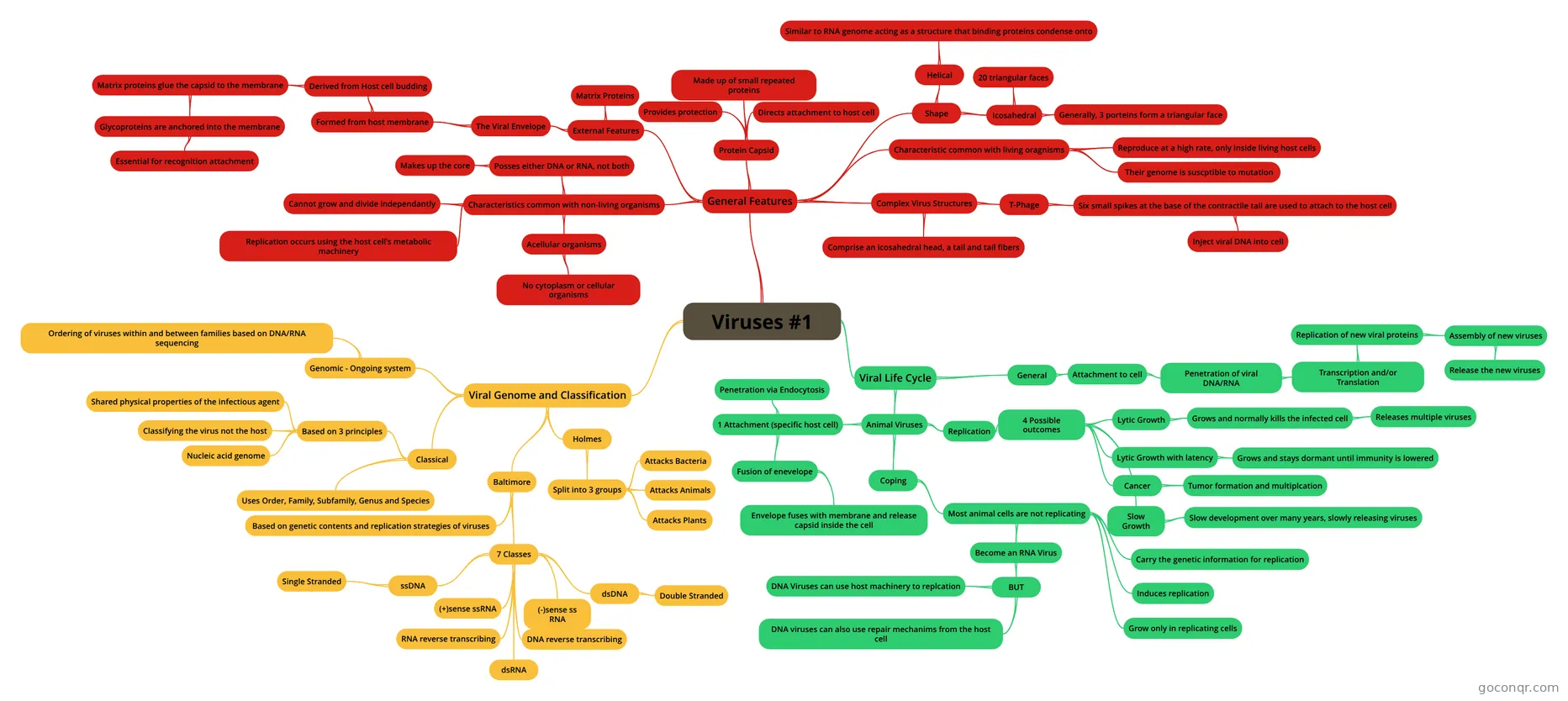
Mind map: viruses
Map content
Viruses #1
General Features
- Characteristic common with living oragnisms
- Reproduce at a high rate, only inside living host cells
- Their genome is suscptible to mutation
- Characteristics common with non-living organisms
- Acellular organisms
- No cytoplasm or cellular organisms
- Cannot grow and divide independantly
- Replication occurs using the host cell's metabolic machinery
- Posses either DNA or RNA, not both
- Makes up the core
- Acellular organisms
- Protein Capsid
- Made up of small repeated proteins
- Directs attachment to host cell
- Provides protection
- Shape
- Helical
- Similar to RNA genome acting as a structure that binding proteins condense onto
- Icosahedral
- Generally, 3 porteins form a triangular face
- 20 triangular faces
- Helical
- External Features
- Matrix Proteins
- The Viral Envelope
- Formed from host membrane
- Derived from Host cell budding
- Matrix proteins glue the capsid to the membrane
- Glycoproteins are anchored into the membrane
- Essential for recognition attachment
- Glycoproteins are anchored into the membrane
- Matrix proteins glue the capsid to the membrane
- Derived from Host cell budding
- Formed from host membrane
- Complex Virus Structures
- Comprise an icosahedral head, a tail and tail fibers
- T-Phage
- Six small spikes at the base of the contractile tail are used to attach to the host cell
- Inject viral DNA into cell
- Six small spikes at the base of the contractile tail are used to attach to the host cell
- Characteristic common with living oragnisms
Viral Genome and Classification
- Holmes
- Split into 3 groups
- Attacks Bacteria
- Attacks Plants
- Attacks Animals
- Split into 3 groups
- Classical
- Based on 3 principles
- Classifying the virus not the host
- Nucleic acid genome
- Shared physical properties of the infectious agent
- Uses Order, Family, Subfamily, Genus and Species
- Based on 3 principles
- Baltimore
- Based on genetic contents and replication strategies of viruses
- 7 Classes
- dsDNA
- Double Stranded
- ssDNA
- Single Stranded
- dsRNA
- (+)sense ssRNA
- (-)sense ss RNA
- RNA reverse transcribing
- DNA reverse transcribing
- dsDNA
- Genomic - Ongoing system
- Ordering of viruses within and between families based on DNA/RNA sequencing
- Holmes
Viral Life Cycle
- General
- Attachment to cell
- Penetration of viral DNA/RNA
- Transcription and/or Translation
- Replication of new viral proteins
- Assembly of new viruses
- Release the new viruses
- Assembly of new viruses
- Replication of new viral proteins
- Transcription and/or Translation
- Penetration of viral DNA/RNA
- Attachment to cell
- Animal Viruses
- Replication
- 4 Possible outcomes
- Lytic Growth
- Grows and normally kills the infected cell
- Releases multiple viruses
- Grows and normally kills the infected cell
- Lytic Growth with latency
- Grows and stays dormant until immunity is lowered
- Slow Growth
- Slow development over many years, slowly releasing viruses
- Cancer
- Tumor formation and multiplcation
- Lytic Growth
- 4 Possible outcomes
- 1 Attachment (specific host cell)
- Penetration via Endocytosis
- Fusion of enevelope
- Envelope fuses with membrane and release capsid inside the cell
- Coping
- Most animal cells are not replicating
- Induces replication
- Carry the genetic information for replication
- Grow only in replicating cells
- Become an RNA Virus
- BUT
- DNA Viruses can use host machinery to replcation
- DNA viruses can also use repair mechanims from the host cell
- BUT
- Most animal cells are not replicating
- Replication
- General
Information
- Description
- 2 Biology Mind Map on Viruses #1, created by Danny Que on 22/03/2016.
- Created by
- Danny Que
- Views
- 5
- Rating