
Mind map
Chapter 4 map
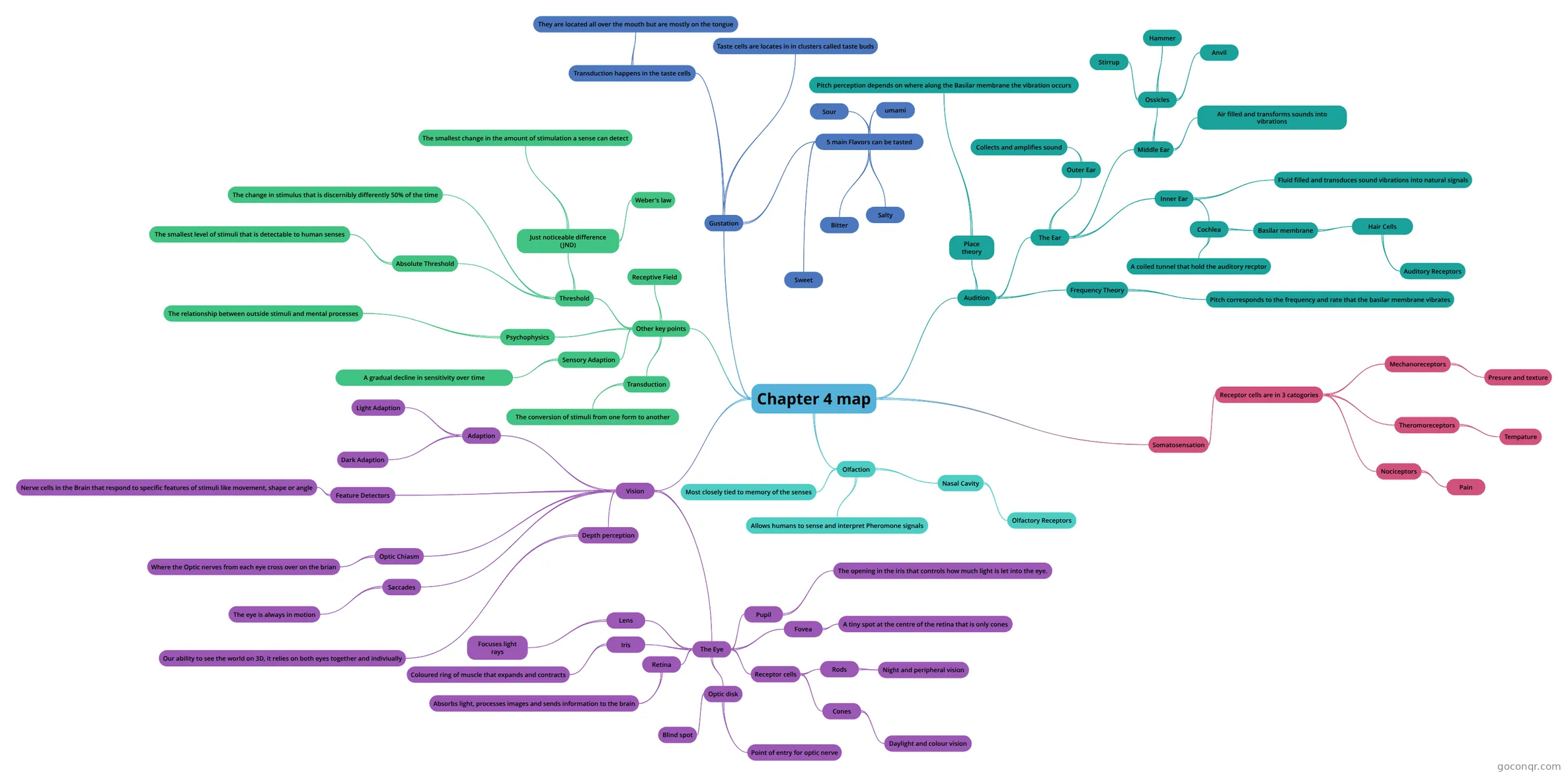
Mind map: chapter 4 senses
Map content
Chapter 4 map
Vision
- The Eye
- Retina
- Absorbs light, processes images and sends information to the brain
- Optic disk
- Blind spot
- Point of entry for optic nerve
- Receptor cells
- Rods
- Night and peripheral vision
- Cones
- Daylight and colour vision
- Rods
- Pupil
- The opening in the iris that controls how much light is let into the eye.
- Lens
- Focuses light rays
- Iris
- Coloured ring of muscle that expands and contracts
- Fovea
- A tiny spot at the centre of the retina that is only cones
- Retina
- Adaption
- Dark Adaption
- Light Adaption
- Saccades
- The eye is always in motion
- Optic Chiasm
- Where the Optic nerves from each eye cross over on the brian
- Feature Detectors
- Nerve cells in the Brain that respond to specific features of stimuli like movement, shape or angle
- Depth perception
- Our ability to see the world on 3D, it relies on both eyes together and indiviually
- The Eye
Audition
- The Ear
- Outer Ear
- Collects and amplifies sound
- Middle Ear
- Air filled and transforms sounds into vibrations
- Ossicles
- Hammer
- Anvil
- Stirrup
- Inner Ear
- Fluid filled and transduces sound vibrations into natural signals
- Cochlea
- A coiled tunnel that hold the auditory recptor
- Basilar membrane
- Hair Cells
- Auditory Receptors
- Hair Cells
- Outer Ear
- Place theory
- Pitch perception depends on where along the Basilar membrane the vibration occurs
- Frequency Theory
- Pitch corresponds to the frequency and rate that the basilar membrane vibrates
- The Ear
Gustation
- Transduction happens in the taste cells
- They are located all over the mouth but are mostly on the tongue
- Taste cells are locates in in clusters called taste buds
- 5 main Flavors can be tasted
- Sweet
- Bitter
- Salty
- Sour
- umami
- Transduction happens in the taste cells
Olfaction
- Most closely tied to memory of the senses
- Allows humans to sense and interpret Pheromone signals
- Nasal Cavity
- Olfactory Receptors
Somatosensation
- Receptor cells are in 3 catogories
- Mechanoreceptors
- Presure and texture
- Theromoreceptors
- Tempature
- Nociceptors
- Pain
- Mechanoreceptors
- Receptor cells are in 3 catogories
Other key points
- Psychophysics
- The relationship between outside stimuli and mental processes
- Threshold
- The change in stimulus that is discernibly differently 50% of the time
- Absolute Threshold
- The smallest level of stimuli that is detectable to human senses
- Just noticeable difference (JND)
- The smallest change in the amount of stimulation a sense can detect
- Weber's law
- Sensory Adaption
- A gradual decline in sensitivity over time
- Receptive Field
- Transduction
- The conversion of stimuli from one form to another
- Psychophysics