
Mind map
Reflection and critical thinking
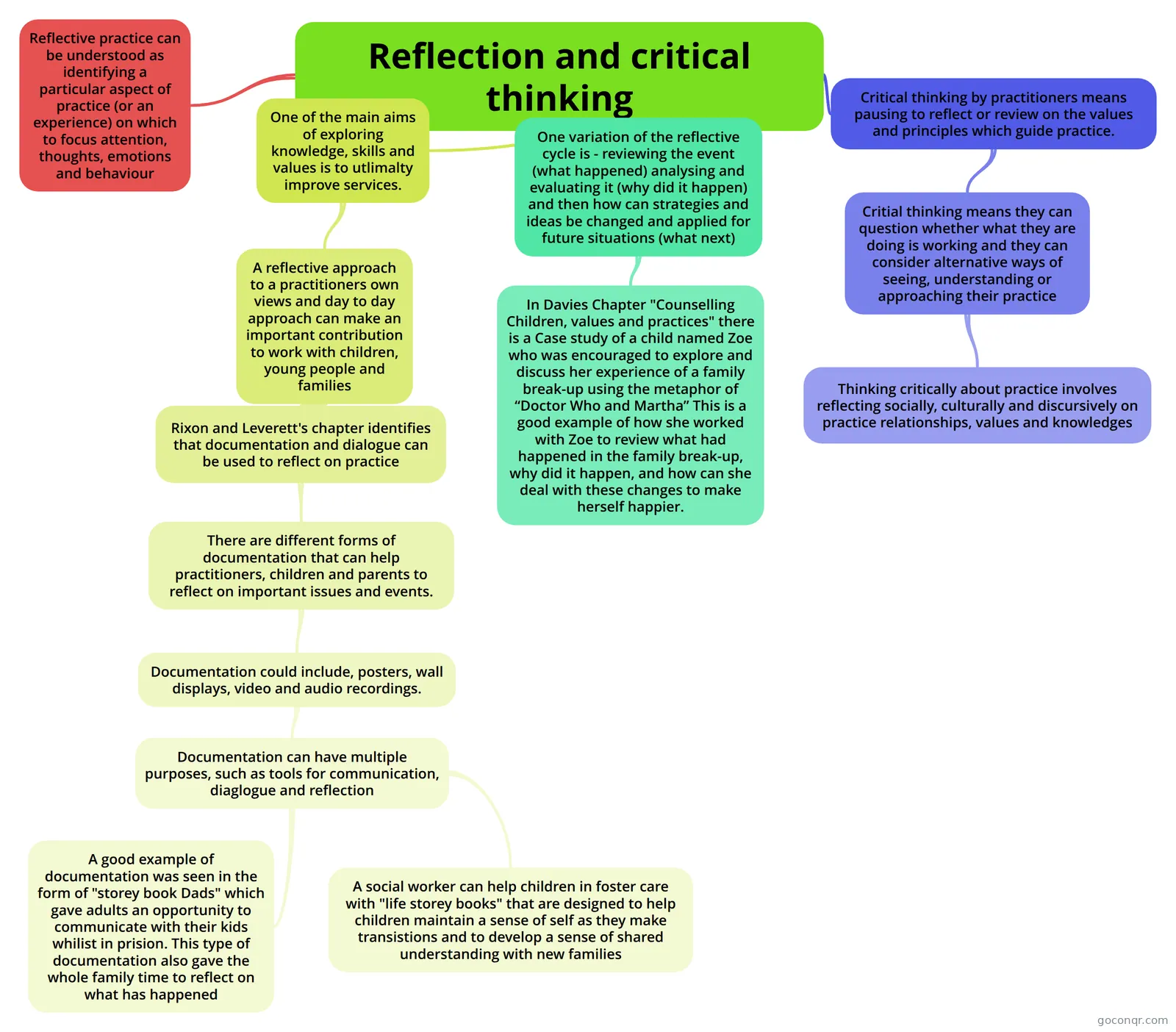
Mind map: Reflection and critical thinking
Map content
Reflection and critical thinking
Reflective practice can be understood as identifying a particular aspect of practice (or an experience) on which to focus attention, thoughts, emotions and behaviour
One of the main aims of exploring knowledge, skills and values is to utlimalty improve services.
- A reflective approach to a practitioners own views and day to day approach can make an important contribution to work with children, young people and families
- Rixon and Leverett's chapter identifies that documentation and dialogue can be used to reflect on practice
- There are different forms of documentation that can help practitioners, children and parents to reflect on important issues and events.
- Documentation could include, posters, wall displays, video and audio recordings.
- Documentation can have multiple purposes, such as tools for communication, diaglogue and reflection
- A good example of documentation was seen in the form of "storey book Dads" which gave adults an opportunity to communicate with their kids whilist in prision. This type of documentation also gave the whole family time to reflect on what has happened
- A social worker can help children in foster care with "life storey books" that are designed to help children maintain a sense of self as they make transistions and to develop a sense of shared understanding with new families
- Documentation can have multiple purposes, such as tools for communication, diaglogue and reflection
- Documentation could include, posters, wall displays, video and audio recordings.
- There are different forms of documentation that can help practitioners, children and parents to reflect on important issues and events.
- Rixon and Leverett's chapter identifies that documentation and dialogue can be used to reflect on practice
- A reflective approach to a practitioners own views and day to day approach can make an important contribution to work with children, young people and families
One variation of the reflective cycle is - reviewing the event (what happened) analysing and evaluating it (why did it happen) and then how can strategies and ideas be changed and applied for future situations (what next)
- In Davies Chapter "Counselling Children, values and practices" there is a Case study of a child named Zoe who was encouraged to explore and discuss her experience of a family break-up using the metaphor of “Doctor Who and Martha” This is a good example of how she worked with Zoe to review what had happened in the family break-up, why did it happen, and how can she deal with these changes to make herself happier.
Critical thinking by practitioners means pausing to reflect or review on the values and principles which guide practice.
- Critial thinking means they can question whether what they are doing is working and they can consider alternative ways of seeing, understanding or approaching their practice
- Thinking critically about practice involves reflecting socially, culturally and discursively on practice relationships, values and knowledges
- Critial thinking means they can question whether what they are doing is working and they can consider alternative ways of seeing, understanding or approaching their practice
Information
- Description
- K218 Working with children, young people and families Mind Map on Reflection and critical thinking, created by selinaward on 05/05/2013.
- Created by
- selinaward
- Views
- 150
- Tags
- Rating