
Mind map
Interpretivism.
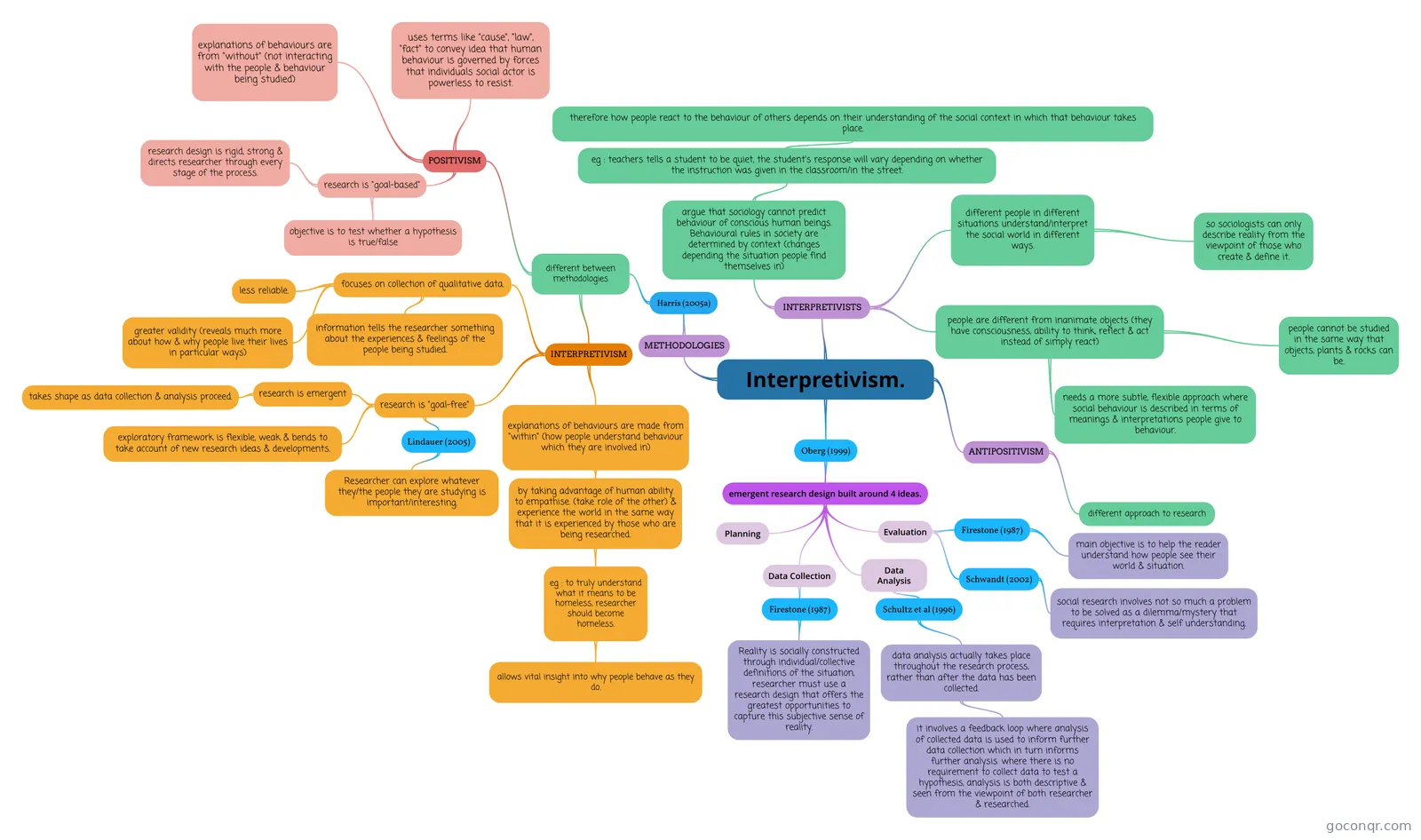
Mind map: Interpretivism
Map content
Interpretivism.
INTERPRETIVISTS
- different people in different situations understand/interpret the social world in different ways.
- so sociologists can only describe reality from the viewpoint of those who create & define it.
- people are different from inanimate objects (they have consciousness, ability to think, reflect & act instead of simply react)
- people cannot be studied in the same way that objects, plants & rocks can be.
- needs a more subtle, flexible approach where social behaviour is described in terms of meanings & interpretations people give to behaviour.
- argue that sociology cannot predict behaviour of conscious human beings. Behavioural rules in society are determined by context (changes depending the situation people find themselves in)
- eg : teachers tells a student to be quiet, the student's response will vary depending on whether the instruction was given in the classroom/in the street.
- therefore how people react to the behaviour of others depends on their understanding of the social context in which that behaviour takes place.
- eg : teachers tells a student to be quiet, the student's response will vary depending on whether the instruction was given in the classroom/in the street.
- different people in different situations understand/interpret the social world in different ways.
METHODOLOGIES
- Harris (2005a)
- different between methodologies
- POSITIVISM
- uses terms like "cause", "law", "fact" to convey idea that human behaviour is governed by forces that individuals social actor is powerless to resist.
- explanations of behaviours are from "without" (not interacting with the people & behaviour being studied)
- research is "goal-based"
- objective is to test whether a hypothesis is true/false
- research design is rigid, strong & directs researcher through every stage of the process.
- INTERPRETIVISM
- explanations of behaviours are made from "within" (how people understand behaviour which they are involved in)
- by taking advantage of human ability to empathise. (take role of the other) & experience the world in the same way that it is experienced by those who are being researched.
- eg : to truly understand what it means to be homeless, researcher should become homeless.
- allows vital insight into why people behave as they do.
- eg : to truly understand what it means to be homeless, researcher should become homeless.
- by taking advantage of human ability to empathise. (take role of the other) & experience the world in the same way that it is experienced by those who are being researched.
- focuses on collection of qualitative data.
- information tells the researcher something about the experiences & feelings of the people being studied.
- less reliable.
- greater validity (reveals much more about how & why people live their lives in particular ways)
- research is "goal-free"
- Lindauer (2005)
- Researcher can explore whatever they/the people they are studying is important/interesting.
- research is emergent
- takes shape as data collection & analysis proceed.
- exploratory framework is flexible, weak & bends to take account of new research ideas & developments.
- Lindauer (2005)
- explanations of behaviours are made from "within" (how people understand behaviour which they are involved in)
- POSITIVISM
- different between methodologies
- Harris (2005a)
ANTIPOSITIVISM
- different approach to research
Oberg (1999)
- emergent research design built around 4 ideas.
- Planning
- A research issue is identified and a research question takes place.
- Data Collection
- - This research design is non-linear (it does not begin with a hypothesis & end with confirmation/rejection). - Researcher is not looking for definite answers, so a research question is explored from different perspectives (those of the people being researches/of the researcher themselves)
- Firestone (1987)
- Reality is socially constructed through individual/collective definitions of the situation, researcher must use a research design that offers the greatest opportunities to capture this subjective sense of reality.
- Data Analysis
- Schultz et al (1996)
- data analysis actually takes place throughout the research process, rather than after the data has been collected.
- it involves a feedback loop where analysis of collected data is used to inform further data collection which in turn informs further analysis. where there is no requirement to collect data to test a hypothesis, analysis is both descriptive & seen from the viewpoint of both researcher & researched.
- data analysis actually takes place throughout the research process, rather than after the data has been collected.
- Schultz et al (1996)
- Evaluation
- - Research is generally non judgemental. - Readers are left to draw their own conclusions.
- Firestone (1987)
- main objective is to help the reader understand how people see their world & situation.
- Schwandt (2002)
- social research involves not so much a problem to be solved as a dilemma/mystery that requires interpretation & self understanding.
- Planning
- emergent research design built around 4 ideas.
Information
- Description
- CIE AS-Level Sociology. Mind map of interpretivism.
- Created by
- J T
- Views
- 122
- Tags
- Rating