
Mind map
Feedback
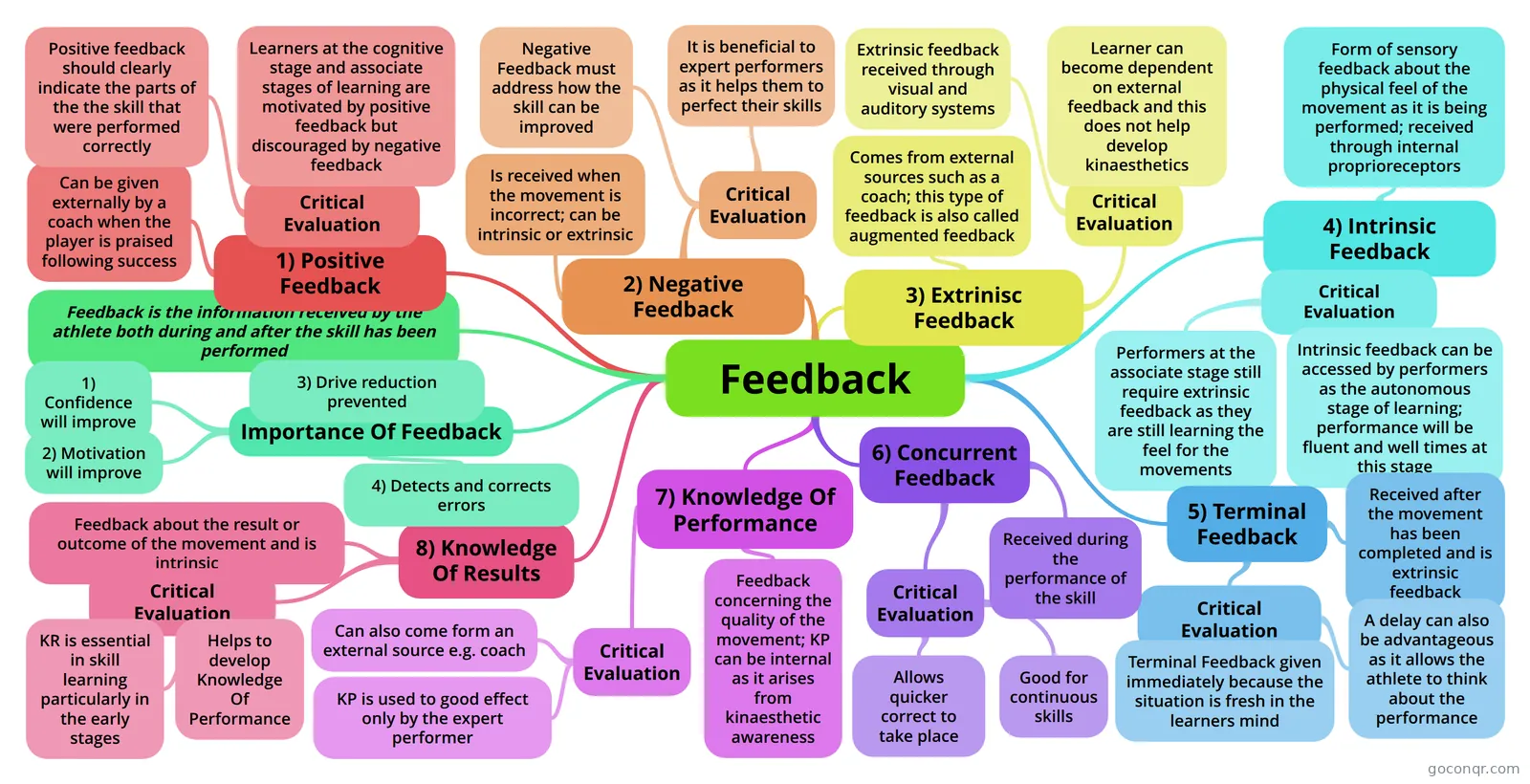
Mind map: Feedback in sports skills
Map content
Feedback
Feedback is the information received by the athlete both during and after the skill has been performed
1) Positive Feedback
- Can be given externally by a coach when the player is praised following success
- Critical Evaluation
- Positive feedback should clearly indicate the parts of the the skill that were performed correctly
- Learners at the cognitive stage and associate stages of learning are motivated by positive feedback but discouraged by negative feedback
2) Negative Feedback
- Is received when the movement is incorrect; can be intrinsic or extrinsic
- Critical Evaluation
- Negative Feedback must address how the skill can be improved
- It is beneficial to expert performers as it helps them to perfect their skills
3) Extrinisc Feedback
- Comes from external sources such as a coach; this type of feedback is also called augmented feedback
- Critical Evaluation
- Extrinsic feedback received through visual and auditory systems
- Learner can become dependent on external feedback and this does not help develop kinaesthetics
4) Intrinsic Feedback
- Form of sensory feedback about the physical feel of the movement as it is being performed; received through internal proprioreceptors
- Critical Evaluation
- Intrinsic feedback can be accessed by performers as the autonomous stage of learning; performance will be fluent and well times at this stage
- Performers at the associate stage still require extrinsic feedback as they are still learning the feel for the movements
5) Terminal Feedback
- Received after the movement has been completed and is extrinsic feedback
- Critical Evaluation
- Terminal Feedback given immediately because the situation is fresh in the learners mind
- A delay can also be advantageous as it allows the athlete to think about the performance
6) Concurrent Feedback
- Received during the performance of the skill
- Critical Evaluation
- Good for continuous skills
- Allows quicker correct to take place
7) Knowledge Of Performance
- Feedback concerning the quality of the movement; KP can be internal as it arises from kinaesthetic awareness
- Critical Evaluation
- KP is used to good effect only by the expert performer
- Can also come form an external source e.g. coach
8) Knowledge Of Results
- Feedback about the result or outcome of the movement and is intrinsic
- Critical Evaluation
- KR is essential in skill learning particularly in the early stages
- Helps to develop Knowledge Of Performance
Importance Of Feedback
- 1) Confidence will improve
- 2) Motivation will improve
- 3) Drive reduction prevented
- 4) Detects and corrects errors
Information
- Description
- A Levels Physical Education (Acquiring Movement Skill) Mind Map on Feedback, created by danny-hudson97 on 10/04/2014.
- Created by
- danny-hudson97
- Views
- 41
- Tags
- Rating