
Mind map
How and why do populations change naturally?
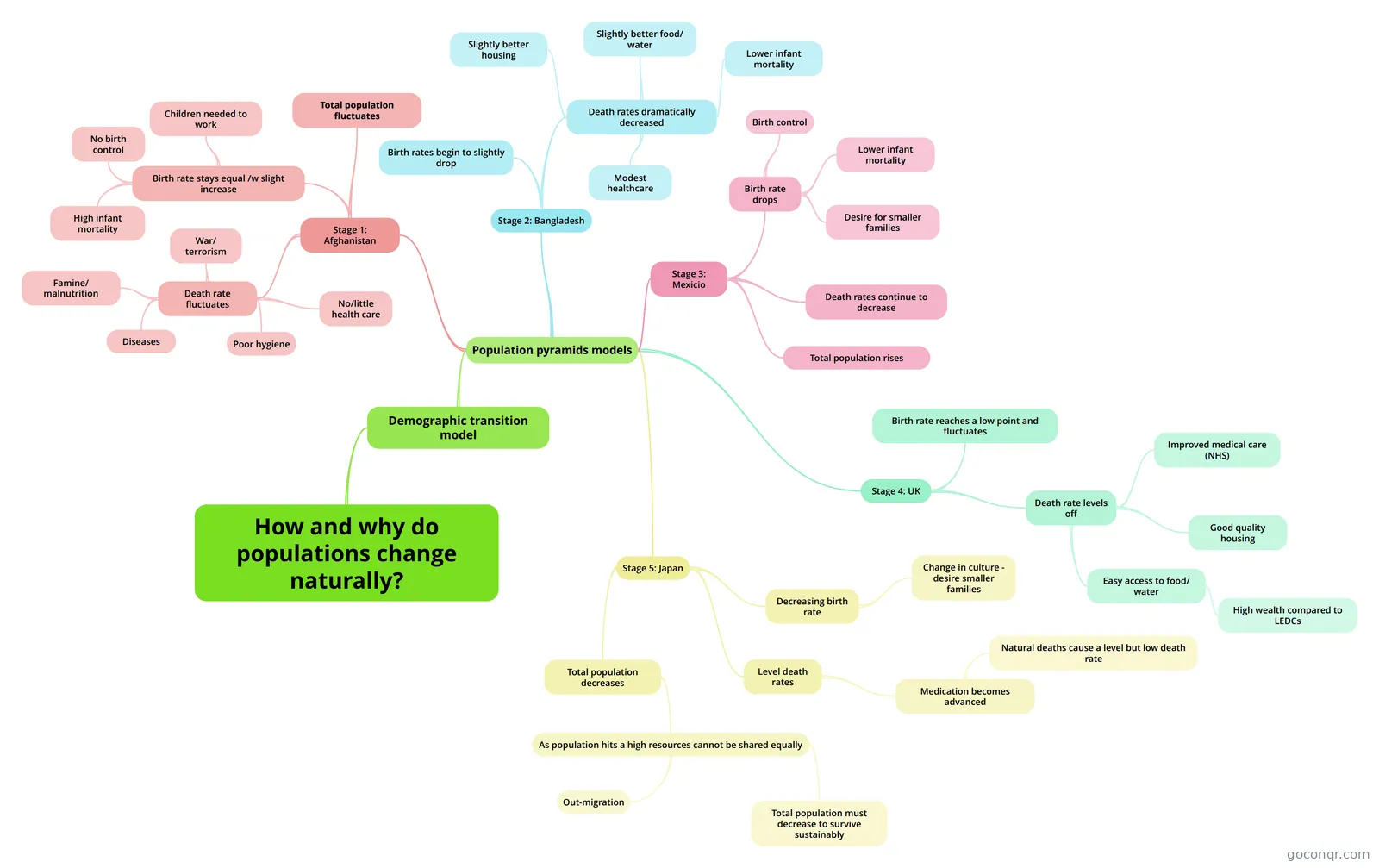
Mind map: how and why populations change naturally
Map content
How and why do populations change naturally?
Demographic transition model
- Population pyramids models
- Stage 1: Afghanistan
- Birth rate stays equal /w slight increase
- No birth control
- High infant mortality
- Children needed to work
- Death rate fluctuates
- Diseases
- Poor hygiene
- No/little health care
- Famine/ malnutrition
- War/ terrorism
- Total population fluctuates
- Birth rate stays equal /w slight increase
- Stage 2: Bangladesh
- Birth rates begin to slightly drop
- Death rates dramatically decreased
- Slightly better housing
- Slightly better food/ water
- Modest healthcare
- Lower infant mortality
- Stage 3: Mexicio
- Birth rate drops
- Birth control
- Lower infant mortality
- Desire for smaller families
- Death rates continue to decrease
- Total population rises
- Birth rate drops
- Stage 4: UK
- Birth rate reaches a low point and fluctuates
- Death rate levels off
- Improved medical care (NHS)
- Good quality housing
- Easy access to food/ water
- High wealth compared to LEDCs
- Stage 5: Japan
- Decreasing birth rate
- Change in culture - desire smaller families
- Level death rates
- Medication becomes advanced
- Natural deaths cause a level but low death rate
- Medication becomes advanced
- Total population decreases
- As population hits a high resources cannot be shared equally
- Total population must decrease to survive sustainably
- Out-migration
- As population hits a high resources cannot be shared equally
- Decreasing birth rate
- Stage 1: Afghanistan
- Population pyramids models
Information
- Description
- A-level Geography G2 (1.2 - How and why do populations change naturally?) Mind Map on How and why do populations change naturally?, created by RoryFlynn2 on 07/05/2013.
- Created by
- RoryFlynn2
- Views
- 212
- Tags
- Rating