
Mind map
C3
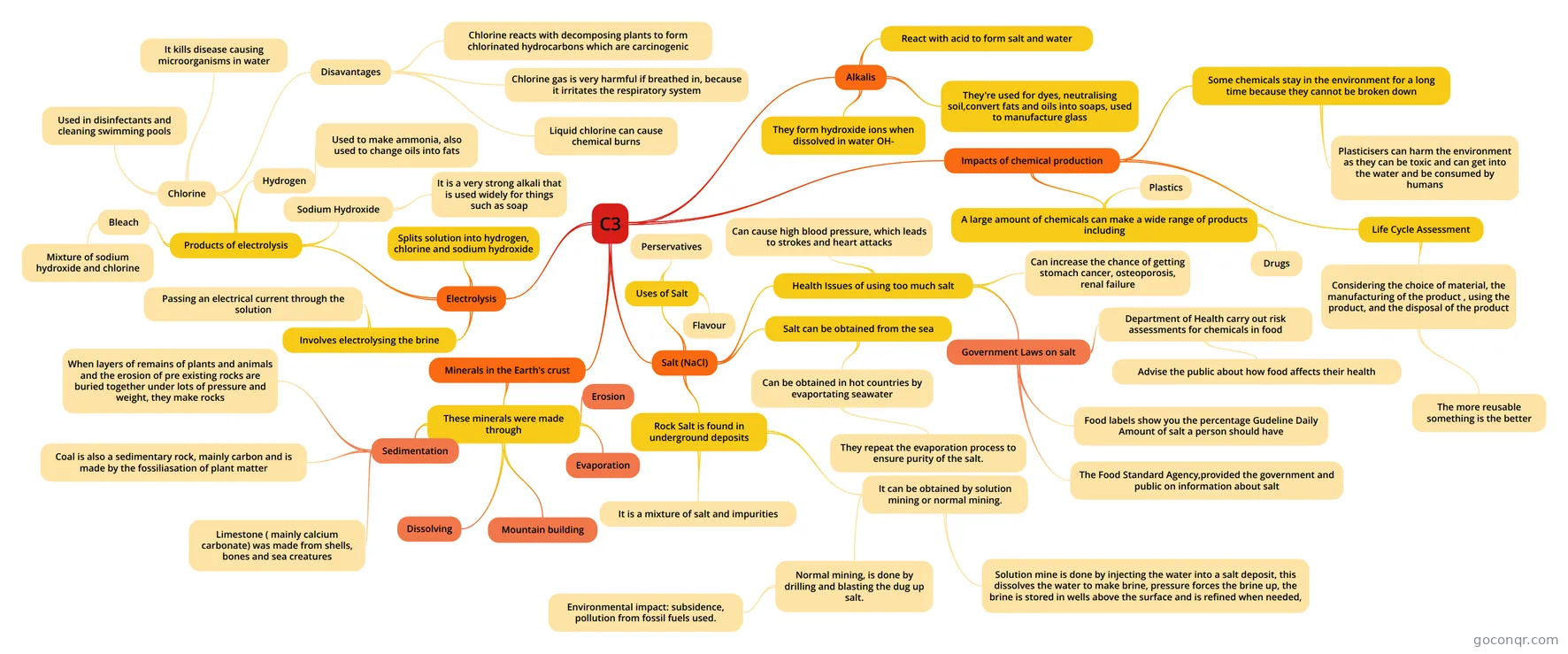
Mind map: Minerals, salt and electrolysis
Map content
C3
Minerals in the Earth's crust
- These minerals were made through
- Sedimentation
- Limestone ( mainly calcium carbonate) was made from shells, bones and sea creatures
- Coal is also a sedimentary rock, mainly carbon and is made by the fossiliasation of plant matter
- When layers of remains of plants and animals and the erosion of pre existing rocks are buried together under lots of pressure and weight, they make rocks
- Dissolving
- Evaporation
- Erosion
- Mountain building
- Sedimentation
- These minerals were made through
Salt (NaCl)
- Rock Salt is found in underground deposits
- It is a mixture of salt and impurities
- It can be obtained by solution mining or normal mining.
- Normal mining, is done by drilling and blasting the dug up salt.
- Environmental impact: subsidence, pollution from fossil fuels used.
- Solution mine is done by injecting the water into a salt deposit, this dissolves the water to make brine, pressure forces the brine up, the brine is stored in wells above the surface and is refined when needed,
- Normal mining, is done by drilling and blasting the dug up salt.
- Salt can be obtained from the sea
- Can be obtained in hot countries by evaportating seawater
- They repeat the evaporation process to ensure purity of the salt.
- Can be obtained in hot countries by evaportating seawater
- Uses of Salt
- Flavour
- Perservatives
- Health Issues of using too much salt
- Can cause high blood pressure, which leads to strokes and heart attacks
- Can increase the chance of getting stomach cancer, osteoporosis, renal failure
- Government Laws on salt
- The Food Standard Agency,provided the government and public on information about salt
- Food labels show you the percentage Gudeline Daily Amount of salt a person should have
- Department of Health carry out risk assessments for chemicals in food
- Advise the public about how food affects their health
- Rock Salt is found in underground deposits
Electrolysis
- Involves electrolysing the brine
- Passing an electrical current through the solution
- Splits solution into hydrogen, chlorine and sodium hydroxide
- Products of electrolysis
- Chlorine
- Used in disinfectants and cleaning swimming pools
- It kills disease causing microorganisms in water
- Disavantages
- Chlorine reacts with decomposing plants to form chlorinated hydrocarbons which are carcinogenic
- Chlorine gas is very harmful if breathed in, because it irritates the respiratory system
- Liquid chlorine can cause chemical burns
- Sodium Hydroxide
- It is a very strong alkali that is used widely for things such as soap
- Hydrogen
- Used to make ammonia, also used to change oils into fats
- Bleach
- Mixture of sodium hydroxide and chlorine
- Chlorine
- Involves electrolysing the brine
Alkalis
- They form hydroxide ions when dissolved in water OH-
- React with acid to form salt and water
- They're used for dyes, neutralising soil,convert fats and oils into soaps, used to manufacture glass
Impacts of chemical production
- A large amount of chemicals can make a wide range of products including
- Drugs
- Plastics
- Some chemicals stay in the environment for a long time because they cannot be broken down
- Plasticisers can harm the environment as they can be toxic and can get into the water and be consumed by humans
- Life Cycle Assessment
- Considering the choice of material, the manufacturing of the product , using the product, and the disposal of the product
- The more reusable something is the better
- Considering the choice of material, the manufacturing of the product , using the product, and the disposal of the product
- A large amount of chemicals can make a wide range of products including
Information
- Description
- Mind Map on C3, created by Lina Yousof on 13/02/2017.
- Created by
- Lina Yousof
- Views
- 1
- Rating