
Mind map
Evolution
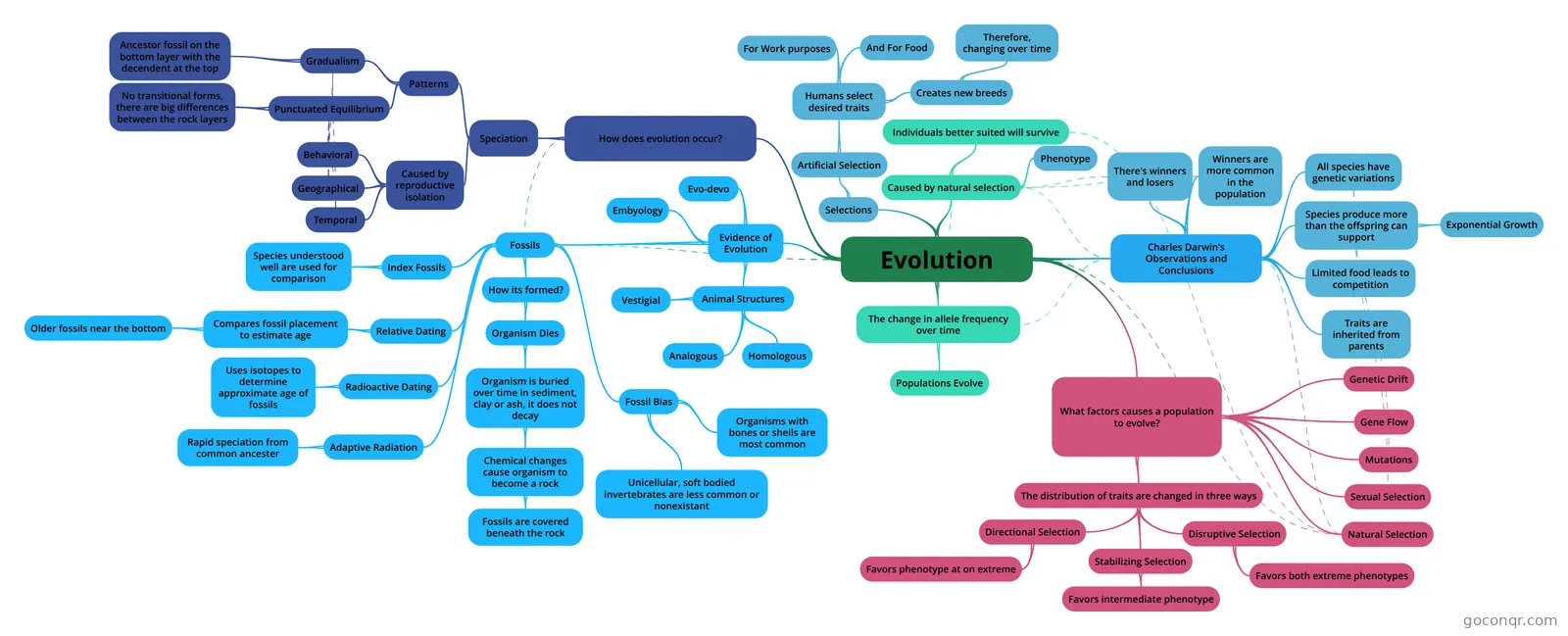
Mind map: Evolution
Map content
Evolution
The change in allele frequency over time
- Populations Evolve
Caused by natural selection
- Phenotype
- Individuals better suited will survive
Charles Darwin's Observations and Conclusions
- All species have genetic variations
- Traits are inherited from parents
- Limited food leads to competition
- Species produce more than the offspring can support
- Exponential Growth
- There's winners and losers
- Winners are more common in the population
How does evolution occur?
- Speciation
- Caused by reproductive isolation
- Geographical
- Behavioral
- Temporal
- Patterns
- Gradualism
- Ancestor fossil on the bottom layer with the decendent at the top
- Punctuated Equilibrium
- No transitional forms, there are big differences between the rock layers
- Gradualism
- Caused by reproductive isolation
- Speciation
Selections
- Artificial Selection
- Humans select desired traits
- For Work purposes
- And For Food
- Creates new breeds
- Therefore, changing over time
- Humans select desired traits
- Artificial Selection
What factors causes a population to evolve?
- The distribution of traits are changed in three ways
- Directional Selection
- Favors phenotype at on extreme
- Stabilizing Selection
- Favors intermediate phenotype
- Disruptive Selection
- Favors both extreme phenotypes
- Directional Selection
- Genetic Drift
- Gene Flow
- Mutations
- Sexual Selection
- Natural Selection
- The distribution of traits are changed in three ways
Evidence of Evolution
- Embyology
- Evo-devo
- Animal Structures
- Homologous
- Analogous
- Vestigial
- Fossils
- How its formed?
- Organism Dies
- Organism is buried over time in sediment, clay or ash, it does not decay
- Chemical changes cause organism to become a rock
- Fossils are covered beneath the rock
- Chemical changes cause organism to become a rock
- Organism is buried over time in sediment, clay or ash, it does not decay
- Organism Dies
- Relative Dating
- Compares fossil placement to estimate age
- Older fossils near the bottom
- Compares fossil placement to estimate age
- Index Fossils
- Species understood well are used for comparison
- Fossil Bias
- Organisms with bones or shells are most common
- Unicellular, soft bodied invertebrates are less common or nonexistant
- Radioactive Dating
- Uses isotopes to determine approximate age of fossils
- Adaptive Radiation
- Rapid speciation from common ancester
- How its formed?
Information
- Description
- 9th grade Biology (Evolution) Mind Map on Evolution, created by Joshua Zhang on 07/04/2017.
- Created by
- Joshua Zhang
- Views
- 0
- Rating