
Notes
Nitrogen Cycle
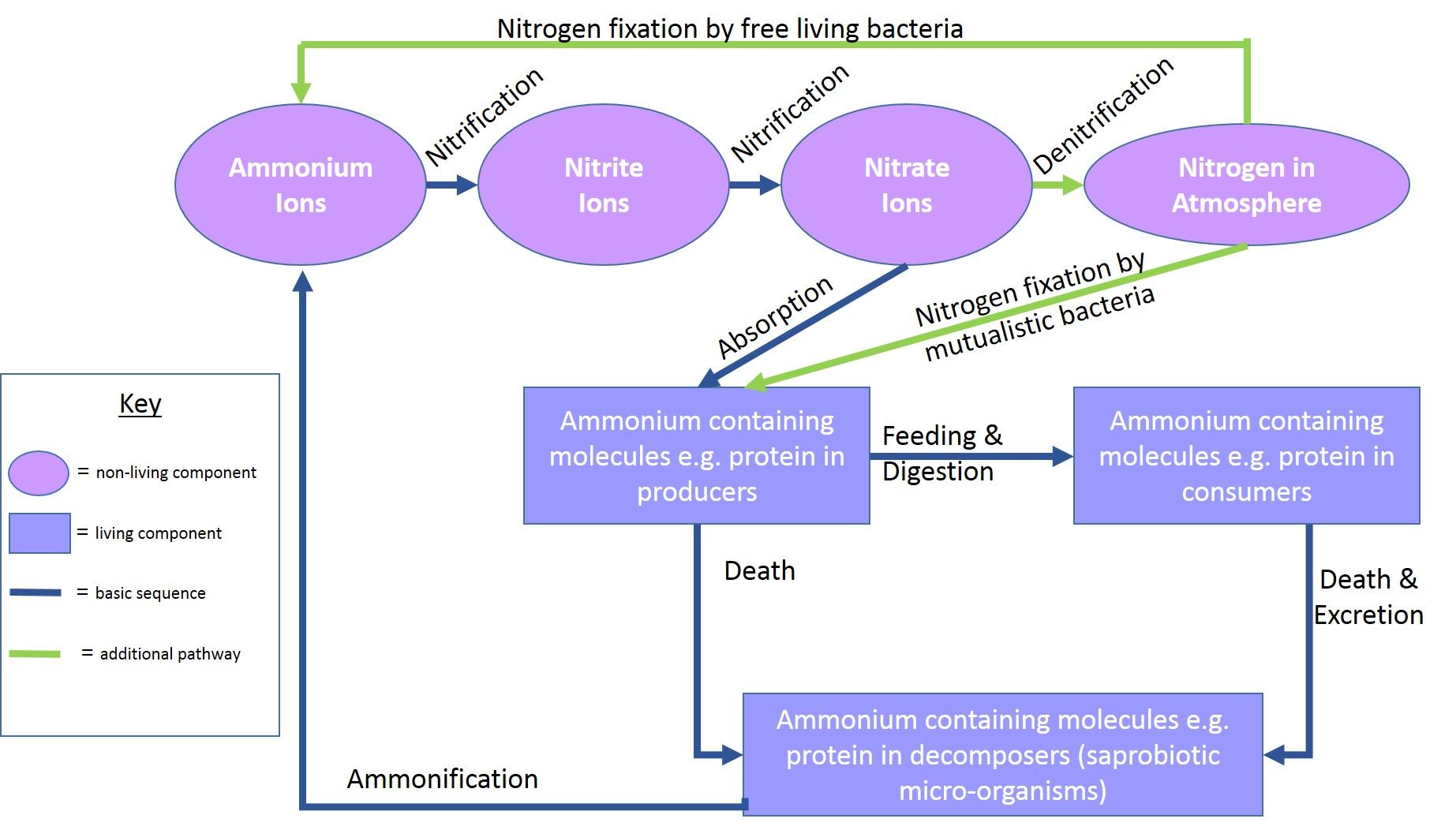
Content of the notes (1)
Page 1
Nitrogen Cycle
Ammonification:
Saprobiotic microorganisms feed on urea found from the ammonium containing compounds.
They release NH3 as they do so, then it is converted to NH4+ in ammonification in the soil.
Nitrification:
Ammonium ion is oxidised first to Nitrite then to Nitrate ions by an oxidation reaction.
This is done by nitrifying bacteria, since this is an oxidation reaction it will need to be in aerobic conditions.
So the soil will need to be light structured and well aerated by ploughing to maximise productivity.
Also, good drainage system to prevent build of water which will otherwise cause anaerobic conditions and lead to denitrification.
Nitrogen fixation
Where atmospheric nitrogen is converted to NH3.
This can be done industrially via the Haber process or naturally by lightning.
There are 2 forms of nitrogen fixing bacteria:
1- Free-living nitrogen fixing bacteria. These reduce atmospheric nitrogen into ammonia via the enzyme nitrogenase (Off spec), they then use this to manufacture amino acids. When they die and decay, they release nitrogen-rich compounds.
2- Mutualistic nitrogen fixing bacteria. They are attached on root nodules of plants as they provide amino acids to the plant and it is supplied with carbohydrates from the plant (Mutual relationship).
Denitrification:
If the soil is not well aerated by ploughing and not a very sufficient drainage system the soil will become waterlogged.
This will cause anaerobic conditions which will increase the amount of denitrifying bacteria present and decrease nitrogen fixing and nitrifying bacteria.
The denitrifying bacteria converts the nitrites present in the soil into atmospheric nitrogen and therefore reduce growth of plants and ultimately reducing productivity.
Information
- Description
- A level Biology Note on Nitrogen Cycle, created by Taran Sahota on 06/06/2015.
- Created by
- Taran Sahota
- Views
- 8
- Rating