
Notes
Biodiversity
Content of the notes (6)
Page 1
Biodiversity
Biodiversity is the variety of living things - plants, trees, fungi (mushrooms), animals and bacteria.
An ecosystem is made up of both living and non-living parts. Within each ecosystem there can be many habitats. A habitat is when a living things live.
Each habitat is made up of a community. When looking at a community, you can see that it is made up of many different species.
However, a community can be broken down into different populations. A population is a focus on one specific species.
Example
When you look at an ecosystem that is thriving in the soil, the soil is the habitat as the community is living within in. The community is made up of worms, beetles and other insects. Looking at the community in further detail, there is a population of worms; a population of beetles; and so on.
Biodiversity is important for an ecosystem to thrive. When there is a high biodiversity, there is a great variety in the range of species in the community. On the other hand, you can have an ecosystem with a low biodiversity - meaning that there is a small variety within the community in the ecosystem.
When the ecosystem has a high diversity, it makes it less likely to be affected by small changes that can happen. They can adapt and work around any changes that arise, allowing for ecosystem to be a more stable place.
Page 2
Abiotic and Biotic Factors
Interdependence is when living organisms/things depend on each other for survival. However, interdependence can be affected by different factors - biotic and abiotic.
Living factors that can affect biodiversity are call Biotic factors. This can include:
Predators - Being overhunted can cause a population to shrink and being under hunted can cause the population to grow
Disease - This can lead to multiple populations to either grow or shrink. If one population was to become diseased and shrink, it can lead to its predators to then become smaller in population due to a shortage of food
Competition - If a population is trying to get food and water, but has other members of its population or another population to have to compete with to have as much access to these as possible.
Factors that are not living and can affect biodiversity are known as Abiotic Factors. These factors can be measured and can include:
Temperature
Light Intensity
Moisture Content
Wind Speed
Salt Concentration - for living organisms that live in water (eg fish)
Page 3
Branch Key
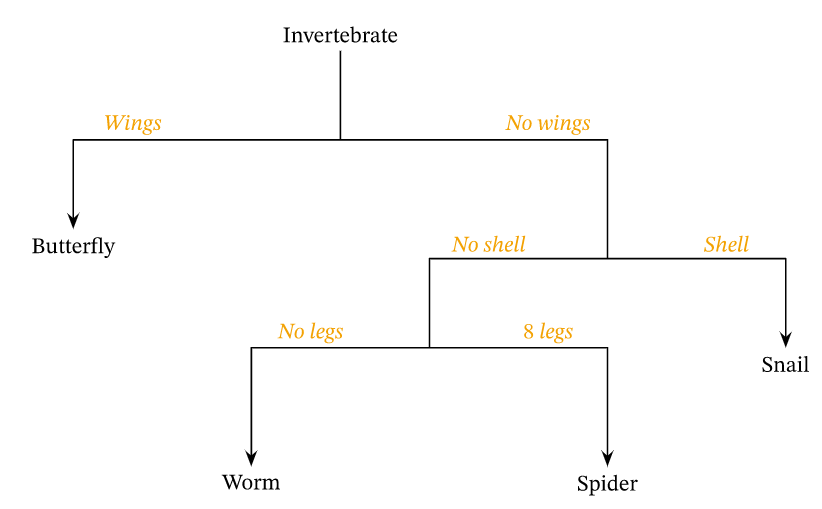
A Dichotomous Key is a set of questions that only have 2 answers. It is called a branch key, as it does what is says - the key is set out to branch off in opposite directions based on the answer to the question. Finally you will get to the answer by following the branches.
You can use it to identify organisms living in a community - this can be used for trees, plants, animals and insects. In the example given below, it shows how to use the branch key to identify invertebrates (animals that don't have a back bone).
Page 4
Importance of Biodiversity
Biodiversity is vital for all living things - if there was only one species of an animal it would die out if it was to catch a disease or if an animal only had one food source, then if it died out then the animal eating it would also die out du to starvation. However, with there being a variety of animals and food, there is less chance of a species dying due to biotic factors.
Biodiversity is needed to make an ecosystem healthy and self-sustaining. Human beings are dependent on all ecosystems working efficiently and constantly. This is due to the healthy ecosystems purify water, making it safe to drink. Healthy ecosystems also contain a variation of pants, that take out harmful carbon from the air and give off oxygen which humans need to survive.
Page 5
Decline of Biodiversity
Sadly, biodiversity is declining. As mention on the previous page, humans need a healthy ecosystem to be able to survive and a healthy ecosystem needs biodiversity.
Biodiversity is declining due to a few reasons:
Increased Carbon Levels - By humans burning fossil fuels, a lot more carbon dioxide is being released into the atmosphere. This is then causing the heat from the sun to build up and heating up the earth. The build up of carbon dioxide in the atmosphere is known as the Greenhouse affect (as the earth is heating up like a greenhouse)
Use of Land and Sea - Large areas of land is being cleared of plants and trees which are needed for oxygen and humans are also over fishing and hunting - causing wither extinction of species or a knock on effect of other species starting to become lower in population.
Exploitation of Animals - Due to the increase of the human population growing over the years, more plants and animals are needed to feed them. As well as this, humans are hunting some animals until there are none left and the entire species had been killed off for sport, medicines and food
Climate Change - With the increase in carbon dioxide, the earth is getting hotter causing changes to happen and many living things cannot cope with the change, having a knock o effect with the animals that can cope with the changes. Due to the overheating of the earth, ice caps are melting and there is a change in weather patterns (more floods and fires, for example), habitats are being destroyed and animals no longer have a place to live that suit their needs.
Page 6
Types of Habitats
There are 5 main types of habitats:
Forests
Deserts
Aquatic Regions
Polar Regions
Grasslands
Forests
These kind of habitats include rainforests, jungles nd woodlands. The most well know forest habitat is the Amazon Rainforest, in South America. Forests absorb a lot of carbon dioxide from the air, due to their diversity of plants and trees that need it for photosynthesis. However, due to humans cutting down the trees and plants (deforestation) for things such as mining and palm oil production - there is a less carbon dioxide being absorbed and thus causing the greenhouse affect to get worse.
Deserts
To be classed as a desert, this ecosystem has to have very little rain fall (most have les that 25cm per year). Deserts are very hot during the day, but during the night they are a very cold place to stay. Due to this, animals that live in the desert have to be able to adapt to the huge change in temperature daily. The driest desert in the world is called the Atacama Desert - located in Chile - and receives an average of only 1mm of rain each year. Sadly, due to human activity, the deserts are getting a lot hotter faster than the animals that live there can change to be adapted to survive there.
Aquatic Regions
More than 70% of the earth is covered in water, making this the biggest habitat out of the 5 types of habitats. The oceans and seas supports a vast number of marine life (fish, sharks, whales, etc), as well as producing half the oxygen in the world. It is also used to give safe drinking water for animals, plants and humans. However, due to rubbish and chemicals being disposed into the oceans, marine life are dying by getting caught in it, swallowing it and even affecting the ability for marine life to reproduce. Many places in the water are being overfished for human consumption (eating) and either animals higher up in the food change are being left with les food source or animals are being caught in the fishing nets by accident (such as dolphins, sharks and whales), which is causing them to start to die out and run the risk of endangerment or becoming extinct.
Polar Regions
This type of habitat includes the Artic (north of the earth) and Antarctic (south of the earth). Millions of people permanently live in the Artic, but no one lives in the Antarctic permanently. Both of these places are very very cold, so the animals and plants that inhabit these places have to adapt to living in the freezing cold. The Artic region has a high level of biodiversity, however due to climate change, its is starting to suffer. The ice caps are melting and the water is rising - meaning that the living organisms that inhabit the polar land are losing more and more of their home space. The rising rate of pollution is also causing debris (rubbish) to go to the polar regions and animals are either getting caught in it or swallowing it -resulting in the death of animals to rise. On top of this, the chemicals coming off of ships and boats are killing off that animals that live in the water, making food for the likes of polar bears and penguins to reduce - these animals then die of hunger.
Grasslands
Grasslands are more known as Savannahs, Fields, Prairies and Rangelands. These ecosystems are suited for animals that have to graze (eat grass and hay) for example cows, sheep, etc. However, large areas of grasslands are being destroyed to make way for humans to be able to plant crops. As the population has grown over hundreds of years, more space is needed to be able to grow enough to feed everyone. But this means that habitats are being destroyed and animals left looking for a new suitable place to call home. With these habitats being destroyed, grazing animals that live here are being left with less and less food available for all the animals - meaning that more and more species and animals are starting to die out from hunger. As well as this, animals are being hunted for their body part - humans use these for alternative medicines, home decoration, among other reasons. This has led to a decrease in animal populations.
Information
- Description
- Second Year Biology Note on Biodiversity, created by Blythe Reilly on 20/03/2021.
- Created by
- Blythe Reilly
- Views
- 4
- Rating