
Notes
GEO 3200 2
Content of the notes (1)
Page 1
Global transgressions and regressions - what are they, when did they happen, how are they recognized?
Paleogeographic features - changes in super-continents and features through time
Fossils - which groups appear when, when do major diversifications occur?
What are they?
They are cratonic sequences, eustatic sea level changes, transgressions and regressions
When did they happen?
Sauk Transgression: Cambrian
Tippecanoe Transgression: Ordovician; terminated by evaporites
How are they recognized?
Large bodies of marine sediment deposited on continents when the oceans rose
Uncomformites that can be globally correlated
Paleozoic
Cambrian: Trace fossils, trilobites, giant predators, radiation of large animals, sediment is weakly burrowed. End of Cambrian nautoloids come, and trilobite mass extinctions
Ordovician: Stromatolites decline, coral-strom reefs, early jawless fish, sediment is now heavily burrowed
Silurian: Fishes, early land plants toward end
Devonian: Plants - seed plants, amphibians, wingless insects, LARGE coral-strom reefs
Mississippian: Amphibians, marine radiation, spore plants, seed plants
Pennsylvanian: Early reptiles, giant fixed wing insects
Permian: Folded wing insects, gynosperms, reptiles - therapsids, aragonite sponge reefs
Mesozoic
Triassic: Turtles, pterosaurs, mammals, ferns and seed ferns
Jurassic: Dinosaurs, cycads, large reefs, calcareous nanoplankton, giant sauropods towards end, earliest birds
Cretaceous: Gynosperms continue, flowering plants, marine predators diversify, rudists
Proterozoic
Archea in deep seep hydrothermal vents
Planktonic prokaryotes floated in seas and lakes
Anaerobic prokaryotes floated in seas and lakes
Emergence of eukaryotes at begining
Grypania fossils, algae resembling seaweed
No trace fossils until 560 Ma
Imprints of soft bodied organisms
Arthropods possible
Archean
Tube structures preserved in glassy material on surfaces of pillow basalts, formed by threadlike prokaryotes
Mold of prokaryotic cells
Stromatolites
Neoproterozoic
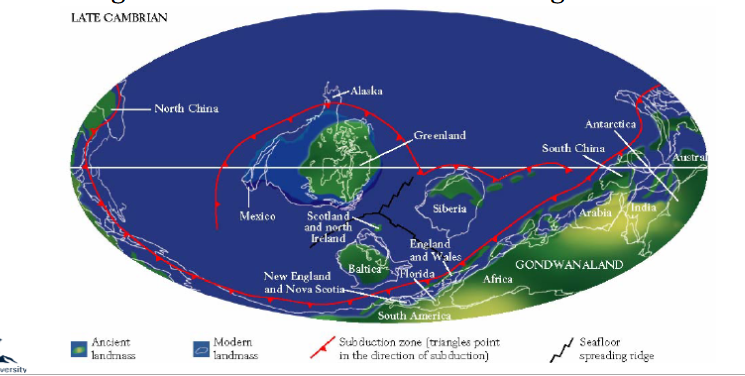
Most of Earth's landmass was in the southern hemisphere -- Gondwana, Laurentia, Siberia, Baltica
Cambrian
Cratons formed supercontinent early in Cambrian
Progressive flooding of continents, regression in middle Cambrian and again in late
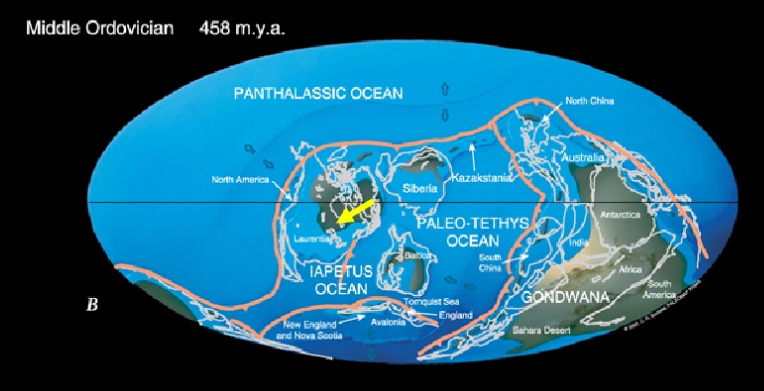
Ordovician
Early - Baltica began move from south pole
End - Baltica moved to tropics
Gondwanaland nearing south pole
Glacier expanded
Sea-level fell
Mass extinction
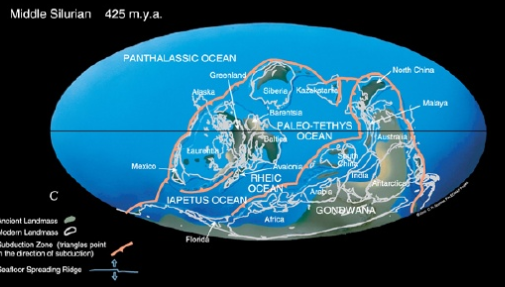
Permian
Pangea nearly complete
Eastern N. American, undergoing erosion
Continental red beds deposited
Appalachian Mtns
Ouachita Mtns in south east
Farther west = Ancestral Rockies
Antler Mountains have eroded = highlands
Subduction and volcanism in far west
Cambrian
Laurentia is nearly covered by shallow epicontinental seas
Laurentia lies on the equator so the water is war
Deposition of sand and carbonate sediments
Water deepens toward edges of continent where hsale is deposited
Paleogeographic Features
Global transgressions and regressions
Fossils
Information
- Description
- Geology (Historical Geology) Note on GEO 3200 2, created by supergoober on 26/04/2014.
- Created by
- supergoober
- Views
- 249
- Rating