
Notes
Plasma Membrane and Cell Transport
Content of the notes (3)
Page 1
Plasma Membrane
Cell membranes are composed of two
phospholipid layers.
The
cell membrane ,
or the plasma membrane, forms a boundary between a
cell and the outside environment and controls the passage of materials into
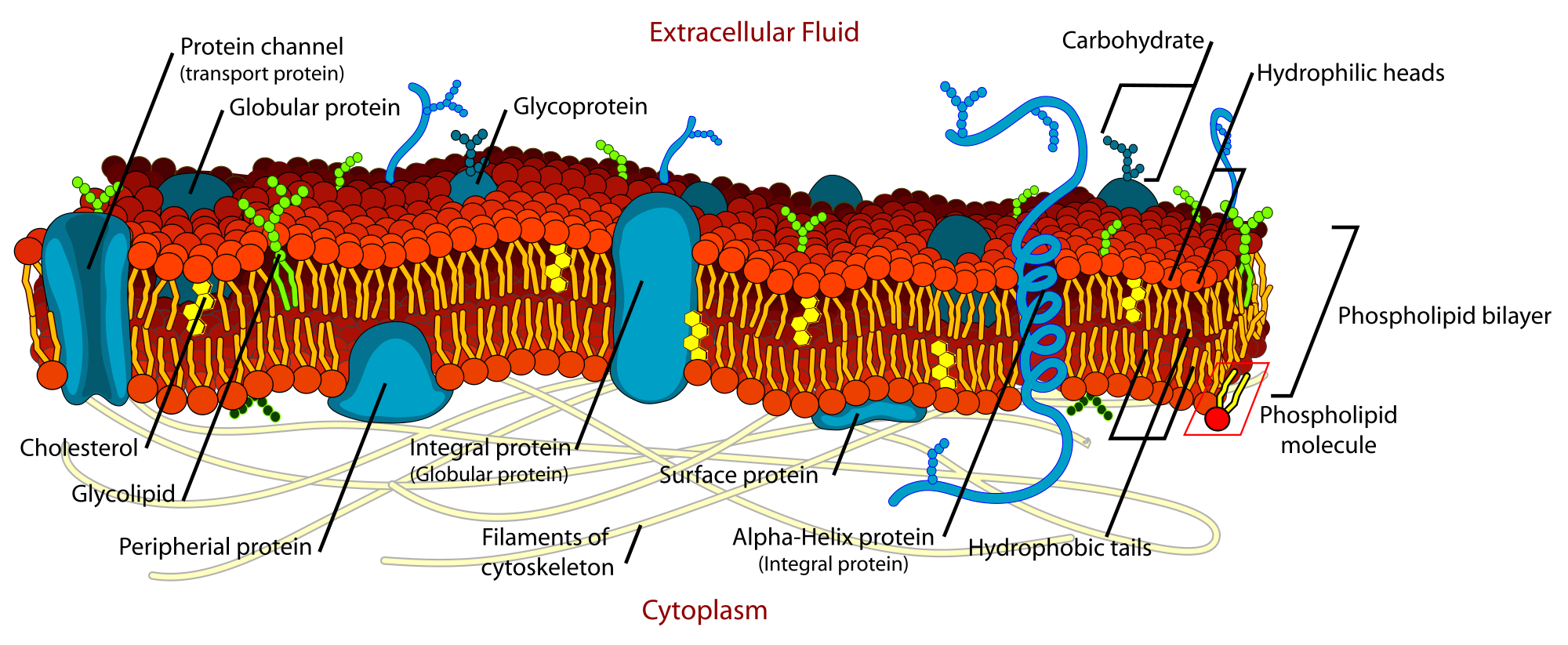
and out of a cell. The cell membrane consists of a double layer of phospholipids interspersed with a variety of
other molecules. A
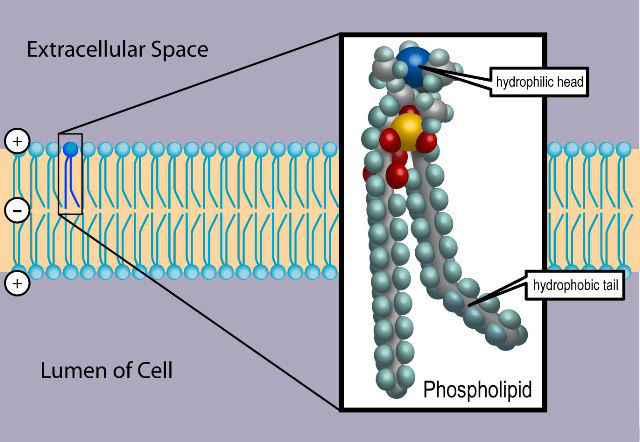
phospholipid is a molecule
composed of three basic parts:
•
a charged phosphate group
•
glycerol
•
two fatty acid chains
Together, the glycerol and the phosphate group form the “head” of a
phospholipid; the fatty acids form the
“tail.” Because the head bears a charge,
it is polar. Recall that water molecules
are also polar. Therefore, the polar
head of the phospholipid forms hydrogen bonds with water molecules. in
contrast, the fatty acid tails are non-polar and cannot form hydrogen bonds
with water. As a result, the non-polar tails are attracted to each other and
repelled by water.
Because the membrane touches the cytoplasm inside the cell and the
watery fluid outside the cell, the properties of polar heads and non-polar tails
cause the phospholipids to arrange themselves in layers, like a sandwich.
The polar heads are like the bread. They form the outer surfaces of the
membrane, where they interact with the watery environment both outside
and inside a cell. The non-polar tails are like the filling. They are sandwiched
between the layers of polar heads, where they are protected from the
watery environment.
Molecules are embedded within the phospholipid layers.
They give the membrane properties and characteristics it would not otherwise
have. These molecules serve diverse functions. Here are a few examples:
•
Cholesterol molecules strengthen the cell membrane.
•
Some proteins extend through one or both phospholipid layers and help
materials cross the membrane. Other proteins are key components of the
cytoskeleton. Different cell types have different membrane proteins.
•
Carbohydrates attached to membrane proteins serve as identification tags,
enabling cells to distinguish one type of cell from another.
Fluid Mosaic Model
Scientists have developed the fluid mosaic model , which describes the
arrangement of the molecules that make up a cell membrane. This model of
cell membrane structure takes its name from two characteristics. First, the cell
membrane is flexible, not rigid. The phospholipids in each layer can move
from side to side and slide past each other. As a result, the membrane behaves
like a fluid, similar to a film of oil on the surface of water. However, proteins
embedded in the membrane do not flip vertically. If one part of a protein is
outside the membrane, it will stay outside the membrane. Second, the variety
of molecules studding the membrane is similar to the arrangement of colorful
tiles with different textures and patterns that make up a mosaic.
Selective Permeability
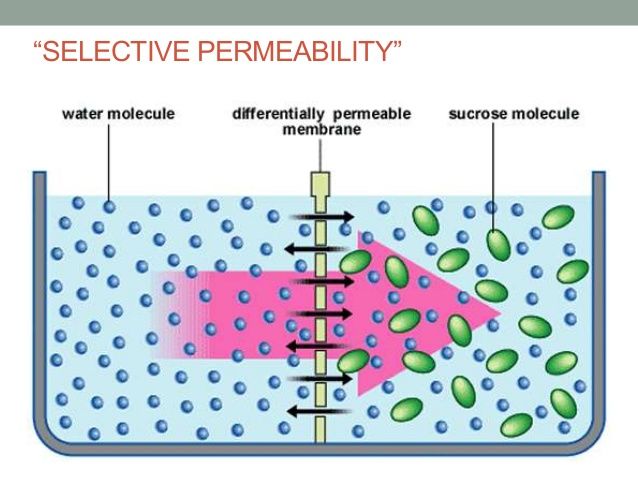
The cell membrane has the property of selective permeability , which means it allows
some, but not all, materials to cross. The
terms semipermeable and selectively permeable
also refer to this property. As an example,
outdoor clothing is often made of semipermeable fabric. The material is waterproof yet
breathable. Molecules of water vapor from
sweat are small enough to exit the fabric, but
water droplets are too large to enter.
Selective permeability enables a cell to maintain homeostasis in spite of
unpredictable, changing conditions outside the cell. Because a cell needs to
maintain certain conditions to carry out its functions, it must control the
import and export of certain molecules and ions. Thus, even if ion concentrations change drastically outside a cell, these ions won’t necessarily interfere
with vital chemical reactions inside a cell.
Molecules cross the membrane in several ways. Some of these methods
require the cell to expend energy; others do not. How a particular molecule
crosses the membrane depends on the molecule’s size, polarity, and concentration inside versus outside the cell. In general, small non-polar molecules easily
pass through the cell membrane, small polar molecules are transported via
proteins, and large molecules are moved in vesicles.
Chemical signals are transmitted across the
cell membrane.
Recall that cell membranes may secrete molecules and may contain identifying
molecules, such as carbohydrates. All these molecules can act as signals to
communicate with other cells. How are these signals recognized?
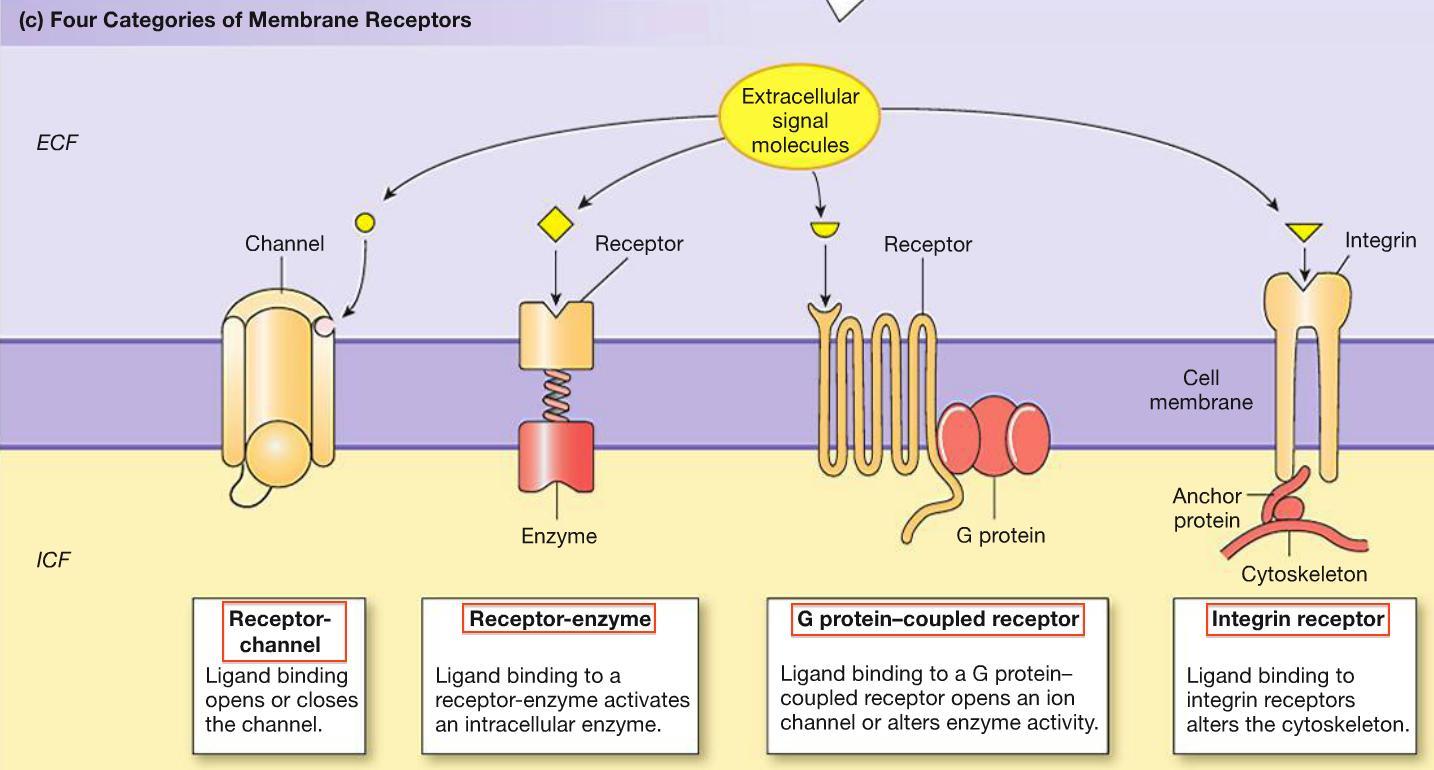
A receptor is a protein that detects a signal molecule and performs an
action in response. It recognizes and binds to only certain molecules, ensuring
that the right cell gets the right signal at the right time. The molecule a receptor binds to is called a ligand. When a receptor and a ligand bind, they change
shape. This change is critical because it affects how a receptor interacts with
other molecules. Two major types of receptors are present in your cells.
Intracellular Receptor
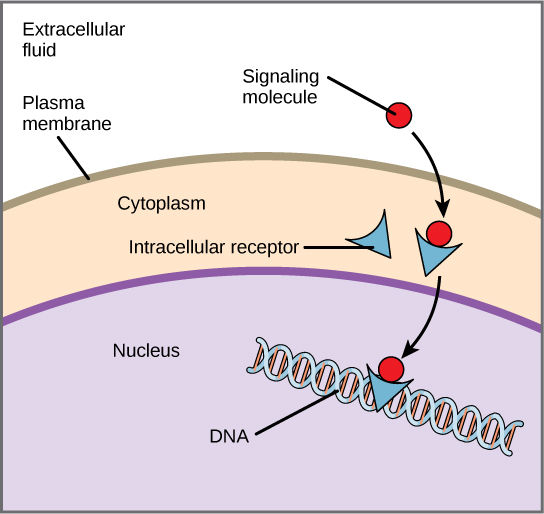
A molecule may cross the cell membrane and bind to an intracellular receptor. The word intracellular means “within, or inside, a cell.”
Molecules that cross the membrane are generally non-polar and may be relatively small. Many hormones fit within this category. For example, aldosterone
can cross most cell membranes. However, it produces an effect only in cells
that have the right type of receptor, such as kidney cells. When aldosterone
enters a kidney cell, it binds to an intracellular receptor. The receptor-ligand complex enters the nucleus, interacts with the DNA, and turns on certain
genes. As a result, specific proteins are made that help the kidneys absorb
sodium ions and retain water, both of which are important for maintaining
normal blood pressure.
Membrane Receptor
A molecule that cannot cross the membrane may bind to a receptor in the cell
membrane.The receptor then sends the message to the cell
interior. Although the receptor binds to a signal molecule outside the cell, the
entire receptor changes shape—even the part inside the cell. As a result, it causes
molecules inside the cell to respond. These molecules, in turn, start a complicated chain of events inside the cell that tells the cell what to do. For instance,
band 3 protein is a membrane receptor in red blood cells. When activated, it
triggers processes that carry carbon dioxide from body tissues to the lungs.
Page 2
Diffusion and Osmosis
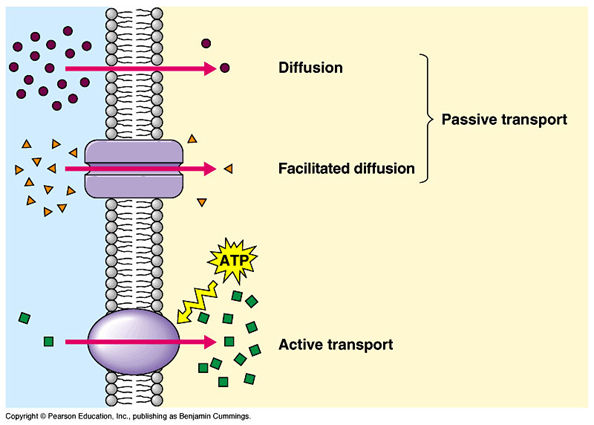
Diffusion and osmosis are types of passive transport.
Cells almost continually import and export substances. If they had to expend
energy to move every molecule, cells would require an enormous amount of
energy to stay alive. Fortunately, some molecules enter and exit a cell without
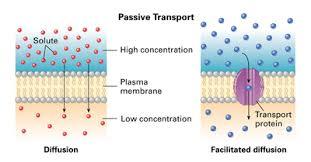
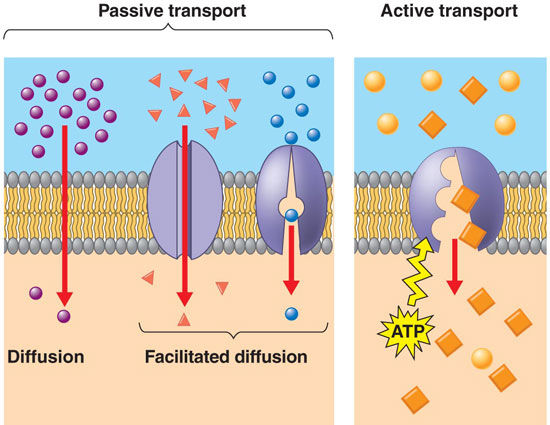
requiring the cell to work. Passive transport is the movement of molecules across a cell membrane without energy input from the cell.
It may also be described as the diffusion of molecules across a membrane.
Diffusion
Diffusion is the movement of molecules in a fluid or gas from a region of
higher concentration to a region of lower concentration. It results from the
natural motion of particles, which causes molecules to collide and scatter.
Concentration is the number of molecules of a substance in a given volume,
and it can vary from one region to another. A concentration gradient is the
difference in the concentration of a substance from one location to another.
Molecules diffuse down their concentration gradient—that is, from a region
of higher concentration to a region of lower concentration.
In the tie-dye example, dye molecules are initially at a high concentration
in the area where they are added to the water. Random movements of the dye
and water molecules cause them to bump into each other and mix. Thus, the
dye molecules move from an area of higher concentration to an area of lower
concentration. Eventually, they are evenly spread throughout the solution.
This means the molecules have reached a dynamic equilibrium. The concentration of dye molecules is the same throughout the solution (equilibrium),
but the molecules continue to move (dynamic).
In cells, diffusion plays an important role in moving substances across the
membrane. Small lipids and other non-polar molecules, such as carbon dioxide
and oxygen, easily diffuse across the membrane. For example, most of your
cells continually consume oxygen, which means that the oxygen concentration
is almost always higher outside a cell than it is inside a cell. As a result, oxygen
generally diffuses into a cell without the cell’s expending any energy.
Osmosis
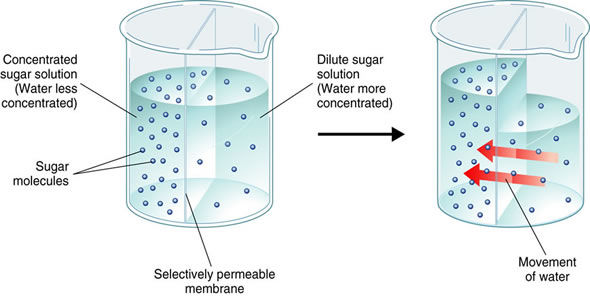
Water molecules, of course, also diffuse. They move across a semipermeable
membrane from an area of higher water concentration to an area of lower
water concentration. This process is called
osmosis.
It is important to recognize that the higher the concentration of dissolved particles in a solution, the
lower the concentration of water molecules in the same solution. So, if you put
1 teaspoon of salt in a cup of water and 10 teaspoons of salt in a different cup
of water, the first cup would have the higher water concentration.
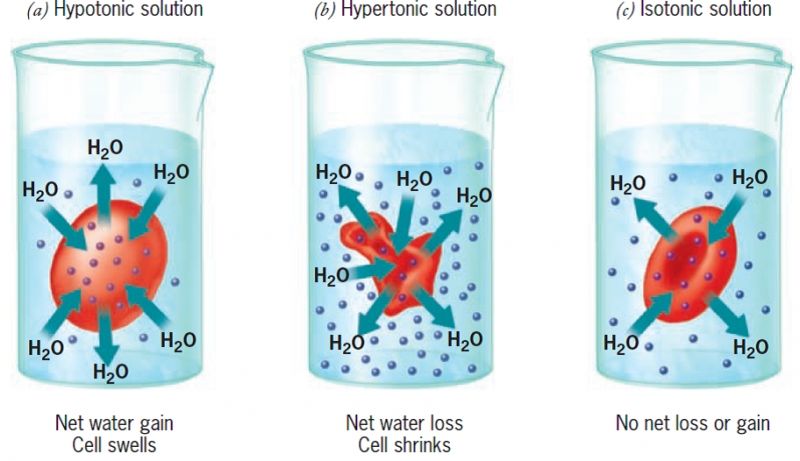
A solution may be described as isotonic, hypertonic, or hypotonic relative
to another solution. Note that these terms are comparisons; they require a
point of reference, as shown in FIGURE 4.3. For example, you may be taller than
your coach or taller than you were two years ago, but you are never just taller.
Likewise, a solution may be described as isotonic only in comparison with
another solution. To describe it as isotonic by itself would be meaningless.
A solution is
isotonic
to a cell if it has the same concentration of dis-
1
solved particles as the cell. Water molecules move into and out of the cell
at an equal rate, so the cell’s size remains constant.
2
A
hypertonic
solution has a higher concentration of dissolved particles
than a cell. This means water concentration is higher inside the cell than
outside. Thus, water flows out of the cell, causing it to shrivel or even die.
A
hypotonic
solution has a lower concentration of dissolved particles
than a cell. This means water molecules are more concentrated outside
the cell than inside. Water diffuses into the cell
.
If too much water enters
a cell, the cell membrane could potentially expand until it bursts.
Some animals and single-celled organisms can survive in hypotonic
environments. Their cells have adaptations for removing excess water. In
plants, the rigid cell wall prevents the membrane from expanding too much.
Remember from Section 2 that pressure exerted on the cell wall by fluid
inside the central vacuole provides structural support for each cell and for the
plant as a whole.
Some molecules diffuse through
transport proteins.
Some molecules cannot easily diffuse across a membrane. They may cross
more easily through transport protein openings formed by proteins that
pierce the cell membrane. Facilitated diffusion is the diffusion of molecules
across a membrane through transport proteins. The word facilitate means “to
make easier.” Transport proteins make it easier for molecules to enter or exit a
cell. But the process is still a form of passive transport. The molecules move
down a concentration gradient, requiring no energy expenditure by the cell.
There are many types of transport proteins. Most types allow only certain
ions or molecules to pass. Some transport proteins are
simple channels, or tunnels, through which particles such as ions can pass.
Others act more like enzymes. When bound, the protein changes shape,
allowing the molecule to travel the rest of the way into the cell.
Page 3
Active Transport, Endocytosis, and Exocytosis
Proteins can transport materials against a concentration gradient.
You just learned that some transport
proteins let materials diffuse into
and out of a cell down a concentration
gradient. Many other transport
proteins, often called pumps, move
materials against a concentration
gradient.
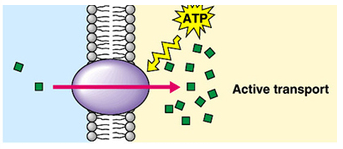
Active transport drives
molecules across a membrane from
a region of lower concentration to a
region of higher concentration.
This process uses
transport proteins powered by chemical energy. Cells use active transport to
get needed molecules regardless of the
concentration gradient and to maintain homeostasis.
Before we discuss active transport proteins, let’s look at transport proteins
in general. All transport proteins span the membrane, and most change shape
when they bind to a target molecule or molecules. Some transport proteins
bind to only one type of molecule. Others bind to two different types. Some
proteins that bind to two types of molecules move both types in the same
direction. Others move the molecules in opposite directions.
The key feature of active transport proteins is that they can use chemical
energy to move a substance against its concentration gradient. Most use
energy from a molecule called ATP, either directly or indirectly. For example,
nerve cells, or neurons, need to have a higher concentration of potassium ions
and a lower concentration of sodium ions than the fluid outside the cell. The
sodium-potassium pump uses energy directly from the breakdown of ATP. It
pumps three sodium ions out of the cell for every two potassium ions it
pumps in. The proton pump, another transport protein, uses energy from the
breakdown of ATP to move hydrogen ions (or protons) out of the cell. This action forms a concentration gradient of hydrogen ions (H
+
), which makes the
fluid outside the cell more positively charged than the fluid inside. In fact, this
gradient is a form of stored energy that is used to power other active transport
proteins. In plant cells, this gradient causes yet another protein to transport
sucrose into the cell—an example of indirect active transport.
Endocytosis and exocytosis transport materials
across the membrane in vesicles.
A cell may also use energy to move a large substance or a large amount of a
substance in vesicles. Transport in vesicles lets substances enter or exit a cell
without crossing through the membrane.
Endocytosis
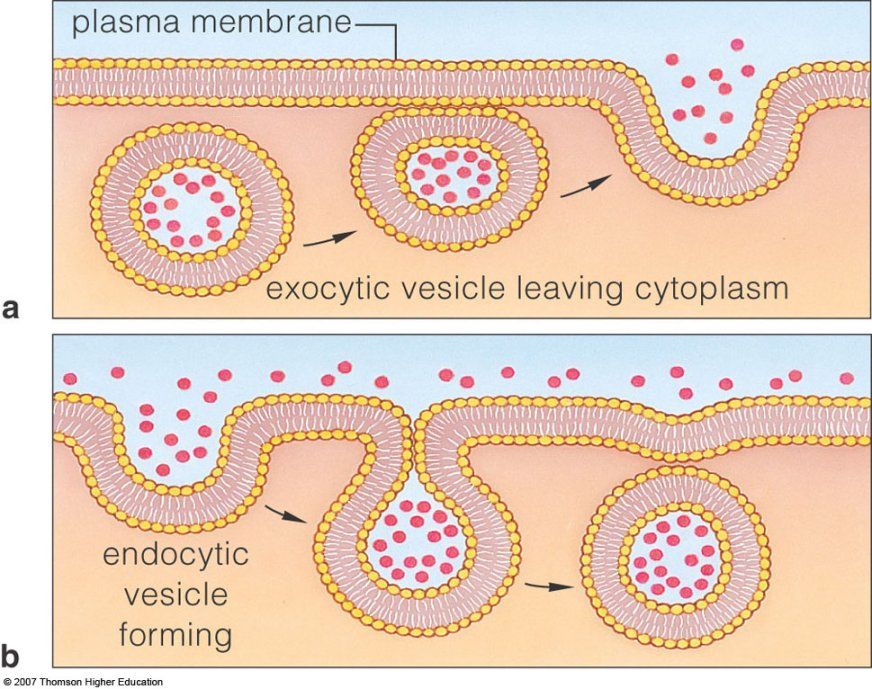
Endocytosis is the process of taking liquids or fairly
large molecules into a cell by engulfing them in a membrane. In this process,
the cell membrane makes a pocket around a substance. The pocket breaks
off inside the cell and forms a vesicle, which then fuses with a lysosome or a
similar type of vesicle. Lysosomal enzymes break down the vesicle membrane
and its contents (if necessary), which are then released into the cell.
The key feature of active transport proteins is that they can use chemical
energy to move a substance against its concentration gradient. Most use
energy from a molecule called ATP, either directly or indirectly. For example,
nerve cells, or neurons, need to have a higher concentration of potassium ions
and a lower concentration of sodium ions than the fluid outside the cell. The
sodium-potassium pump uses energy directly from the breakdown of ATP. It
pumps three sodium ions out of the cell for every two potassium ions it
pumps in. The proton pump, another transport protein, uses energy from the
breakdown of ATP to move hydrogen ions (or protons) out of the cell. This action forms a concentration gradient of hydrogen ions (H
+
), which makes the
fluid outside the cell more positively charged than the fluid inside. In fact, this
gradient is a form of stored energy that is used to power other active transport
proteins. In plant cells, this gradient causes yet another protein to transport
sucrose into the cell—an example of indirect active transport.
Synthesize
In what ways are active transport proteins similar to enzymes?
Endocytosis and exocytosis transport materials
4B
across the membrane in vesicles.
A cell may also use energy to move a large substance or a large amount of a
substance in vesicles. Transport in vesicles lets substances enter or exit a cell
without crossing through the membrane.
Phagocytosis is a type of endocytosis in which the
cell membrane engulfs large particles. The word literally means “cell eating.”
Phagocytosis plays a key role in your immune system. Some white blood cells
called macrophages help your body fight infection. They find foreign materials,
such as bacteria, and engulf and destroy them.
Exocytosis
Exocytosis , the opposite of endocytosis, is the release
of substances out of a cell by the fusion of a vesicle with the membrane. During
this process, a vesicle forms around materials to be sent out of the cell. The vesicle
then moves toward the cell’s surface, where it fuses with the membrane and
releases its contents.
Exocytosis happens all the time in your body. In fact, you couldn’t think or
move a muscle without it. When you want to move your big toe, for example,
your brain sends a message that travels through a series of nerve cells to reach
your toe. This message, or nerve impulse, travels along each nerve cell as an
electrical signal, but it must be converted to a chemical signal to cross the tiny
gap that separates one nerve cell from the next. These chemicals are stored in
vesicles within the nerve cells. When a nerve impulse reaches the end of a cell,
it causes the vesicles to fuse with the cell membrane and release the chemicals
outside the cell. There they attach to the next nerve cell, which triggers a new
electrical impulse in that cell.
Information
- Description
- 9th grade Biology (Plasma Membrane and Cell Transport) Note on Plasma Membrane and Cell Transport, created by Madhu R on 01/10/2016.
- Created by
- Madhu R · Oct 2016
- Updated
- Nov 30, 2016
- Views
- 75
- Rating