
Notes
5. War Communism
Content of the notes (1)
Page 1
Lenin's job during Civil War:
- run the government
- organize food and industrial production in Red-held area
not easy:
- food riots = starving workers = left cities = collapse in industry
He organized a policy that ensured that the army and the industrial centers were properly supplied with what they needed to win the war.
However, the measures taken were brutal and unpopular. In winning the civil war, the Revolution had lost its way.
Many of the high hopes of 1917 were destroyed by the savagery of the civil war.
The Civil War was won - but the consequences for Russia were awesome .-
* Industry and Agriculture were in TOTAL CHAOS.
* Production was but a small fraction of what it had been in 1914.
* Inflation was rife. The Rouble was worthless (it was as bad as Germany in the 1919-23 period.)
* Famine eventually claimed 5 million lives. The Red Grass aid teams reported cannibalism in Russia.
The principle aim was to keep the Red Army supplied during the Civil War
was a big problem in World War I and most likely influenced Lenin's view on the matter
To try to overcome the economic problems caused by the Civil War
It lasted from 1918-1921 (in 1921 Lenin knew that the policy couldn't carry on and it need a change)
While Trotsky was organizing the army during the Civil War, Lenin was busy organizing food and industrial production in the Red-held areas. He had two important problems to tackle:
• The continuing food shortages, especially amongst the workers and soldiers.
• The insufficient level of industrial production.
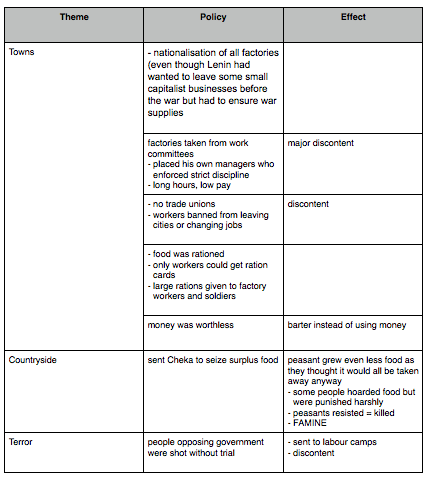
The system he created to tackle these problems is known as WAR COMMUNISM.
Its key features were:
• State control of factories with strict control over what was produced.
• Food rationing.
• Grain requisitioning – forcing the peasants to sell their grain to the state.
• An increase in the Red Terror – anyone who refused to cooperate were shot or sent to labour camps.
- food shortages
- overworked workers
- little supplies
- discontent because of war communism and the war
- people had little private property
Protests in Cities:
- food shortages
- overworked workers
- little supplies
- discontent because of war communism and the war
- people had little private property
Kronstadt Sailors:
- fought with the red army in the October Revolution
- shut down the Constituent Assembly
- helped the Bolsheviks in the July Days
Joine
Joined protests of another group of sailors
- declared revolution in March
- wanted equality and peace
- "life under the Communist dictatorship has become more terrible than death"
Trotsky had to use troops to crush them
20000 men killed
sailors were executed in batches or sent to labour camps
sho
shock to the Communists as the sailors had been among their strongest supporters but they were going against the Bolsheviks because of War Communism
production went down -- little motivation to for productivity as there was no profit for the workers and everything was going to the army
Causes of War Communism
Effects of War Communism
Kronstadt Uprising
Information
- Description
- IGCSE History (Russia) Note on 5. War Communism, created by ShreyaDas on 29/03/2014.
- Created by
- ShreyaDas · Mar 2014
- Updated
- Sep 2, 2017
- Views
- 516
- Tags
- Rating