
Notes
Osmoreglation
Content of the notes (4)
Page 1
Regulation of the water potential of the blood
Water potential depends on the concentration of solutes (i.e glucose, mineral ions etc.)
Body response to a fall in water potential
Change
Fall in water potential
Receptor
Osmoreceptors in hypothalamus detect the fall in water potential.
Water moves from osmoreceptor cells into the blood by osmosis down their water potential gradient, causing the osmoreceptor to crenate.
Co-ordinator
This change causes the hypothalamus to produce the hormone ADH.
ADH passes to posterior pituitary gland, where it is secreted into capillaries.
Effector 1
ADH in the blood travels to the kidney, specifically to the epithelium cells of the distal convoluted tubule and collecting duct.
Specific protein receptors on the cell surface membrane bind to ADH molecules, activating the enzyme phosphorylase.
The activated phosphorylase causes vescicles to move and fuse with the cell surface membrane. The vescicles contain pieces of plasma membrane that have numerous aquaporins.
This makes the cell surface membrane much more permeable to water, as the number of water channel proteins have increased.
ADH increases the permeability of the collecting duct to urea, which therefore passes out, lowering the water potential of the tissue fluid around the duct.
More water leaves the collecting duct by osmosis, lowering the water potential, which then is transported by osmosis into the tissue fluid and further into the capillaries to the blood.
Effector 2
Osmoreceptors send nerve impulses to the thirst centre of the brain, encouraging the individual to drink water.
Osmoreceptors in the hypothalamus detect rise in water potential, leading to fewer impulses sent to the pituitary gland.
Fewer impulses sent to the pituitary gland reduces the amount of ADH produced, permeability of the collecting ducts to water and urea reverts back to its normal state.
Output response
Water potential increases back to normal levels.
Page 2
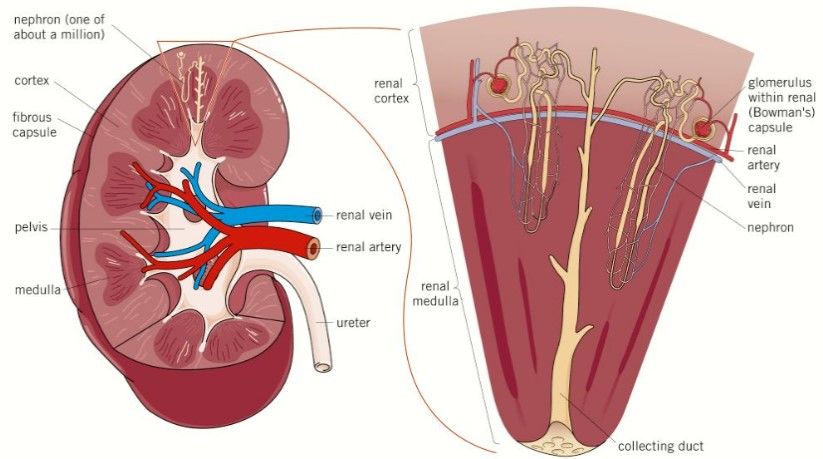
The structure of a mammalian kidney
Page 3
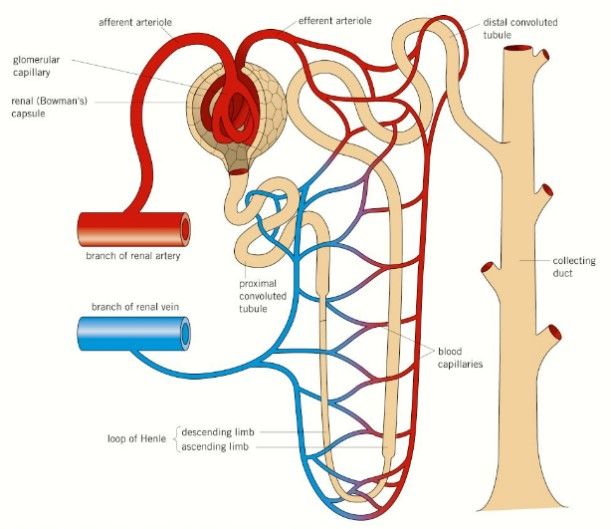
The regions of the nephron and associated blood vessels
Page 4
Role of the nephron in osmoregulation
Blood journey Afferent arteriole > glomerulus > efferent arteriole > capillaries > renal vein
Ultrafiltration
Dirty blood will flow through the afferent arteriole at a
relatively high pressure.
It enters the Bowman’s capsule, reaching the
glomerulus (a many-branched knot of capillaries).
Due to the increase in
hydrostatic pressure, small molecules such as water, glucose, urea and ions
such as sodium will be forced out into tissue fluid, leaving larger molecules
such as red and white blood cells and large proteins in the capillaries.
These
molecules leave through spaces between the glomerulus endothelium cells and the
podocyte cells, which line the Bowman’s capsule.
Blood leaves the Bowman’s
capsule through an efferent arteriole, where the pressure is greater as the
arteriole is much narrower.
The efferent arteriole carries blood away from the
Bowman’s capsule and then later branches to form the blood capillaries.
Information
- Description
- AS - Level Biology (Chapter 16) Note on Osmoreglation, created by Sara Bowen on 07/11/2016.
- Created by
- Sara Bowen · Nov 2016
- Updated
- Jan 15, 2017
- Views
- 3
- Rating