
Quiz
Aggression
This quiz has question types that open in the usual player.
Questions in this quiz (6)
1Aggression is defined as a behavior that causes (or leads to) harm, damage or destruction of another organism.
Aggression is not a unitary phenomenon. However, there is heuristic value in reducing the broad spectrum and diversity of aggression in [blank_start]humans[blank_end] to two main categories:
• [blank_start]affective[blank_end] aggression (reactive, defensive, or hostile aggression)
• [blank_start]predatory[blank_end] aggression (proactive, premeditated, or instrumental aggression)
These forms of human aggression [blank_start]have parallels with biologically[blank_end]-disposed types of aggression in other animals.- Aaffective
- Bpredatory
- Chave parallels with biologically
- Dhumans
2AFFECTIVE AGGRESSION
An animal parallel of [blank_start]affective[blank_end] aggression in humans is [blank_start]defensive/offensive aggression[blank_end]
** The basic characteristics of this response have been largely studied in felines.
** Defensive aggressive behavior occurs when the animal is [blank_start]frustrated, irritated, or threatened[blank_end] by another animal of the same or different species.
** Key features of this response are that:
**** it lacks [blank_start]planning[blank_end]
**** it is highly [blank_start]impulsive[blank_end]
There are [blank_start]striking similarities[blank_end] between defensive/offensive aggression in animals and affective aggression in humans:
• Associated with sudden, significant increases in [blank_start]sympathetic activation[blank_end]
• Impulsive and [blank_start]clearly lacking cortical involvement[blank_end]
• There is [blank_start]displacement of the target[blank_end] to other individuals or objects in the environment
• Basically aversive in nature (humans experience fear and/or anger), and therefore the response is designed to reduce or eliminate the obstacle, threat, or irritating stimulus, and thus reduce the tension in the environment.
PREDATORY AGGRESSION
[blank_start]Predatory aggression[blank_end] in humans can be considered as a parallel of [blank_start]predatory attack[blank_end] (“quiet biting”) in animals
** It occurs in response to [blank_start]prey objects[blank_end]. For instance, the cat stalks the prey and then bites the back of the neck of the animal
** Key features of predatory attack are that:
**** it is highly directed to the prey object and not to other components of the environment
**** it requires methodical [blank_start]planning and strategies[blank_end] to be employed in the attack
** Predatory attack in animals is almost always directed against an animal of another species, usually a typical prey object, so it is essentially a form of food-seeking. Modern people relatively infrequently exhibit this form of predation (food is readily available in supermarkets…), and predatory (“cold-blooded”, premeditated) aggression in humans is usually directed against other human being.
** Certain types of human aggression can be justifiably referred to as predatory, and are similar to predatory attacks described in animals:
• relative [blank_start]absence of sympathetic activation[blank_end]
• the attack appears to be planned, goal-directed and purposeful
• there is little perceived threat
• it is highly [blank_start]focused upon a specific[blank_end]
Additionally, in humans,
- the associated emotion(s) seem to have positive reinforcing properties, such as heightened self-esteem and a greater sense of self-confidence
- the process includes a cognitive component it may be triggered by a variety of motivating factors (monetary gain, power, control, or gratification of desires or fantasies); the act of aggression may take place over hours, days, weeks, months, or even years.- Adefensive/offensive aggression
- Bplanning
- Cimpulsive
- Daffective
- Estriking similarities
- Fclearly lacking cortical involvement
- Gsympathetic activation
- Hdisplacement of the target
- IPredatory aggression
- Jpredatory attack
- Kfrustrated, irritated, or threatened
- Lprey objects
- Mplanning and strategies
- Nabsence of sympathetic activation
- Ofocused upon a specific
3THE NEURAL BASIS OF AGGRESSION
• Animal research on aggression has focused on natural forms of aggressiveness or aggressive behavior induced by electrical stimulation
• The key brain structure that mediates aggressive behaviors is the [blank_start]hypothalamus[blank_end]
• There are [blank_start]two distinct neural circuits for[blank_end] defensive rage and predatory attack:
*** defensive rage: medial [blank_start]amygdala[blank_end], medial hypothalamus, and dorsolateral [blank_start]PAG[blank_end]
*** predatory attack: central amygdala, lateral hypothalamus, and ventrolateral PAG
• Reciprocal [blank_start]inhibitory GABA connections[blank_end] between lateral and medial hypothalamus allow either [blank_start]predatory attack or defensive rage[blank_end] to occur at a given time
• The cortex modulates (inhibits) activity of the hypothalamus and PAG
• Inputs from monoamine brainstem neurons provide modulating function on the limbic system, cerebral cortex, hypothalamus, and PAG.
THE NEURAL BASIS OF HUMAN AGGRESSION
Aggressive behavior in humans is not all pathological, or inappropriate. Both affective and predatory aggression in animals are bio- behavioral adaptations that enhance reproductive success.
** Affective aggression (“hot blooded”) is common among healthy individuals and may represent an adaptive response to anger- eliciting stimuli including provocation (e.g., verbal insults), threat, frustration, or anything that challenges the individual’s authority,
independence, image, or control over situations/resources
** Predatory aggression (“cold-blooded”, premeditated) in humans is often associated with crimes (e.g., serial homicides, mass murders, rape) and psychopathological conditions ([blank_start]“psychopathy”[blank_end]).- Aamygdala
- BPAG
- Chypothalamus
- Dinhibitory GABA connections
- Etwo distinct neural circuits for
- Fpredatory attack or defensive rage
- G“psychopathy”
4THE NEURAL BASIS OF HUMAN AGGRESSION
Research into the neural basis of human aggression has typically focused on pathological aggression, which is maladaptive and restricted to particular subgroups of
individuals such as:
• forensic samples
• individuals with psychopathologies (antisocial personality disorder, borderline personality disorder, conduct disorder, intermittent explosive disorder, ADHD, schizophrenia, mood disorders, dementia, substance- related disorders)
As compared with pathological aggression, much less is known about the neural substrates of adaptive human (affective) aggression:
** Although aggressive behavior in humans is strongly influenced by environmental, social and cultural factors which shape the manner in which it is expressed, it is likely that there are specific neural substrates underlying different forms of aggressive behavior.
** Reactive aggression in humans is probably mediated by the same basic circuitry described in other mammals, but…
**** It is difficult to identify activity in sub-cortical regions such as PAG and hypothalamus in human neuroimaging work
**** The magnitude and type of aggressive response that can be induced during functional brain imaging studies is subject to practical and ethical constraints
**** However, neurological patients showing uncontrollable outbursts of aggressive behavior (temporal lobe epilepsy, tumors of the temporal lobe/other regions of limbic system / hypothalamus) points the role of [blank_start]limbic structures and hypothalamus[blank_end] in aggressive behavior.
**** The fact that neurodegenerative/neoplastic/traumatic lesions of the frontal lobes often lead to abnormally aggressive behavior (whereas stimulation inhibits aggression) clearly suggest that [blank_start]structures[blank_end] involved in emotion regulation and social cognition play a key role in the cognitive control of reactive aggressive impulses “within normal range”
Patient with advanced Parkinson’s Disease was successfully treated by bilateral stimulation of the subthalamic nucleus. The electrode was located within the posteromedial hypothalamus. These patients developed acute transient aggressive behavior during electrical test stimulation (vigilant, tense facial expression, tachycardic, agitated, furious, started to shout, attempted to get down from the surgical table).- Alimbic structures and hypothalamus
- Bstructures (PFC)
5In a recent study, it was found that, in hypothalamus, defensive rage circuit is oriented more [blank_start]medially[blank_end], predatory attack is more [blank_start]laterally[blank_end]. This study was conducted with human, cat, mice, rat and hamster. While a predatory attack area in the hypothalamus in mice, hamsters, and humans were not found, evidence for such an area was obtained in cats and rat.
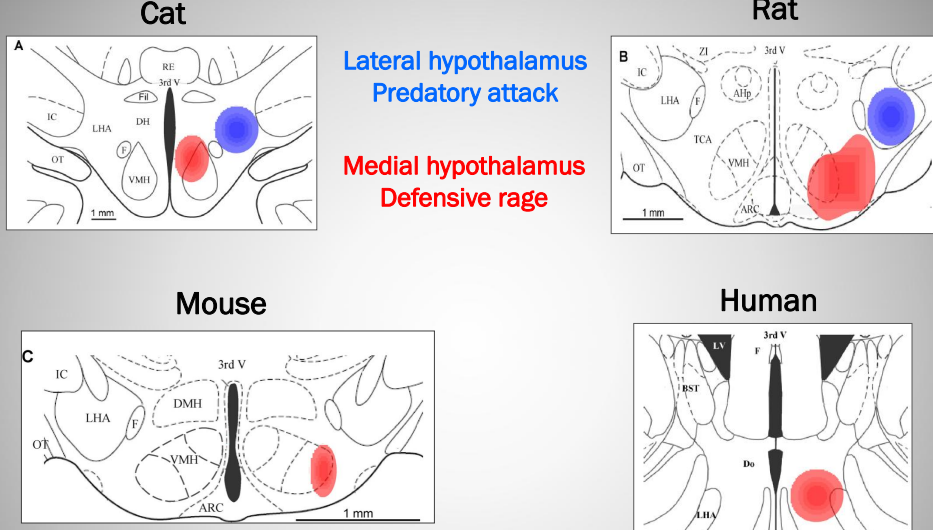
- Amedially
- Blaterally
6“Normal” aggression is expressed through a balance between orbitofrontal cortex / anterior cingulate cortex and limbic regions, such as the amygdala.
** [blank_start]OFC and ACC[blank_end] provides a “top-down” suppressive or regulative input and they are involved in calibration of behavior in response to social cues and in predicting expectancies of reward and punishment.
** On the other hand, lymbic regions such as [blank_start]amygdala[blank_end], and [blank_start]insula[blank_end] trigger “bottom-up” or “drives”.- AOFC and ACC
- Bamygdala
- Cinsula
Information
- Description
- Master Affective Neuroscience Quiz on Aggression, created by Süleyman Öztürk on 03/01/2024.
- Author
- Süleyman Öztürk
- Language
- English
- Views
- 0
- Tags
- Rating
- No ratings yet Rate this quiz