
GCSE Chemistry: The Crust
Slides in this set (10)
-
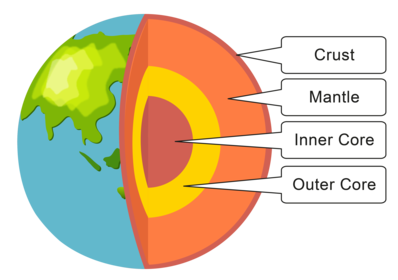
- The Earth is almost a sphere. These are its main layers, starting with the outermost:
- crust - relatively thin and rocky
- mantle - has the properties of a solid, but can flow very slowly
- outer core - made from liquid nickel and iron
- Inner core - made from solid nickel and iron
- The Earth's lithosphere is the rigid outer layer that is made up of the crust and the part of the mantle just below it. The lithosphere is made up of a mixture of minerals.
- Caption: Cross section showing structure of the Earth
-
Continental Drift & Wegener’s Theory
- The theory of continental drift was proposed at the beginning of the last century by German scientist Alfred Wegener.
- Before Wegener developed his theory,
- it was thought that mountains formed because the Earth was cooling down,
- and, as it cooled down, it contracted This process formed wrinkles, or mountains, on the Earth’s crust.
- If this was the case, then mountains would be spread evenly over the Earth's surface. We know that this is not the case.
- Wegener suggested that mountains formed
- when the edge of a drifting continent collided with another, causing it
- to crumple and fold. For example, the Himalayas formed when India came
- into contact with Asia.
- It took more than 50 years for
- Wegener’s theory to be accepted. One of the reasons was that it was
- difficult to work out how whole continents could move. It was not until
- the 1960s that enough evidence was discovered to support the theory
- fully.
-
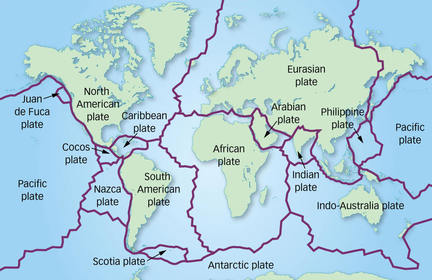
- The Earth's crust and upper part of the mantle are broken into large pieces called tectonic plates.
- These are constantly moving at a few centimetres each year. Although
- this doesn't sound like very much, over millions of years the movement
- allows whole continents to shift thousands of kilometres apart. This
- process is called continental drift.
- The plates move because of convection currents in the Earth’s mantle. These are driven by the heat produced by the natural decay of radioactive elements in the Earth.
- Where tectonic plates meet, the
- Earth's crust becomes unstable as the plates push against each other, or
- ride under or over each other. Earthquakes and volcanic eruptions
- happen at the boundaries between plates, and the crust may ‘crumple’ to
- form mountain ranges.
- Caption: The earth's continents are constantly moving due to the motions of the tectonic plates. Closely examine the map below, which shows the 15 major tectonic plates.
-
- Igneous Rock
- Igneous Rocks are formed by magma from the molten interior of the Earth. When magma erupts it cools to form volcanic landforms.
- When it cools inside the Earth it forms intrusive rock, which may later be exposed by erosion
- and weathering. Intrusive rock will have large crystals as it has
- cooled slowly. Magma that has cooled on the surface is known as extrusive rock. This will have small crystals as it has cooled quickly
- Igneous Processes and Products
- Intrusive and Extrusive Activity
- Differences Between Intrusive and Extrusive Rocks
-
- A river carries, or transports,
- pieces of broken rock as it flows along. When the river reaches a lake
- or the sea, its load of transported rocks settles to the bottom. We say
- that the rocks are deposited. The deposited rocks build up in layers,
- called sediments. This process is called sedimentation.
- The weight of the sediments on top squashes the sediments at the bottom. This is called compaction. The water is squeezed out from between the pieces of rock and crystals of different salts form.
- These are the different processes in order:
- sedimentation → compaction → cementation
- Sedimentary rocks contain rounded grains in layers. Examples of sedimentary rock include: chalk, limestone, sandstone, shale
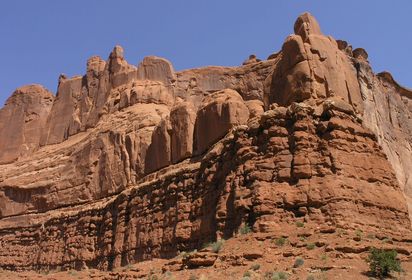
- Caption: Sedimentary rocks may contain fossils of animals and plants trapped in the sediments as the rock was formed. Sedimentary rocks are often quite soft and are susceptible to erosion.
-
- Metamorphic rock has been subjected to tremendous heat, pressure
- or both. This has caused it to change into another type of rock. It is
- usually resistant to weathering and erosion and is therefore very
- hard-wearing.
- Examples of metamorphic rock include:
- marble - which originates from chalk or limestone
- slate - which originates from clay
- schists – which have formed from sandstone or shale (sedimentary rocks)
- https://www.youtube.com/watch?v=tI344TmxN-I (Embed)
- Caption: Metamorphic Rocks
-
- Limestone - which is a sedimentary rock- is a valuable resource from the Earth’s crust. It has many uses. For example:
- it can be used as a building material
- it is a major ingredient in toothpaste
- it can be used as a food additive to provide calcium ions for strong teeth and bones
- it can be processed as a useful raw material in the chemical industry
- Most limestone is obtained by quarrying, where the rock is blasted out of the ground in huge pits.
- Chemistry revision: Arguments for and against quarrying, etc.
- Chemistry 2 Limestone and its uses Core GCSE
- C1.2 Limestone And Building Materials
-
- Reactions with Acids
- Carbonates react with acids to produce carbon dioxide, a salt and water. For example:
- calcium carbonate + hydrochloric acid → carbon dioxide + calcium chloride + water
- CaCO3(aq) + 2HCl(aq) → CO2(g) + CaCl2(aq) + H2O(l)
- Since Limestone is mostly calcium carbonate, it is damaged by acid rain.
- Sodium carbonate, magnesium
- carbonate, zinc carbonate and copper carbonate also react with acids -
- they fizz when in contact with acids, and the carbon dioxide released
- can be detected using limewater.
-
- When limestone is heated strongly, the calcium carbonate it contains decomposes to form calcium oxide.
- calcium carbonate → calcium oxide + carbon dioxide
- CaCO3(s) → CaO(s) + CO2(g)
- This reacts with water to form calcium hydroxide, which is an alkali
- calcium oxide + water → calcium hydroxide
- CaO(s) + H2O(l) → Ca(OH)2(s)
- Calcium hydroxide is used to neutralise
- excess acidity, for example, in lakes and soils affected by acid rain.
- Calcium hydroxide dissolves in water to produce calcium hydroxide
- (limewater), which is used to test for carbon dioxide.
-
- Cement is made by heating powdered limestone with clay.
- Cement is an ingredient in mortar and concrete.
- Mortar - used to join bricks together - is made by mixing cement with
- sand and water. Concrete is made by mixing cement with sand, water and
- aggregate (crushed rock).
- Advantages and disadvantages of various building materials
- Concrete is easily formed into
- different shapes before it sets hard. It is strong when squashed, but
- weak when bent or stretched. However, concrete can be made much stronger
- by reinforcing it with steel.
- Limestone, cement and mortar slowly
- react with carbon dioxide dissolved in rainwater and wear away. This
- damages walls made from limestone, and leaves gaps between bricks in
- buildings. These gaps must be filled in or ‘pointed’.
- Pollution from burning fossil fuels makes the rain more acidic than it should be, and this acid rain makes these problems worse.
- The structure of the earth
- The Earth
- Plate Tectonics
- Rocks and Minerals Quiz