Antigen uptake
Slides in this set (11)
-
- Innate immunity
- Rapid immune response with low, generalised specificity. There is no requirement for MHC, T or B cells. F actors of the innate immune system include phagosomes, compliment and lysosomes within cells.
- Adaptive immunity
- Recent product of evolution - 500 million years. A highly specific response, that retains antigen memory, however a slower response (peak at 1-2 weeks) compared to innate system. The adaptive system is dependant on MHC, and B and T cells containing somatically rearranged DNA.
-
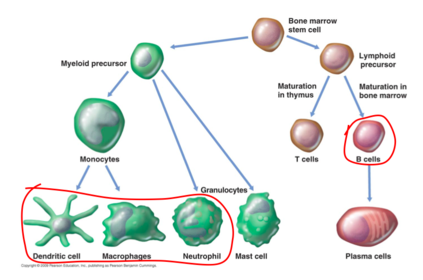
- There are 2 main lineages - myeloid and lymphoid.
- B and T 'lymphocytes' are product of the lymphoid line, while monocytes and granulocytes are a product of the myeloid line.
- Monocytes differentiate into macrophages and dendritic cells. Granulocytes can be either mast cells of neutrophils.
- Caption: Immune cell lineage schematic
-
- Few in number, but the most potent in antigen presentation. The DCs are found in tissues as 'sentries' keeping guard for pathogens. upon identification of pathogen, they migrate to the lymph nodes to confer with lymphocytes, initiating the adaptive immune response. Note, in the event of sepsis, the spleen is the alternative to the lymph.
- Adaptive initiation:
- Step 1 - dendritic cells activate CD4 helper cells.
- Step 2 - CD4 helper cells activate CD8 killer cells, in conjunction with DCs. At the same time, CD4 activate B cells.
- This is general, but all adaptive responses must go through this path.
-
Antigen recognition and uptake by APCs
- Antigen recognition
- Toll like receptors
- NOD like receptors
- Compliment and antibody
- Antigen uptake
- Phagocytosis
- Pinocytosis
- Receptor mediated endocytosis
- Autophagy
-
- Broad classing of of receptors to recognise antigen:
- PAMPS - recognise pathogen associated molecular patterns e.g. bacterial DNA
- These detect infection
- DAMPS - recognise damage associated molecular patterns e.g. uric acid and heat shock proteins
- These detect tissue damage
- The role of PRR in antigen recognition is distinguishing between broad classes of pathogens e.g. bacteria from fungus. This allows for mounting of the correct immune response.
- **TLRs and NLRs are present in both invertebrates and mammals
-
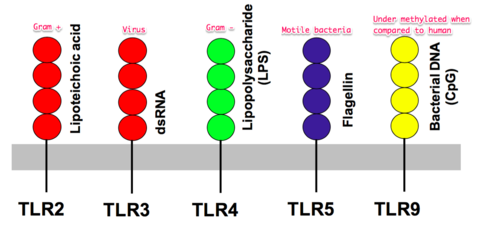
- TLRs signal to the cell as dimers (homo or hetero), they can also form oligodimers. They are present on the cell surface and in endosomes.
- Ligand binding to a TLR signals the recruitment of adaptor molecules to the TLR base, these facilitate dimerisation.
- The dimers act as transcription factors, upregulating inflammatory gene transcription e.g. cytokine production.
- In the endosome, TLRs bind nucleic acids. Note the endosome is acidic and this proteinates the nucleic acids, making binding to the TLR more efficient.
-
- Reside in the cytoplasm and recognise peptidoglycans.
- When they become activated they too, like TLRs act as transcription factors, however act through the induction of NF-KB (N F kappa B), this is the transcription factor.
- NF-KB is held inactive in the cytoplasm by IKB. PRR activation leads to IKB cleavage and translocation of NF-KB to the nucleus.
-
Effect of NLR and TLR (both PRR)
- Increase cytokine secretion and phagocytic ability, causing a greater pathogen clearance.
- Increase immunostimulatory capacity of APCs e.g. dendritic cells.
- All in the name of increasing T cell stimulation and thus better memory responses.
- If an antigenic protein was administered by itself, poor immune response (T cell activation) would result due to the lack of PRR activation. This is contrasted against administering antigenic protein and PRR ligands resulting in a good T cell activation and strong immune response.
-
Compliment/antibody mediated recognition
- These are 'tags' for dangerous antigenic molecules.
- The 'tags' facilitate recognition through cell surface receptors:
- Compliment receptors (CR)
- Fc receptors (FcR) - binding antibody
-
- Phagocytosis
- Antigen binds cell surface and is endocytosed. The endocytosed vesicle has H+ pumped by ATPase to acidify the vesicle, lysosomes fuse and proteolytic degradation occurs.
- Pinocytosis
- Same mechanism as phagocytosis by in fluid phase.
- Receptor mediated phagocytosis
- Operates on 'tagged' antigen, cell receptor is recycled to cell surface.
- Fc binds antibody (bound to antigen changes conformation increases binding), CR and mannose receptor (fungi)
-
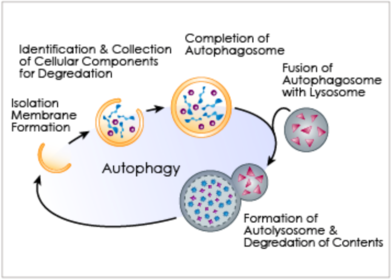
- Recycling cellular material.
- Intracellular antigen coated in molecule - ubiquitin, tagging it for recycling. Phagophore encircles intracellular pathogen forming autophagosome.
- Autophagosome the fuses with lysosome - autolysosome.