
T cells
Slides in this set (3)
-
T helper 1 and T helper 2 responses
- There are multiple subsets of CD4 T cells. We will address 2. They differ in the cytokine they produce.
- T helper 1:
- Cytokine profile profile protects against viruses and other intracellular parasites - INFgamma
- T helper 2:
- Cytokine profile protects against extracellular bacteria and parasites, it is also involved in allergy - IL-4
-
T cell production and maturation
- T cell precursors produced in the bone marrow
- Migrate through the blood to the thymus
- TCR gene rearrangement in the thymus
- Mature clonal population producing distinct TCR released into blood
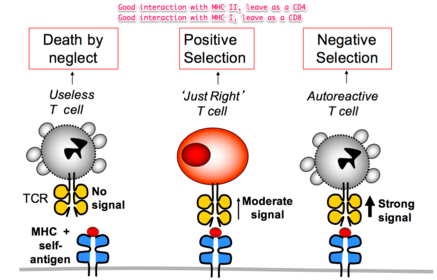
- Thymic screening:
- Thymic stroma (epithelia) express MHC I/II
- Thymocytes (immature T cells) are tested for their ability to bind self protein on MHC
- Escape from central tolerance can occur if self antigen is expressed at low levels in the thymus (autoreactive T cells) or if self antigen is expressed at higher levels in the periphery (autoimmunity)
-
Transplant rejection - MHC restriction
- A T cell from another organism will not recognise MHC upon transplantation. This is known as MHC restriction.
- Some mature T cells will recognise foreign MHC on an allograft (transplanted material).
- Autologous - self + self
- Syngeneic - Self + identical
- Allogeneic - non identical members of same species
- Xenogeneic - different species
- Upon transplantation, 1-5% of host T cells are alloreactive to the donor MHC and begin to launch an immune response against it - this is essentially transplanted MHC mimicking a foreign peptide.
- Immunosuppressants repress T cell activity allowing tolerance to accumulate over time.