
Flashcards
The Nervous System
Cards in this deck (94)
- 1What is the Nervous System (3 points)1) Its the body control and communication centre
2) It is a continuous flow of information between the environment and brain
3) It allows the ordinary functions in an effective way - 2How does the Nervous System Function (3 points)1) Sensory : detect the change in the environment through sensory receptors
2) Integrative: CNS receives and decides which effectors need to react
3) Motor: The effectors bring about appropriate responses - 3What are the types of StimuliPhysical - respond to external stimuli
Chemical - respond to internal stimuli
(change in the environment) - 4Explain how the stimuli functionThey cause responses in the organism because of the changes in the environment
- 5Name the internal stimuliBlood pressure levels
PH levels
Tension in the muscles - 6Name examples of external stimuliLight
Temperature
Sound
Atmospheric Pressure
Smell - 7Explain how a nervous system worksCommunication between effectors and receptors so that the correct reactions to the change in environment happens.
- 8What are the two types of nervous systems1) Central Nervous System (CNS)
2) Peripheral Nervous System (PNS) - 9What is the difference between the Nervous System and the Endocrine SystemThe nervous system are fast responses and impulses through the nerves
The endocrine system are slower responses through chemicals called hormones via the blood - 10Explain the CNS (4 points)1) It is a concentrated mass of inter connected neurons grouped together to form the brain and spinal cord
2) It processes all information from sensors
3) Keeps organs and reflexes functioning
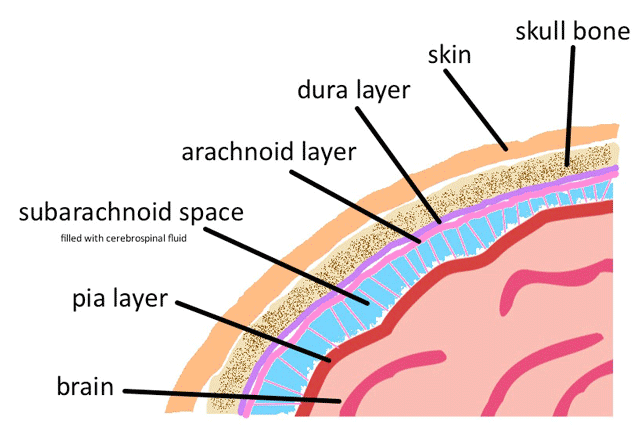
4) Directs movement, thoughts and feelings - 11How is the CNS protectedProtected by 3 connected layers
1) Meninges
2) 2nd and 3rd layer filled with Cerebro-spinal fluid that cushions from shock and damage - 12What is the Meninges made ofThe bony case - the cranium
The vertebral column - 33 irregular shaped vertebrae - 13Label the Protective layers of the CNS
- 14What are the 3 functions of the Cerebrum1) Motor
2) Sensory
3) Association Cortex - 15Explain the Motor Function of the CerebrumIt is situated in the frontal lobe
All voluntary movement originates here
It is conscious movement - 16Explain the Sensory Functions of the CerebrumIt receives and interprets impulses from the sensory organs
Temporal Lobe: Hearing, Smelling and Tasting
Occipital Lobe - Sight
Parietal Lobe - skin and sensation - 17Explain the Association CortexControls higher mental activities like intelligence, memory, perception, consciousness and language
Frontal lobe - emotion
Controls
It integrates and stores info before it is sent to the motor - 18What is the CerebrumLargest part of the brain
Divided into two cerebral hemispheres by the longitudinal fissure - 19What are the cerebral hemispheres held together byMyelinated nerve fibres bundled to form corpus (body) callosum (white)
- 20What is the function of the Corpus CallosumIt provides communication between the cerebral hemispheres and the cerebral cortex
It enables them to function as a co-ordinated whole - 21Name the structural elements of the Cerebrum (3)1) Outer cerebrum - forms the cerebral cortex
2) Surface area
3) 4 Cavities - 22Explain the Outer CerebrumIt forms the cerebral cortex
The cerebral cortex is made up of cell bodies called neurons - 23What is the formation of Neurons1) Made up of grey and white matter
2) Grey matter is cytoplasm
3) White matter is myelinated nerve fibres - fatty myelim - 24Explain the surface area of the CerebrumFolds called gyri
Grooves called sulci
Folds and grooves enlarges the surface area - 25What are the 4 cavitiesventricles in the centre of the brain filled with cerebro-spinal fluid
- 26What does the cerebellum do?1) Processes information and uses it to co-ordinate the other actions of the voluntary muscles so that complicated physical actions are performed in a smooth controlled way
2) Partly responsible for controlling muscle tone
3) Uses information from inner ear to maintain pressure and balance - 27What is the function of the CerebellumIt receives sensory input from the region of the cerebrum, eyes, muscle spindals and organs of balance in the ear
- 28What is the cerebellum (5 Points)1) Lies behind the cerebrum
2) Has 2 hemispheres
3) Has shallow folds
4) Is an arrangement of grey and white matter
5) It has tree branches surrounding the grey matter and is known as the tree of life - 29What is the HypothalamusIt lies below the thalamus and above the pituitary gland
- 30Explain the function of the hypothalamus (4 Points)1) Controls the ANS therefore maintains homeostasis
2) Centre for emotional responses and behaviour (pain, pleasure, fear, rage)
3) Centre for biological rhythms and drives
4) Controls functioning of pituitary gland by releasing hormones - 31What is the Medulla Oblongata (3 points)Forms the lowest part of the brain
It passes through the foramen magnum
Base of the cranium - 32What is the function of the Medulla Oblongata (3 points)1) Pathway into brain
2) Acts as a reflex centre controlling breathing, heartbeat, blood pressure, swallowing, peristalsis
3) Controls less important reflexes : sneezing, coughing, hiccoughing, salivating - 33Explain the Structure of the spinal (4 points)1) H shaped Grey matter -white matter surrounds the grey matter
2) Made with axons with myelin sheath
3) the Central canal -the Grey matter runs down the ventricle trains
4) Spinal nerves- enter and exit through the DORSAL and VENTRAL root (neuron cell bodies form in the ganglion in Dorsal) - 34Function of the spinal cord (2 points)(1) Pathway for impulses From receptors to the brain to effectors
(2) Integrative function of the primitive reflex actions i.e. spinal reflexes -protect body - 35What is the Spinal CordIt is an elongated rod of nervous tissue situated on the vertebral canal
- 36What is the structure of the Spinal Cord (6 Points)1) Vertebral Column/Backbone
2) Vertebrae- 33 bones
3) Vertebral Canal - hollow tube through 33 vertebrae
4) Discs of Cartilage - between the vertebrae for bending and stabilisation
5) Spinal Cord runs in the vertebral canal
6) Central Canal - runs through spinal cord - filled with spinal fluid - 37What is the function of the PNS (2 Points)1) Collects info from receptors and transmits along sensory afferent neurons to sensory function
2) Transmits impulses by way of motor and efferent neurons to effectors to bring about the correct motor function - 38What is the PNS made up of (4 points)1) Somatic Nervous System
2) ANS
2.1) ANS - Sympathetic
2.2) ANS - Parasympathetic - 39What is the function of somatic NSIt conducts impulses from CNS to skeletal muscles and controls voluntary movements
- 40What is the function of the ANS1) Conducts impulses from CNS to cardiac muscles controlling involuntary muscles and glands, therefore maintaining homeostasis
2) Made up of Sympathetic and parasympathetic systems - 41What is the function of the ANS (5 points)1) Controls the speed up and slowing of the heart rate
2) Adjusts BP and temperature
3) Moves blood to the most needed area
4) Increases or decreases digestion
5) The effects of the ANS are antagonistic - 42What is the Sympathetic ANS (4 points)1) It works with adrenaline in emergencies
2) Fight or flight
3) Stimulation = more O2, glucose and muscles to skeletal muscles
4) Cellular respiration increases - 43What is Parasympathetic ANS (3 points)1) It is the rest/digest
2) It is the recover from the sympathetic
3) Involuntary reflex - 44Explain the structure of the PNS ( 4 points)1) Consists of all nervous tissue outside of CNS
2) 43 Pairs of Nerves
3) 12 Pairs of Cranial Nerves
4) 31 Pairs of Spinal Nerves - 45Describe Nervous Tissue (5 points)1) It is made up of millions of neurons that form a structural unit that can function for a lifetime
2) Cannot undergo mitsosis
3) Cannot be replaced if destroyed
4) Needs the constant supply of O2
5) High metabolic rate - 46Classify Neurons (3 points)1) Unipolar - only carries impulses towards CNS
2) Connector - 99% of all neurons carry impulses from Unipolar and passes them on
3) Multipolar - carries impulses away from CNS - 47What is Neuroglia (3 points)1) Is called the glial cells
2) Plays a critical role in making myelin
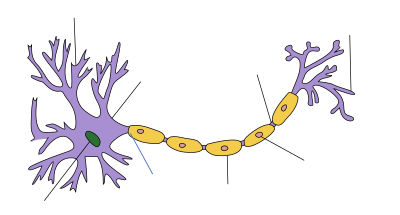
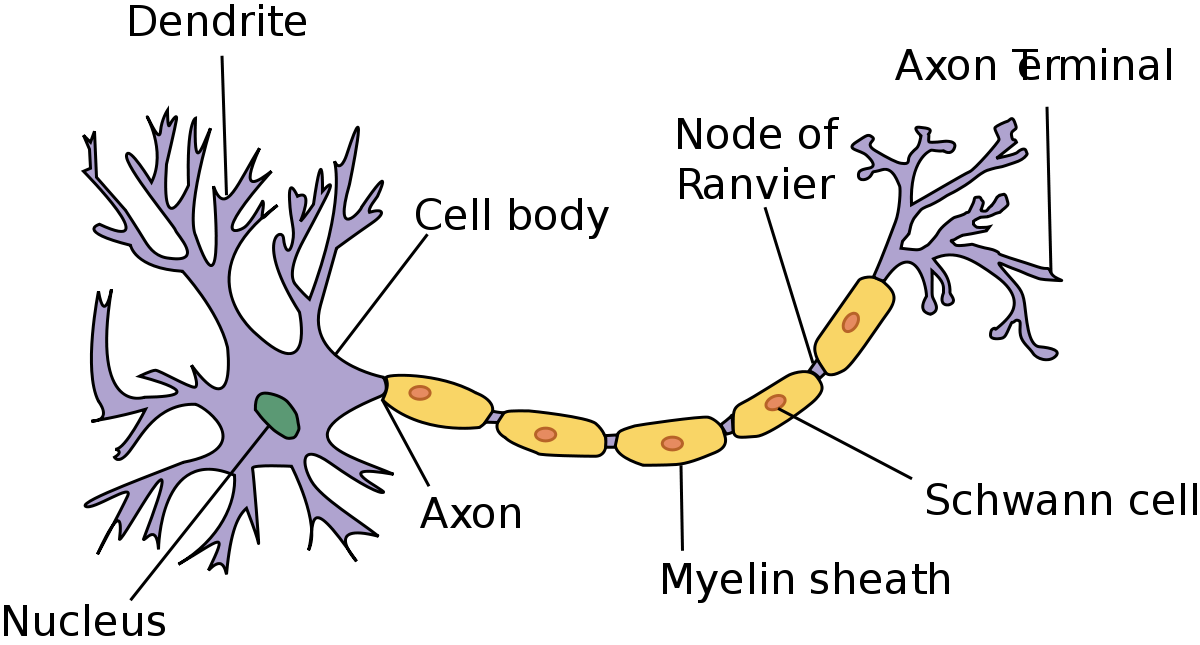
3) Neurons and supporting cells - 48Describe the structure of the Nervous tissue (3 points)1) Made up of cells and fibres of cytoplasm (long thin processes)
2) Dentrites - conduct impulses towards cell body (short tapering process that branch extensively to provide a large surface area)
3) Axion - conducts impulses away from the cell body. Each neuron is a single axion. End of axion forms terminal branches - 49What is a Dendrite and what does it do1) It is a short tapering process that branch extensively to provide a large surface area 2) It conducts impulses towards cell body
- 50What is an Axion and what does it do1) Each neuron is a single axion. End of axion forms terminal branches
2) It conducts impulses away from the cell body. - 51—
- 52What are nerves (2 points)Nerves are a bundle of neurons
It is the basic unit of the nervous system - 53Structure of Nerves (5 Points)1) Large number of Neuron Fibres
2) Neurons are bound in bundles called Perineurium
3) Inside the bundles are tissues called Endoneurium
4) The entire nerve is surrounded by connective tissue called Epineurium
5) Artery and vein occur between the bundle to nourish and remove waste - 54What is the function of nervesTo carry impulses
- 55What are nerve impulses (2 points)1) Minute electrical signals
2) A wave of depolarisation which is caused by a stimulus which creates a difference across the membrane of the nerve fibre - 56What is the type of stimuli (4 points)Mechanical
Electrical
Chemical
Thermal - 57What is transmissionIt is when Nerve impulses are carried along nerve fibres
- 58What is Resting Potential (3 points)1) A neuron is in resting state when it is not stimulated
2) The membrane is positively charged, while the inside is negatively charged
3) Therefore Resting potential is the difference in charge across the cell membrane - 59What are Synapses (2 points)1) Neurons do not touch each other as there is a small gap called synaptic cleft
2) It is a junction which impulses pass through from terminal to dendrite - 60Why are Synapses important (4 points)1) They make sure all flows are in the same directions
2) Allows dispersal of impulses to many other neurons
3) Neuro transmitter can stimulate multiple synaptic membranes
4) Filters out unnecessary stimuli - 61Label Synapses diagram
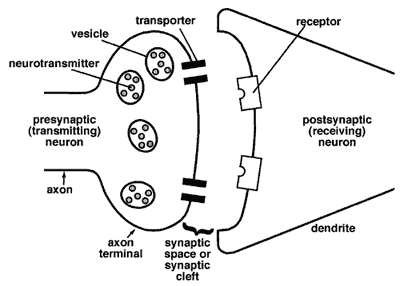
- 62What is a Simple Reflex Arc (2 points)1) It is the function unit of the nervous system
2) It is the pathway for impulses from receptor to effector for reflex action - 63What is a Reflex ActionIt is fast automatic action from affector to receptor
- 64What are the types of Reflex actions (2 points)1) Somatic - activated by skeletal muscles
2) Autonomic - activated by smooth cardiac muscles and glands - 65What are reflex centres (2 points)1) Brain - controls involuntary and important reflexes
2) Spinal cord - controls primitive reflexes - 66What is the significance of the simple reflex arc (2 points)1) Enables the body to respond quickly to a stimulus
2) Provides inborn safety mechanisms to protect the body from danger - 67What are the types of simple reflex arcs (4 points)1) Sneezing
2) Blinking
3) Coughing
4) Yawning - 68How does the simple reflex arc function (6 points) for example finger in fire1) Receptors respond to pain > free nerve endings generate impulses in sensory neurons
2) Impulses are conducted along sensory neurons to spinal cord
3) Contact with connector neurons which act as a reflex centre
4) Synaptic contact with motor neuron which conduct to effector
5) The Effector (flexor muscle in finger) brings about a response
6) Impulses are conducted to the brain for pain to be interpreted - 69What is Alzheimers (4 points)1) Incurable degenerative terminal disease
2) Named after German Psychiatrist - Alois Alzheimer in 1906
3) Most common form of dementia
4) It is a mental dysfunction that affects thinking, memory, behaviour and emotion - 70What are the causes of Alzheimer'sNo one knows but it is thought to be associated with old age
It is not associated with race, sex or culture - 71What are the Symptoms of Alzheimer's (4 points)1) Short term memory loss
2) Difficulty in recall
3) As disease advances, confusion, irritability, aggression, mood swings, difficulty with sentences, long term memory loss, general withdrawal from society
4) Life expectancy after diagnosis is 7 years - 72What is the treatment for Alzheimer'sThere is no cure, but mental health and exercise helps
- 73What are the effects of drugs on the CNS (3 points)1) Results in permanent damage to the brain
2) Effects become known through brain scans
3) All drugs affect synapses and functioning of neurotransmitters - 74Explain the stages of drug dependency (4 points)1) Experimental
2) Recreational - only used when offered
3) Regular - always has a supply at least 2x per week
4) Dependency - addiction - drugs become more important than anything - is called the journey to no-where - 75Classifications of Drugs (3 points)1) Hallucinogens
2) Stimulants (uppers)
3) Depressants (downers) - 76What are hallucinogens (2 points)1) Psychedelic drugs that distort reality
2) Cause delusions and hallucinations - 77What is dagga (4 points)1) It is a gateway drug
2) Called Weed, Cannabis, marijuana, dope, grass, pot, ganga, zol, hashish, snoop, 5 star, MJ
3) Made from dried leaves and flowers of the Cannabis Satvia
4) Causes a high (up) in effect and a downer afterwards - 78Why is dagga a hallucinogenIt contains 426 known chemicals including THC - tetrahydrocannabinols
Stimulates the release of dopamine which is the pleasure hormone - 79What is the effect of dagga on the CNS (4 points)1) Lack of concentration
2) A-motivational syndrome > lethargic, forgetful, and antisocial
3) Dagga Psychosis > exaggerated mood swings, excessive agitations, excessive hallucinations, and persecution
4) Suppression of ovulation in women - 80What are depressants (3 points)1) They delay brain functions
2) Produced by resin of the opium poppy
3) Heroin is most addictive - 81What is heroin also known asChina white, smack, mud, brown, mexican brown, brown sugar, gear, H, horse junk
- 82What does heroin look likePure = white odorless Chrystal like powder with a bitter taste
Non pure = brown with impurities - 83What is the effect of Heroin on the CNSOnce injected it passes through the blood rapidly into the brain barrier. Mimics endorphins in brain
- 84What are the symptoms of addiction to Heroin1) Withdrawal
2) Once addicted, tolerance is created and more heroin is needed
3) If non available = craving and restlessness
4) Babies of heroin addicted mothers are born addicted - 85Describe the effects of Heroin1) Ups > warmth and welling
2) Downs> 6-8 hours - nausea, vomiting, chills, withdrawal, sweating and bone pain - 86What happens when you take a stimulantAbrupt mood changes
- 87Common Names for EcstasyAdam, E, Roll, XTC, Hug Drug, Sky Blue
- 88What are the effects of Ecstasy (3 points)1) Ups = increase in self confidence and pleasure
2) Downs = Blurred Vision, sweat, clenched teeth
3) Repeated use = depression, paranoia,
damaged cells (serotonin), liver/kidney and heart failure - 89What is the effect of Ecstasy on the CNS (3 points)1) Releases an excess of neuro-transmitters especially serotonin and is not reabsorbed
2) Plays an important role in mood, aggression, sexual activity, body temp and sleep
3) Results in exhaustion, sleep problems, severe anxiety and drug cravings - 90Common names for TIKSpeed, Ice, Crank, Chrystal Straw, Chalk, frost
- 91Medical name for TikMethamphetamine
- 92How is TIK sold, used and manufacturedSold in the form of a powder or pearls or capsules
It is snorted, smoked and injected
It is manufactured in illegal labs using supermarket ingredients - 93Effects of TIK (2 points)1) Ups = increased alertness and self confidence
2) Downs = withdrawal, aggression and violence - 94Effects of TIK on the CNS (5 points)1) Highly addictive
2) Affects the brain's reward system
3) Releases neuro-transmitters especially dopamine (pleasure, well being and elation)
4) After effects are devastating.
5) Addicts can suffer from Parkinson's, Psychosis and low sperm count in men
Information
- Description
- Definition of the Central Nervous System Grade 11
- Created by
- Janice Wright
- Views
- 62
- Tags
- Rating